Coor Brand Guidelines
A Skanska service unit that became a listed Nordic facility-services name.
Aa
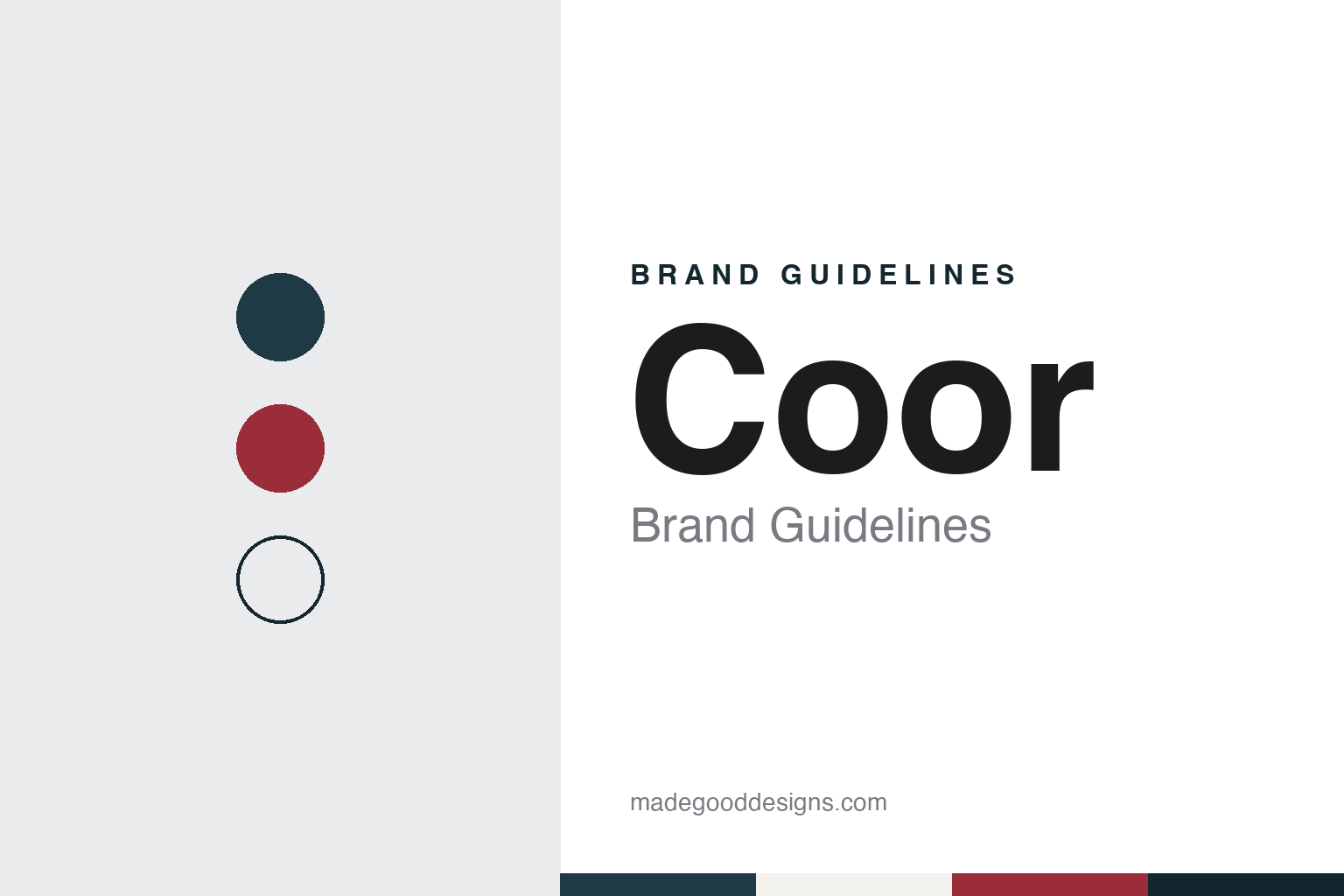
Two constants: a fjord ink, birch white and lingonberry palette and a plain grotesque register. Abstract homage — not a Coor asset or mark; no logo, uniform or photograph is reproduced.
Skanska Services
A construction group’s service unit goes its own way.
Coor began in 1998 inside the Swedish construction group Skanska. The company’s own timeline says it was formed that year as Skanska Services, part of the Skanska group, and Swedish Wikipedia describes the business as spun off from Skanska. Its first assignments came in 1999, the company says, and in 2000 it took over the internal service company of Ericsson. Swedish Wikipedia places that move in the telecom downturn of the time and says Coor took over large parts of Ericsson’s in-house facility management.
The business soon crossed borders. Coor dates its start in Denmark to 2001, in Finland to 2002 and in Norway to 2004. In 2004 it also left Skanska’s ownership: the company says it was acquired that year by the investment firm 3i, and that in 2005 the unit, by then called Skanska Facilities Management, took the name Coor Service Management. In December 2005 it bought Celero, the service company of AB Volvo, Swedish Wikipedia says, and the company’s timeline describes that purchase as a step into production services for manufacturers.
Ownership changed again two years later. Cinven, the European private equity firm, lists its investment in Coor as running from December 2007 to June 2015. Its portfolio page describes the Coor it owned as an integrated facilities management provider working in Sweden, Norway, Denmark and Finland for large companies and public institutions. Before the stock-market listing, Cinven says, it separated Coor’s industrial services business, Jernbro, which was later sold in 2018.
Coor’s shares were listed on Nasdaq Stockholm on 16 June 2015, according to the company. Cinven says it sold its remaining shares in May 2016, completing its exit. The listed parent is Coor Service Management Holding AB, and the head office is in Solna, described on the company’s press pages as Solna, Stockholm.
Colour
One contract, many services.
Coor sells what the trade calls integrated facility management, or IFM: many workplace and building services bundled into one contract with one supplier. The company lists more than 100 services, from cleaning, property management and staff restaurants to logistics, energy and workspace optimisation, conference services and administration, delivered singly, in bundles or as IFM. Its about page describes the Nordic countries as its home market, with operations in Sweden, Norway, Denmark and Finland, and gives a figure of more than 12,000 employees.
Its timeline is built around long contracts. In 2010 the company won the work to design, develop and deliver facility services for the new Karolinska University Hospital in Solna. In 2014 it signed a contract with Statoil, now Equinor, in Norway, which the company calls the largest IFM deal in the Nordics up to that time. In 2017 it won an IFM contract with ABB covering sites in Sweden, Norway, Finland and the Baltic states; in 2026 the company said ABB and ABB Robotics had renewed it for Sweden, Norway, Estonia and Lithuania. In November 2026 Coor said the Norwegian property company Entra had chosen it for cleaning, catering and reception at around 40 properties in Oslo, Bergen and Sandvika.
Growth has also come by acquisition, mostly of regional cleaning and property firms. The company lists the Danish cleaning company Elite Miljø and the Norwegian firms OBOS Eiendomsdrift and West Facility Management in 2018; Norrlands Miljövård in northern Sweden in 2019; R&K Services in the Stavanger region, Veolia Technical Management and Inspira in 2021; Centrumstäd in 2022; and Skaraborgs Städ in 2023.
Environmental work is a recurring theme in its reporting. Coor launched an environmental label, Coor Green Services, in 2009, the company says; its short-term climate targets were approved by the Science Based Targets initiative in May 2022, and a plan for net-zero emissions by 2040 followed in 2023. In 2024 it introduced two concepts, Envirosense and Carbon Insight, aimed at customers’ sustainability goals, and it says it won IFMA’s Innovation Award in 2020.
Typography
Design and documentation.
Facility-services companies sell work that happens inside other people’s buildings, and the two in this guide describe it in short lists. In a July 2022 release, Atalian grouped its work under five headings: cleaning, security, maintenance and energy management, reception, and catering. EMCOR, a contractor that also maintains buildings, summed up its work in late 2025 with four verbs, saying it would serve customers that “build, power, service and protect facilities and critical infrastructure.”
The people who do the work are the service itself, and staff numbers are among the figures given for both companies. Atalian gave more than 123,000 employees in 35 countries in 2022, and La Tribune de l’Hôtellerie put it at about 63,000 in 15 countries in 2024; English Wikipedia gives EMCOR 40,400 employees in 2024. The photographs of staff at work, the uniforms and the workplace scenes that such companies publish belong to them, and this guide reproduces none of them.
Names matter because a name can tie a company to one service. TFN, the French cleaning firm founded in 1944, renamed itself Atalian in 2009 because, its chief executive told Le Figaro, the old name was too closely associated with cleaning. When Atalian and the British firm Servest formed a joint venture in 2016, it took both names, and Servest’s chief executive told the European Cleaning Journal that a customer should find the same look and feel in an office in London or Frankfurt as in Madrid or Paris.
Ownership can change quickly, as both companies here show, which makes corporate pages on owners and countries, and the annual and sustainability reports that sit beside them, part of how these firms present themselves. EMCOR sold its British business to OCS in December 2025, BIC Magazine reported, and Atalian agreed a recapitalisation with its creditors in June 2026. This guide sets each company’s own account beside dated press and marks what rests on the company’s word.
Aa
A plain grotesque for a short, four-letter name. (Specimen set in Work Sans, a sans STAND-IN; NOT the Coor logo.)
Coor
From Coor Service Management to four letters.
The shorter name is recent. In 2016, the company says, it changed its logo and removed “Service Management” from its name, and since then it has been called simply Coor in all communications; the longer form survives in the name of the listed holding company. Swedish Wikipedia records an older slogan, “Passion for service, passion for people,” while the current about page uses the line “We make it possible.”
Around the main name sits a family of service brands. The company’s media pages mention Food by Coor for its restaurant work, a restaurant concept called Vigor & Joy in Solna and Middlepoint, a reception brand; its timeline adds Signatur by Coor, launched in 2017 for meals in the public sector after it won the work to serve patient meals at Karolinska University Hospital. Its business areas are named in plain terms: IFM, Property and Cleaning.
The press centre shows how the company wants to be pictured. It offers logotype files to download, portraits of the management team and a set of operations photographs: cleaners at work in restaurants and offices, property technicians at a hospital and in a service car, chefs planning a menu, and receptionists at the front desk of the Solna head office. The pictures are free for use by the daily and business press, the company says. It is a people-first visual record rather than one built around buildings.
For a design guide, Coor shows how a service business carved out of a construction group can settle on a short, plain name and a set of sub-brands for its restaurants and reception work. Compare ISS, another Nordic facility-services group, and Sodexo, which also pairs food services with workplace management. For this guide we use fjord ink, birch white and a lingonberry red with a sans, an unofficial interpretation; no product or logo is reproduced.
Explore & save
Keep Coor’s identity on hand — save it to a board in the Made Good inspiration library.
Coor identity set
Pin the Coor fjord ink, birch white and lingonberry palette and the plain grotesque register to your own board.