Cycle Lab Brand Guidelines
The South African bike megastore chain owned by a golf retailer.
Aa
Two constants: a navy, clay and mist palette and a condensed sans register. Abstract homage — not a Cycle Lab product or mark; no logo, sign or shopfront is reproduced.
A rider’s shop
Founded by a former professional cyclist in 1995.
Cycle Lab is a South African chain of bicycle shops. Its owner, the sports retail group MoreCorp, says on its division page that Cycle Lab was founded in 1995 by Andrew McLean, a former professional cyclist, and “quickly established itself as an innovative specialist retailer” serving riders from weekend enthusiasts to elite racers. Cycle Lab’s own website gives the same founding year: a July 2025 post on its blog says the company was “established in 1995” and was celebrating its 30th anniversary that year.
The company writes its name as two words, Cycle Lab, on its shops and website, while its web address runs the words together as cyclelab.com. The website’s footer says it is powered by MoreCorp.
The change of owner came in 2013. MoreCorp’s history, published on Cycle Lab’s “Our Journey” page, begins with The Pro Shop, which it describes as South Africa’s first large-format, off-course specialist golf store, opened in 1976 on Commissioner Street in downtown Johannesburg. “In 2013, we extended our business into cycling and acquired Cycle Lab,” the page says, calling the business South Africa’s largest cycling retail chain. MoreCorp’s division page puts it the same way: buying Cycle Lab marked the group’s entry into cycling and led to “nationwide expansion through a network of flagship megastores in key locations across South Africa.”
Inside MoreCorp, the cycling businesses sit in a division called MoreCycle. MoreCorp describes it as a group that brings together retail, community rides and grassroots racing, with Cycle Lab at its centre. The same page lists a second shop brand, Chris Willemse Cycles, founded in 1977 by the former professional cyclist Chris Willemse, and a digital platform called MyCycleLife, offered as an app and a website, which connects members with the group’s shops, bike parks and partner brands.
Colour
Megastores, workshops and a pump track.
The format Cycle Lab is associated with is the megastore. In November 2013 the British trade magazine BikeBiz reported that a Cycle Lab Megastore had opened “just north of Johannesburg” on 8 November 2013, with a soft opening that drew more than 2,500 cyclists in one day and an official grand opening set for 28 November. The store measured 2,300 square metres, and Cycle Lab claimed it was the largest cycling retail store in the Southern Hemisphere and the largest bike workshop in South Africa, BikeBiz wrote. The magazine described more than 1,000 bikes in stock across 250 models, a Scott bike-fitting system, and a pump track designed to UCI specifications at the front of the store, where customers could try more than 40 demo bikes.
Cycle Lab now calls its Fourways store in Johannesburg its flagship. A post on its blog in July 2025 described Fourways as “the flagship store and one of the largest bike shops in the Southern Hemisphere” when it marked the arrival of Giant bicycles in its range, launched there on 22 February 2025. The company’s history page names stores in Johannesburg, Pretoria, Boksburg and Durban, and says Cape Town was added through Chris Willemse Cycles.
That Cape Town link is dated by an independent source. In May 2024 the magazine Bicycling South Africa, profiling Chris Willemse, wrote that in 2018 “Johannesburg giant Cycle Lab bought into” the business he ran with his son, including its online shop and its bricks-and-mortar store, after more than four decades of family ownership.
The chain has continued to add stores in the Western Cape. The Newspaper, a monthly paper in the province, reported in October 2024 that a new Cycle Lab megastore would open at La Concorde in Paarl on 25 October 2024, and that the branch came from a merger with Bicycle Garage, a local bike shop. In November 2024 the same paper reported that the store had opened as a shared building, with Cycle Lab on the ground floor and The Pro Shop golf store upstairs. It listed road, gravel, mountain and children’s bikes and e-bikes from brands including SCOTT, Cannondale, Merida and Marvel, along with a full-service workshop and an in-store coffee shop.
Typography
Shops, signs and workshops.
Bicycle shop chains present themselves in a few recognisable ways. Some run very large stores on retail parks, with test tracks, workshops and thousands of bikes under one roof; Fahrrad XXL in Germany, for example, describes branches of up to 11,000 square metres with test tracks beside them. Others keep to city-centre shops and neighbourhood workshops, or began as websites and added a small number of shops later, as Tredz did in South Wales.
Structure shapes how the names look. A chain may own every branch itself, or a shared name may sit above independent businesses: Fahrrad XXL says its stores are run by seven family firms, and several of its branch names add the family name of the firm behind them. In the Netherlands and France, formulas and networks of independent bicycle shops work in a similar way, giving each shop one sign, one website and shared buying while the owner keeps the business, as the companies describe their own structure.
Workshops are part of the offer almost everywhere. The companies in this group describe repair and servicing in their own words, from in-store workshops for bicycles and e-bikes to trade-in schemes for used bikes; logos, shop signs and colour schemes are shown as the companies publish them on their own sites and storefronts. Their corporate pages usually tell a founding story and name the current owner, whether a family, a founder or a listed retail group.
These guides, covering chains in Germany, the Netherlands, France, the United Kingdom, Australia, South Africa and Japan, set out what can be checked about each one: who founded it, who owns it now, how its stores and workshops are described, and which descriptions rest only on the company’s own word. Each suggests an unofficial palette and a stand-in typeface for designers studying the category.
Aa
A condensed sans for a megastore register. (Specimen set in Barlow Condensed, a sans STAND-IN; NOT the Cycle Lab logo.)
Cycle Lab
A bike shop inside a sports group.
Cycle Lab presents itself as more than a shop. MoreCorp says the chain runs group rides, offers skills lessons and opens bike parks to the public through memberships or pay-as-you-go access, and that its team owns and runs the Cycle Lab Schools Mountain Bike Series, a racing series for schools. Cycle Lab’s history page names a Cycle Lab Active cycling club and a Cycle Lab Bike Park in Johannesburg. The website also lists finance options, workshop services, bike fitting, a trade-in programme and a section for pre-owned bikes, and a Marvel Kids Club for young riders.
In November 2026 MoreCorp’s division page gave the size of the cycling business as eight retail stores, two online shops and 22 bike parks, along with more than 7,000 subscribed members and a wider community it put at more than 200,000.
MoreCorp describes the omnichannel model in its own words: it says Cycle Lab joined physical retail with an online platform to reach recreational and beginner riders as well as racers, and calls Cycle Lab “the country’s fastest-growing specialist cycling retailer.” Those are the company’s claims. The documented record is narrower and still clear: a former professional cyclist’s shop founded in 1995, bought in 2013 by a group that began with a Johannesburg golf store, and grown through large stores, the 2018 move into Chris Willemse Cycles and the 2024 Paarl store shared with The Pro Shop.
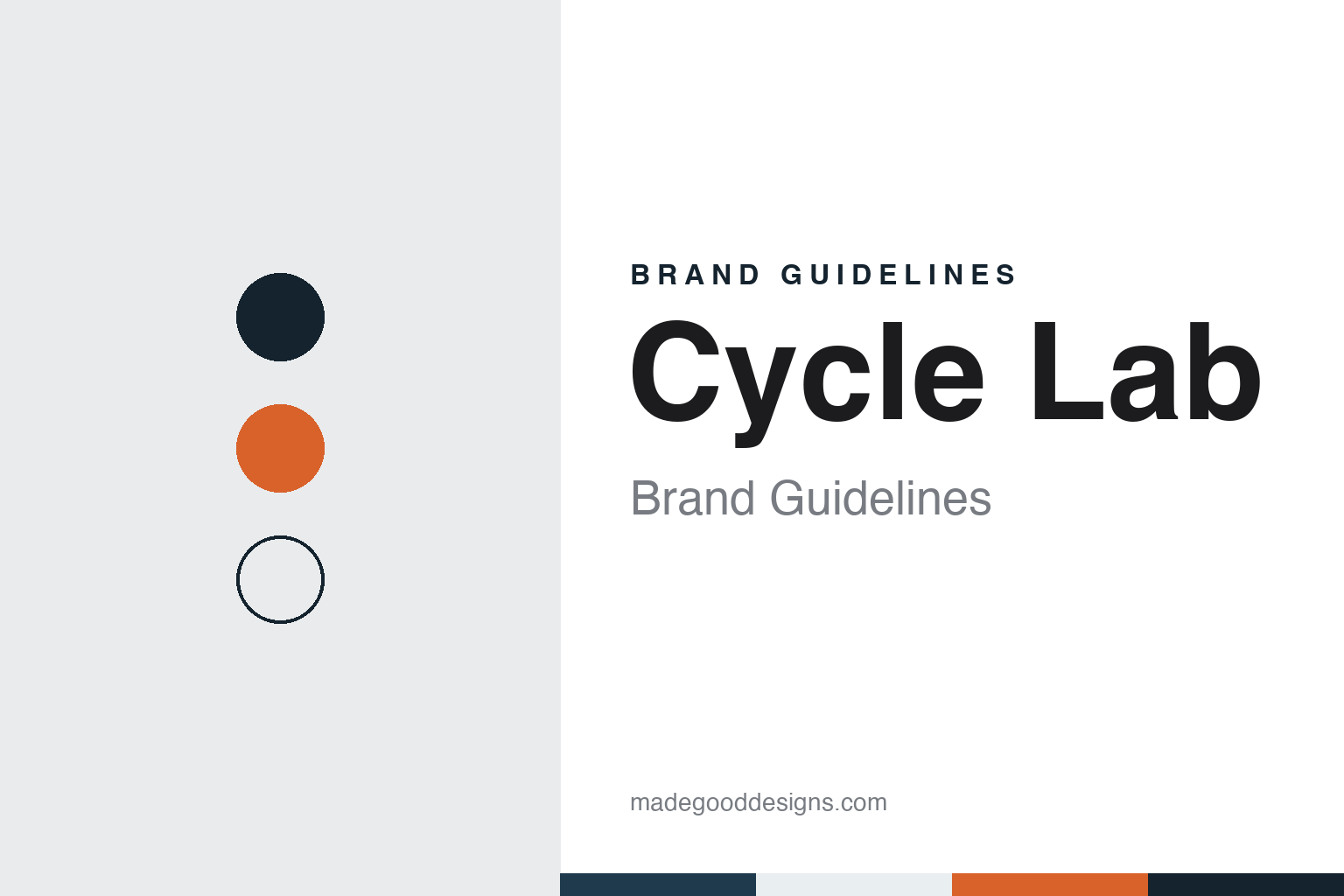
For a design guide, Cycle Lab shows how a specialist bicycle retailer can sit inside a wider sports group while keeping its own name on the door, and how a store format built around workshops, demo bikes and a pump track can carry a retail brand. Compare 99 Bikes, another Southern Hemisphere bicycle chain, and Halfords, a retailer that pairs bicycles with workshop services. For this guide we use a workshop navy, a deep ink, a clay orange and a pale mist with a condensed sans, an unofficial interpretation; no product or logo is reproduced.
Explore & save
Keep Cycle Lab’s identity on hand — save it to a board in the Made Good inspiration library.
Cycle Lab identity set
Pin the Cycle Lab navy, clay and mist palette and the condensed sans register to your own board.
Source & notes
Frequently Asked Questions
What font can I use to match the Cycle Lab look?
This guide describes Cycle Lab’s type as “A condensed sans for a megastore register”. Its type specimen is set in Barlow Condensed from Google Fonts as a stand-in; Barlow Condensed is not Cycle Lab’s own lettering.
What colours are in the Cycle Lab palette?
This guide’s Cycle Lab palette is Workshop navy #1F3A4D, Night ink #14232E, Highveld clay #D9622B, Morning mist #E9EEF0 and Paper #F8F7F5. The tones are the guide’s own unofficial interpretation, not official Cycle Lab hex codes.
When was Cycle Lab founded?
Cycle Lab was founded in 1995, in South Africa. Cycle Lab is known for Bicycle megastores with workshops.
Who founded Cycle Lab?
Cycle Lab was founded in 1995 by Andrew McLean, a former professional cyclist.
Who owns Cycle Lab?
Cycle Lab is owned by MoreCorp, since 2013. Cycle Lab is known for Bicycle megastores with workshops.