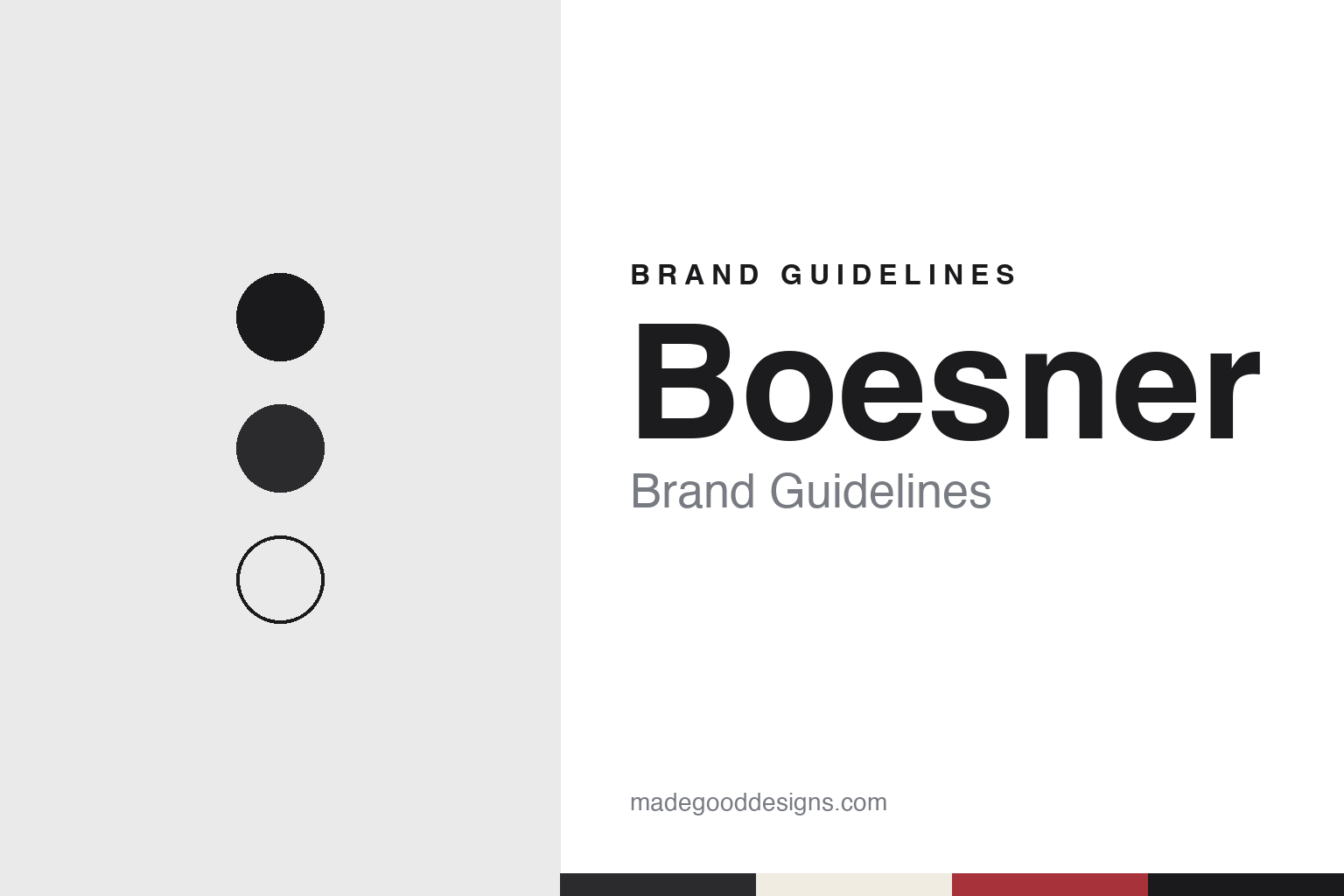
Boesner Brand Guidelines
The Witten art-supply group founded by a painter and sculptor in 1982.
Aa
Two constants: a charcoal, canvas and madder palette and a lower-case grotesque register. Abstract homage — not a Boesner product or mark; no catalogue, logo or shop sign is reproduced.
From the studio
A painter and sculptor turned supplier.
Boesner was founded by an artist. According to German Wikipedia (revised in October 2025), Wolfgang Boesner, who had trained as a business economist, became a painter and sculptor in Bochum in 1981, and on 1 April 1982 founded the firm that carries his name. Three years later it moved to Herbede, a district of Witten in the Ruhr, where the head office still is.
The company describes its origins in the same terms. Its corporate page says the business grew from the idea of founding a company that would make artists’ work easier, and its page for prospective partners traces the founder’s drive to his own experience of a turbulent and at times anxious period as a working artist. It names him as the source of an “idealistic” spirit it says is still felt in its stores.
The business soon became a family one. German Wikipedia says the founder’s younger brother, Klaus Boesner, joined in 1986. The second branch opened in Cologne in 1987 and the third at Forstinning, near Munich, in 1989. From the 1990s, and above all between 2004 and 2011, Boesner expanded into Switzerland, Austria, France, Sweden and Denmark, according to the same article.
The company writes its own name in lower case, boesner, across its websites, catalogues and magazine titles; this guide uses the capitalised form in headings and prose for readability.
Colour
Big stores, a catalogue and a partnership model.
Boesner’s stores are large. German Wikipedia gives an average sales area of 3,000 square metres, a figure the company also uses, and the company says a typical branch presents around 26,000 articles, from paints, brushes, stretcher frames, canvas and paper to picture frames and art books. It describes its branches as conveniently located with ample parking, and says attached workshops make picture frames, mounts and painting supports.
The count of stores has grown with time and depends on the date. German Wikipedia, in its October 2025 revision, lists 46 branches: 36 in Germany, three in Austria, four in Switzerland and four in France, with online shops for Sweden and Denmark; it puts staff at around 850. The company’s own pages, read in November 2026, speak of more than 40 locations and more than 800 employees, and in March 2023 it announced that it had opened its fifth location in France in January that year, a smaller branch of its Lyon store serving Marseille and southern Provence. That shop, the company said, has a floor area of about 250 square metres and carries a selected part of the full range, a much smaller format than the large stores elsewhere in the group.
The structure behind the stores is unusual. The group is led by a holding company in Witten, which German Wikipedia says provides purchasing, media design, marketing, IT, finance and personnel services for the branches. Each branch is a separate company, and its managers generally hold a stake in it. The company calls this its Beteiligungskonzept, or participation concept, and recruits managing directors who become co-owners of a branch. A separate mail-order company, boesner Versandservice, has shipped from Witten since 2001, according to German Wikipedia.
The company calls itself the European market leader for professional artists’ materials; that is its own description. It also reports a run of customer-survey awards from the German Institute for Service Quality and the broadcaster ntv in the artists’ and craft supplies category, most recently in September 2026.
Typography
How art-supply chains present themselves.
Art-supply retail chains sell materials made by other companies, so much of their identity lives in the shop itself: the sign over the door, the name on the carrier bag, the catalogue cover and the colours of a website. The chains in this guide come from Germany, the United Kingdom, France, the United States, Canada and Singapore, and each presents that identity in its own way, often in a name its founders or owners chose decades ago.
Store formats vary widely. Some chains run large stores on the edge of town; German Wikipedia gives the average sales area of a Boesner branch as about 3,000 square metres. Others keep compact shops in city centres or near art schools, and several run both, alongside web shops that now carry most of their range.
Print still matters in this trade. Gerstaecker, which began in Eitorf in 1953, built its business on a mail-order catalogue that the company says took its present form in 1982, and Boesner publishes its own catalogue and customer magazines. Chains also name their own-label ranges and services, such as framing workshops, and many describe courses, demonstrations and workshops held in their stores; where this guide repeats such descriptions, they are given as the companies’ own words.
Corporate pages tell the rest of the story: who founded each chain, who owns it now and how it grew, through new stores, sister chains abroad or changes of owner. This guide sets out what can be checked about each company, separates documented facts from what the company says about itself, and states plainly where a chain has changed hands or closed.
Aa
A lower-case grotesque in the spirit of a name written small. (Specimen set in Work Sans, a sans STAND-IN; NOT the Boesner logo.)
Boesner
A store chain that publishes for artists.
Boesner presents itself through print as much as through its stores. The company says its yearly main catalogue runs to more than 1,500 pages. It also publishes two customer magazines: Kunst und Material, which German Wikipedia says appears every eight weeks, and the boesnerzeitung, a quarterly with a stronger focus on materials and practice. By the company’s own figures, cited by German Wikipedia, Kunst und Material prints about 34,000 copies an issue and the free boesnerzeitung about 68,000. German Wikipedia adds that the group includes a magazine and book publisher, ars momentum Kunstverlag, and an online art portal with artist portraits, interviews, exhibition reports and material guides.
The stores double as places to learn. According to German Wikipedia, which cites the company, Boesner branches hold more than 500 workshops, readings and demonstrations a year, on techniques from oil, acrylic and watercolour painting to printmaking and etching, and also on legal questions and self-marketing for artists. Many branches have their own framing workshops, and cafés or reading corners in their book departments.
For its 30th anniversary in 2012, Boesner founded the boesner art award, which was given for the second time in 2014, German Wikipedia says. Both award ceremonies and the exhibitions that followed were held with the Märkisches Museum Witten, the art museum in the company’s home town, and the 2014 jury was drawn from academies, universities and museums.
For a design guide, Boesner shows how a retailer can build its identity on store scale, publishing and a name written in lower case. Compare Gerstaecker, another German art-supply group built on a thick catalogue, and Rougier & Plé, a Paris art-supply retailer. For this guide we use a charcoal, a raw-canvas white and a madder red with a sans, an unofficial interpretation; no product or logo is reproduced.
Explore & save
Keep Boesner’s identity on hand — save it to a board in the Made Good inspiration library.
Boesner identity set
Pin the Boesner charcoal, canvas and madder palette and the lower-case grotesque register to your own board.
Source & notes
Frequently Asked Questions
What font can I use to match the Boesner look?
This guide describes Boesner’s type as “A lower-case grotesque in the spirit of a name written small”. Its type specimen is set in Work Sans from Google Fonts as a stand-in; Work Sans is not Boesner’s own lettering.
What colours are in the Boesner palette?
This guide’s Boesner palette is Charcoal #2B2B2E, Lamp black #1A1A1C, Raw canvas #F1ECE2, Madder red #A8323A and Stretcher pine #D8C3A0. The tones are the guide’s own unofficial interpretation, not official Boesner hex codes.
Who founded Boesner?
Boesner was founded by Wolfgang Boesner. Boesner is known for Large artists’ materials stores, mail order.