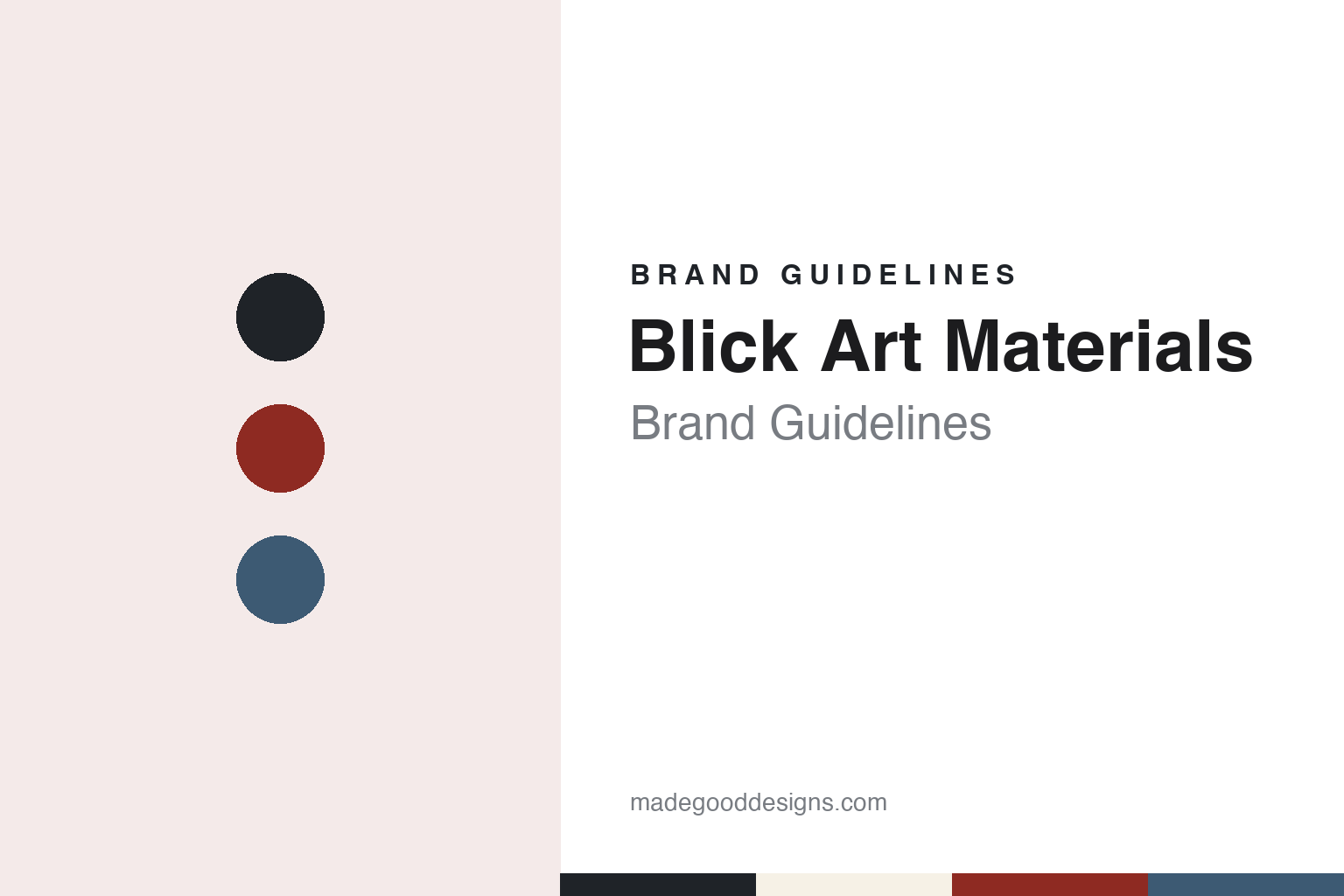
Blick Art Materials Brand Guidelines
The 1911 mail-order pen seller that grew into a store chain.
Aa
Two constants: a barn red, ink and slate blue palette and a plain catalogue sans register. Abstract homage — not a Blick product or mark; no store sign, catalogue or logo is reproduced.
The Payzant pen
A kitchen-table mail-order business in Illinois.
Blick began in 1911 in Galesburg, Illinois. English Wikipedia, citing the company’s own history, says Dick and Grace Blick started the Dick Blick Company from their kitchen, selling their first product, the Payzant pen, by mail order. Galesburg remained the company’s base for decades: the Chicago Tribune still described it as a Galesburg-based company in 2015.
The business did not stay with its founders. Robert Metzenberg bought the company from Dick Blick in 1948, according to the Chicago Tribune in February 2015; English Wikipedia gives 1947. Wikipedia says Metzenberg expanded the mail-order side with offices in Las Vegas, Hartford in Connecticut and Allentown in Pennsylvania, and that he opened the first Blick shop in Galesburg in 1974, followed by stores in Las Vegas, Allentown and Dearborn, Michigan.
Blick has stayed in the same family. The parent company is Dick Blick Holdings, the Chicago Tribune reported in 2015, and its chief executive, Robert Buchsbaum, is Metzenberg’s grandson; English Wikipedia says he became chief executive in 1996. In 2016 the Business Committee for the Arts, part of Americans for the Arts, gave Buchsbaum its Leadership Award, Wikipedia says. An advisers’ deal note from May 2025 described it as family-owned and gave its headquarters as Highland Park, Illinois.
The catalogue has always been central. In 2015 Buchsbaum told the Tribune that slightly less than half of Blick’s business was retail, with the rest coming from the catalogue and the internet.
Colour
From 39 shops to a national chain.
Blick grew its store chain largely by buying other art-supply retailers. English Wikipedia says it bought 11 stores from The Art Store in 2004.
The larger step came in April 2013, when Blick bought Utrecht Art Supplies from the private-equity firm Topspin Partners LBO, as Hyperallergic and Seattle’s The Stranger reported at the time. The press release, which The Stranger printed in full, described Blick as a multi-channel retailer with 39 stores and Utrecht as a 45-store retailer that also published an annual catalogue, The Resource Guide. Utrecht had been founded in New York in 1949 by Norman and Harold Gulamerian, according to English Wikipedia, and began as an importer of canvas; Hyperallergic noted that it made its own artists’ colours at a workshop in Brooklyn. Utrecht continues as a Blick brand: Wikipedia lists its paints, mediums and brushes among the company’s products.
The name has a history of its own. The founder’s name survives in the web address, dickblick.com, and in the parent company, Dick Blick Holdings, while the stores and the 2013 press release use Blick Art Materials; English Wikipedia says the company dropped “Dick” from its trading name around the Utrecht purchase.
By February 2015 Blick had about 70 stores and was adding one or two a year, the Chicago Tribune reported. Buchsbaum told the paper that the company often took unusual spaces to keep costs down, so that each store was different: its Chicago store on State Street sat mostly in a second-floor loft, while a New York store had its entrance on Sixth Avenue and a large window display on a side street. Buchsbaum also told the paper that the company had doubled its IT staff in recent years to more than 40 people, and that the company spent heavily on its website. English Wikipedia says the company runs three distribution centres, two in Galesburg and one in Monroe, New Jersey.
Typography
How art-supply chains present themselves.
Art-supply retail chains sell materials made by other companies, so much of their identity lives in the shop itself: the sign over the door, the name on the carrier bag, the catalogue cover and the colours of a website. The chains in this guide come from Germany, the United Kingdom, France, the United States, Canada and Singapore, and each presents that identity in its own way, often in a name its founders or owners chose decades ago.
Store formats vary widely. Some chains run large stores on the edge of town; German Wikipedia gives the average sales area of a Boesner branch as about 3,000 square metres. Others keep compact shops in city centres or near art schools, and several run both, alongside web shops that now carry most of their range.
Print still matters in this trade. Gerstaecker, which began in Eitorf in 1953, built its business on a mail-order catalogue that the company says took its present form in 1982, and Boesner publishes its own catalogue and customer magazines. Chains also name their own-label ranges and services, such as framing workshops, and many describe courses, demonstrations and workshops held in their stores; where this guide repeats such descriptions, they are given as the companies’ own words.
Corporate pages tell the rest of the story: who founded each chain, who owns it now and how it grew, through new stores, sister chains abroad or changes of owner. This guide sets out what can be checked about each company, separates documented facts from what the company says about itself, and states plainly where a chain has changed hands or closed.
Aa
A plain, sturdy sans, in the spirit of a mail-order catalogue. (Specimen set in Libre Franklin, a sans STAND-IN; NOT the Blick logo.)
Blick Art Materials
Wholesale, and another chain.
Blick has kept buying. In May 2025 Blick Art Materials, LLC bought the remaining inventory and selected intellectual-property assets of MacPherson’s Art Supply, an art-materials wholesaler of more than 40 years’ standing, in a private sale under Article 9 of the Uniform Commercial Code, according to a deal note from the adviser SSG Capital Advisors published by the Secured Finance Network on 16 May 2025. The note listed Art Alternatives and Fredrix among MacPherson’s own brands, said the purchase marked Blick’s formal entry into wholesale distribution, and gave Blick more than 60 stores at the time.
In 2026 it took over Plaza Artist Materials & Picture Framing, a chain based in Silver Spring, Maryland. In July 2026 the Maryland retail newsletter Store Reporter reported that Plaza’s Rockville shop was being rebranded as Blick Art Materials, that Plaza-branded products were being phased out in favour of similar Blick-branded ones, and described Blick as the largest art-supply retailer in the United States, with 72 locations.
The pattern has been similar each time: a regional or rival business is bought and brought under the Blick name, as with Utrecht’s stores in 2013 and Plaza’s in 2026, while the founder’s pen-selling catalogue business of 1911 lives on in the company’s mail-order and online trade.
For a design guide, Blick Art Materials shows how a retail name can carry a founder’s surname for more than a century while the business around it changes owners, formats and size. Compare Jerry’s Artarama, another American art-supply retailer, and Michaels, the American arts-and-crafts chain. For this guide we use a barn red, a dark ink and a slate blue with a sans, an unofficial interpretation; no product or logo is reproduced.
Explore & save
Keep Blick Art Materials’s identity on hand — save it to a board in the Made Good inspiration library.
Blick Art Materials identity set
Pin the Blick Art Materials barn red, ink and slate blue palette and the catalogue sans register to your own board.
Source & notes
Frequently Asked Questions
What font can I use to match the Blick Art Materials look?
This guide describes Blick Art Materials’ type as “A plain, sturdy sans, in the spirit of a mail-order catalogue”. Its type specimen is set in Libre Franklin from Google Fonts as a stand-in; Libre Franklin is not Blick Art Materials’ own lettering.
What colours are in the Blick Art Materials palette?
This guide’s Blick Art Materials palette is Barn red #8E2A22, Prairie ink #1F2328, Slate blue #3D5A73, Kraft #CDB58F and Catalogue cream #F6F1E6. The tones are the guide’s own unofficial interpretation, not official Blick Art Materials hex codes.
When was Blick Art Materials founded?
Blick Art Materials was founded in 1911, in Galesburg, Illinois, United States.
Who founded Blick Art Materials?
Blick Art Materials was founded by Dick Blick and Grace Blick in 1911.