Le Géant des Beaux-Arts Brand Guidelines
Gerstaecker’s French art-supply chain, born of a mail-order catalogue.
Aa
Two constants: an earth-pigment palette and a bold catalogue sans register. Abstract homage — not a Le Géant des Beaux-Arts product or mark; no logo, shop sign or catalogue page is reproduced.
A German catalogue in France
The French arm of a mail-order art-supply house.
Le Géant des Beaux-Arts, “the giant of the fine arts,” is the French business of the German art-supply retailer Gerstaecker, based in Eitorf, near Bonn. The French job-and-business site Hellowork described it in September 2006 as a trading name of the Gerstaecker group, and the French company’s own website calls it a family business of more than seventy years that has been present in France for more than twenty-five years as a specialist in distance selling of artists’ materials.
The company’s history of its parent, first published in 2012 on its blog L’Atelier Géant and last updated in October 2023, starts in 1953, when Johannes Gerstaecker set up a business under his own name making and selling educational games meant to develop children’s creativity, travelling from school to school to show them. The same history says the Gerstaecker company itself was created in 1961, with a first stock of 4,000 items, and a 2020 partner page on the CréaFest festival’s website also gives 1961; the two dates sit side by side in the company’s own timeline.
The business grew through its catalogue. The company says Michael Gerstaecker, who succeeded his father, set up a warehouse in 1979 at the goods station in Eitorf, which it calls the cradle of the business, and in 1982 launched the idea of a specialist catalogue and large-scale mail-order operation for artists, art teachers and therapists. In 1991, with Christian Gerstaecker, he built a 5,000-square-metre site in Eitorf’s industrial zone, which became the head office; the company now gives the logistics centre’s total area as 17,000 square metres.
France came at the end of the decade. The company dates the founding of its French subsidiary, Le Géant des Beaux-Arts, to 1999, at Saverne in the Bas-Rhin, in Alsace. The CréaFest page, which quotes the company, says it delivered to customers’ homes in less than a week by private carrier, and that Gerstaecker became “the new Géant des Beaux-Arts” in France.
Colour
From one Alsace shop to a national network.
The shops followed the catalogue. The company says the first Le Géant des Beaux-Arts shop opened in Saverne in 2002, and the first two stores elsewhere in France, in Paris and Strasbourg, in 2005.
In September 2006 Hellowork reported the fourth. After Saverne, Paris and Strasbourg, the chain was opening a shop of about 300 square metres at Saint-Herblain, outside Nantes, with a team of seven and more than 35,000 products available through the catalogue. The report described a children’s corner, demonstrations by professional artists, a specialist bookshop and a framing workshop.
The wider group grew in step, by the company’s account: a British subsidiary, Great-Art, in 2002; a Swiss subsidiary at Olten in 2006; a shop in Vienna in 2007; and a London shop in Shoreditch in 2016. The parent company says its catalogues have reached customers in Germany, Austria, Belgium, Spain, the Netherlands and Switzerland as well as France and England.
The French network is now larger. The company’s 2023 history gave 21 stores in France and an online shop, and its store page in November 2026 still lists 21 shops, from Paris to Nantes, Reims, Rennes, Rouen, Strasbourg and Toulouse. The website says it lists more than 80,000 items from more than sixty brands, naming makers that include Arches, Canson, Sennelier and Pébéo, alongside the group’s own labels: Gerstaecker stretchers and brushes and an entry-level range called I Love Art by Gerstaecker.
The shops also work as collection points. The company says customers can have online orders delivered to any of its stores, use a drive-through collection service, or book an appointment with a sales adviser for help choosing materials and techniques.
Typography
How the chains present themselves.
Art-supply retail chains sell materials made by other companies, so much of their identity lives in the shop itself: the sign over the door, the name on the carrier bag, the catalogue cover and the colours of a website. The chains in this guide come from Germany, the United Kingdom, France, the United States, Canada and Singapore, and each presents that identity in its own way, often in a name its founders or owners chose decades ago.
Store formats vary widely. Some chains run large stores on the edge of town; German Wikipedia gives the average sales area of a Boesner branch as about 3,000 square metres. Others keep compact shops in city centres or near art schools, and several run both, alongside web shops that now carry most of their range.
Print still matters in this trade. Gerstaecker, which began in Eitorf in 1953, built its business on a mail-order catalogue that the company says took its present form in 1982, and Boesner publishes its own catalogue and customer magazines. Chains also name their own-label ranges and services, such as framing workshops, and many describe courses, demonstrations and workshops held in their stores; where this guide repeats such descriptions, they are given as the companies’ own words.
Corporate pages tell the rest of the story: who founded each chain, who owns it now and how it grew, through new stores, sister chains abroad or changes of owner. This guide sets out what can be checked about each company, separates documented facts from what the company says about itself, and states plainly where a chain has changed hands or closed.
Aa
A bold catalogue sans for a chain built on mail order. (Specimen set in Archivo, a sans STAND-IN; NOT the Le Géant des Beaux-Arts logo.)
Le Géant des Beaux-Arts
A giant’s name, a catalogue’s habits.
The name does much of the brand’s work. “Géant” means giant, and the company works the word into its own channels: its website advertises “promotions Géantes,” and its blog, L’Atelier Géant, gathers product tests, tutorials and demonstrations, a guide to learning art, listings of courses, small advertisements, events and partner associations, and pages about the company itself.
The catalogue habit remains visible. The company’s homepage still introduces it as a distance-selling specialist, and its own timeline puts the catalogue first: a mail-order idea in 1982, a French subsidiary in 1999, a logistics centre in 2001 and a first shop in 2002. The company also supports art events. In October 2020 the CréaFest creativity festival named it as a new partner, and the company says on its website that it backs exhibitions and art events with materials and publicity.
Ownership has stayed with the parent. Hellowork described the chain as part of the Gerstaecker group in 2006, and the French website in 2026 still describes the business as a family firm, carrying Gerstaecker’s own-label ranges and the parent’s history on its blog.
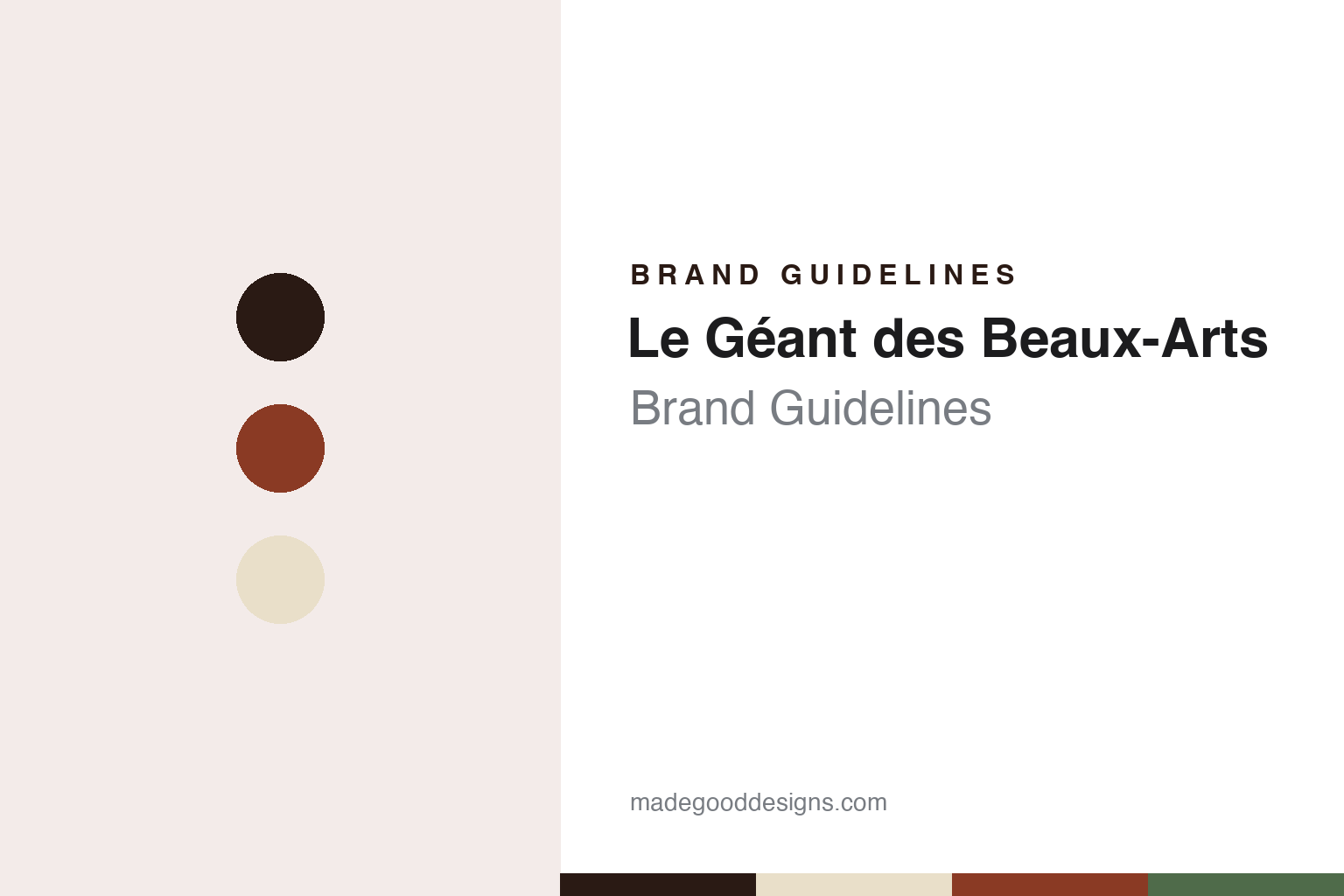
For a design guide, Le Géant des Beaux-Arts shows how a retailer can carry a foreign parent’s catalogue business under a French name that states its ambition plainly. Compare Gerstaecker, its German parent, and Rougier & Plé, a Paris art and craft retailer. For this guide we use an easel brown, a burnt sienna and a sap green on canvas with a sans, an unofficial interpretation; no product or logo is reproduced.
Explore & save
Keep Le Géant des Beaux-Arts’s identity on hand — save it to a board in the Made Good inspiration library.
Le Géant des Beaux-Arts identity set
Pin the Le Géant des Beaux-Arts earth-pigment palette and the bold catalogue sans register to your own board.
Source & notes
Frequently Asked Questions
What font can I use to match the Le Géant des Beaux-Arts look?
This guide describes Le Géant des Beaux-Arts’ type as “A bold catalogue sans for a chain built on mail order”. Its type specimen is set in Archivo from Google Fonts as a stand-in; Archivo is not Le Géant des Beaux-Arts’ own lettering.
What colours are in the Le Géant des Beaux-Arts palette?
This guide’s Le Géant des Beaux-Arts palette is Easel brown #2A1A14, Burnt sienna #8A3A24, Canvas #E9DFC9, Sap green #4F6B4A and Primer white #F8F6F1. The tones are the guide’s own unofficial interpretation, not official Le Géant des Beaux-Arts hex codes.
When was Le Géant des Beaux-Arts founded?
Le Géant des Beaux-Arts was founded in 1999, in Saverne, Alsace, France.
Who owns Le Géant des Beaux-Arts?
Le Géant des Beaux-Arts is owned by Gerstaecker group (Eitorf, Germany).