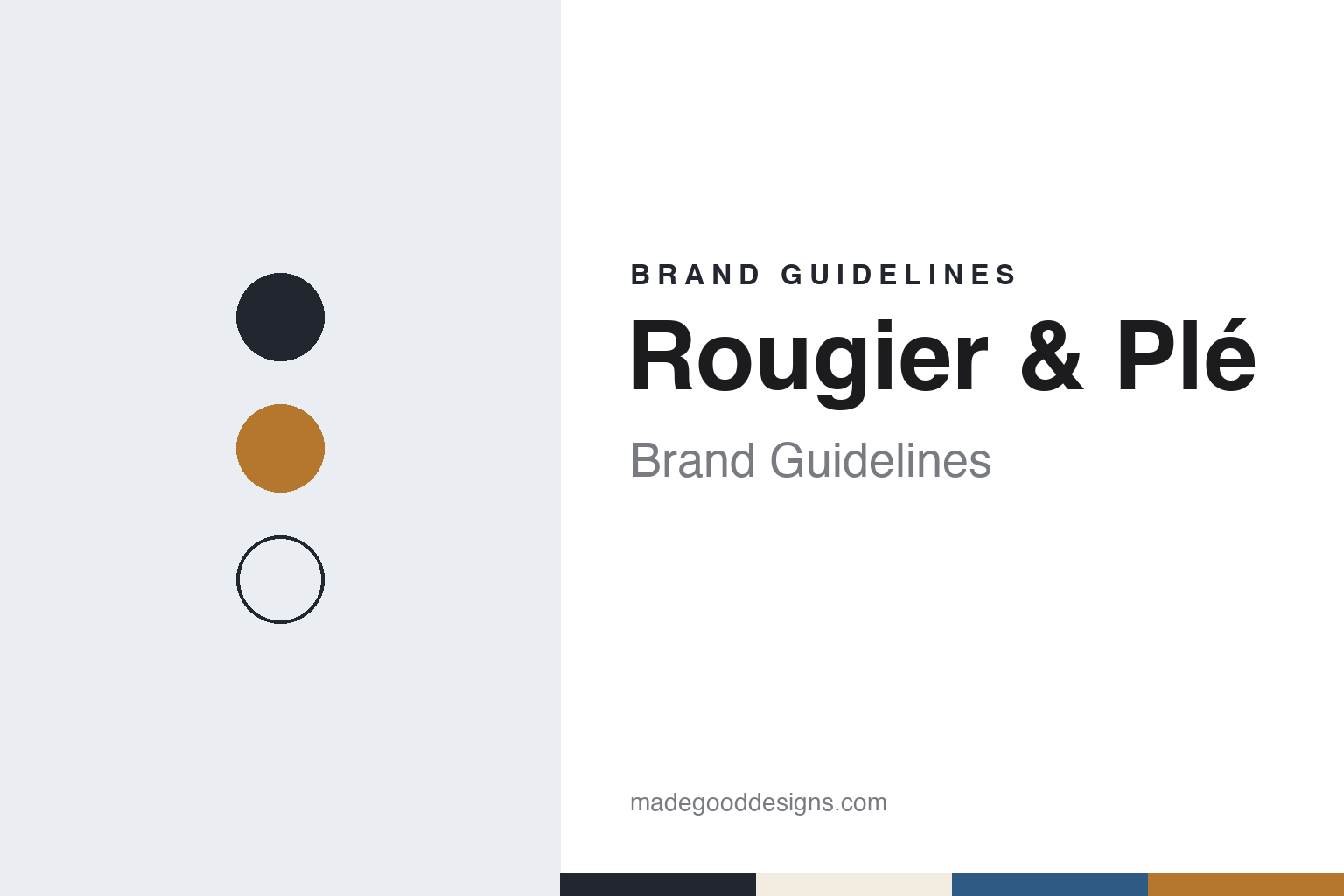
Rougier & Plé Brand Guidelines
The Paris creative-supplies house that began as a hardware shop.
Aa
Two constants: an ink, blue and amber palette and an old-house serif register. Abstract homage — not a Rougier & Plé product or mark; no façade, logo or shop sign is reproduced.
From hardware to handicraft
A Paris tool shop that turned to artistic crafts.
Rougier & Plé dates its beginnings to 1854 in Paris. French Wikipedia says it opened that year as a seller of everyday hardware, and the company’s own history, published on its blog in January 2024 for its 170th anniversary, tells the story in more detail. The company says François Thuillier and Clarisse Thuillier opened a shop selling tools for leatherwork, the Maison de la Quincaillerie, and that after several moves forced by the rebuilding of Haussmann’s Paris, and 23 years in business, the shop passed to Abel Rougier.
Under Abel Rougier, the company says, the business widened its range. In 1890 he devised a gas-heated pot for melting strong glue, aimed at the craftsmen who cover boxes and cases, and the shop became a supplier to box-makers, upholsterers and leather-goods makers. In 1897 it moved to the rue du Temple, in the Marais, into an 800-square-metre shop that the company says was the first on the street to have electric light.
The double name arrived with the next generation. The company says Gabrielle Rougier and Maurice Plé, who came from three generations of hardware dealers, took over in 1901, and that Plé became a formal partner in 1904, working alongside Henri Rougier. In 1905, by the company’s account, Rougier & Plé turned to artistic handicrafts: decorative nailwork, pyrography, repoussé metal, screen printing and basketry. French Wikipedia also gives 1905 as the year of its first mail-order catalogue, and the company says ten thousand teachers received it, with more than 10,000 items listed, as schools took up handicraft lessons.
The company says Henri Rougier designed bookbinding tools from 1912, and that in the late 1920s, as fine bookbinding grew popular, Rougier & Plé offered a bookbinding correspondence course and several catalogues on the craft. The sources used for this guide do not say how the company operated during the occupation of 1940–1944. A fourth generation followed, the company says, and in 1961 the shop moved again, to the boulevard des Filles-du-Calvaire, opposite the Cirque d’Hiver, where it fills more than 1,000 square metres on four levels.
Colour
Expansion, bankruptcy and new owners.
From the 1970s, the company says, Rougier & Plé opened shops in France’s largest cities. French Wikipedia, citing a company history published for its 140th anniversary, dates new stores to Bordeaux in 1980, Lyon in 1983, Lille and Nantes in 1984 and Aubagne in 1992. A fifth generation, the company says, added mail-order services, a loyalty card, in-store demonstrations and, later, online sales.
The turn of the century brought consolidation and then difficulty. French Wikipedia says the business merged with Graphigro, a chain of drawing and fine-art supply shops, in 2000, creating a network of more than twenty stores; that it filed for bankruptcy in 2005; and that it was then taken over by DeSerres France, which went into liquidation in July 2008.
New owners arrived the same year. Livres Hebdo reported in October 2013 that the entrepreneurs Patrick Lasry and Pierre Madelpuech, whose speciality was taking over businesses in difficulty through their consulting firms, had bought Artacrea in 2008, a company then in liquidation that held the Rougier & Plé and Graphigro brands. French Wikipedia says the takeover kept eight stores: three in Paris and others in Lyon, Marseille, Lille, Toulouse and Strasbourg.
The owners then built a wider group. According to Livres Hebdo, they added the Art’Pro and Artéïs chains in 2009 and Color’i in 2010, and by 2013 led one of the main fine-art retail networks in France, with about fifty shops, many of them franchised. In its January 2024 history, the company said that in the 2000s it had opened up to drawing and fine-art products by taking over the specialist Graphigro, Artéïs and Color’i shops.
The group has also bought outside its own trade. In November 2016, the company announced on its blog that the commercial court in Angers had chosen Rougier & Plé to take over the Librairie Richer, a bookshop in that city that had been in receivership since September 2016. The company said the shop would keep its twenty staff and its historic name, and that it would add a fine-art and craft department within the shop’s 900 square metres while keeping its books, stationery and press sections.
Typography
How the chains present themselves.
Art-supply retail chains sell materials made by other companies, so much of their identity lives in the shop itself: the sign over the door, the name on the carrier bag, the catalogue cover and the colours of a website. The chains in this guide come from Germany, the United Kingdom, France, the United States, Canada and Singapore, and each presents that identity in its own way, often in a name its founders or owners chose decades ago.
Store formats vary widely. Some chains run large stores on the edge of town; German Wikipedia gives the average sales area of a Boesner branch as about 3,000 square metres. Others keep compact shops in city centres or near art schools, and several run both, alongside web shops that now carry most of their range.
Print still matters in this trade. Gerstaecker, which began in Eitorf in 1953, built its business on a mail-order catalogue that the company says took its present form in 1982, and Boesner publishes its own catalogue and customer magazines. Chains also name their own-label ranges and services, such as framing workshops, and many describe courses, demonstrations and workshops held in their stores; where this guide repeats such descriptions, they are given as the companies’ own words.
Corporate pages tell the rest of the story: who founded each chain, who owns it now and how it grew, through new stores, sister chains abroad or changes of owner. This guide sets out what can be checked about each company, separates documented facts from what the company says about itself, and states plainly where a chain has changed hands or closed.
Aa
An old-house serif for a firm that dates itself to 1854. (Specimen set in Cormorant Garamond, a serif STAND-IN; NOT the Rougier & Plé logo.)
Rougier & Plé
The ampersand brand, with a façade by Daniel Buren.
The network kept growing after the takeover. French Wikipedia lists Rougier & Plé openings in Avignon in 2014; Nîmes, Troyes and Villebon-sur-Yvette in 2015; Mulhouse and Rennes in 2016; Rouen in 2017; Montpellier in August 2018; the Vélizy 2 shopping centre in May 2023; the Italie 2 centre in Paris in August 2023; and Toulon in May 2024. In its January 2024 history, the company said it offered more than 45,000 products through 40 points of sale and its website, and that professional artists lead workshops in its shops. Its range runs from fine art, graphic arts, stationery and framing to jewellery-making, scrapbooking, sewing and children’s activities, with a book section.
The company describes itself as “la grande maison des arts créatifs”, the great house of the creative arts, and as “l’enseigne à l’esperluette”, the ampersand brand. Its Paris flagship gained a new face for the 170th anniversary. In September 2024, Museum TV reported that October, the artist Daniel Buren completed a site-specific façade for the building on the boulevard des Filles-du-Calvaire, using his vertical bands of white and colour, each 8.7 centimetres wide, set beside brightly coloured shop windows. The Paris neighbourhood guide Le Marais Mood describes red, yellow and blue filters in the windows and says Buren took the triangle of the building’s gable as his starting point.
For a design guide, Rougier & Plé shows how an old shop name, carried by an ampersand, can pass through bankruptcy, new owners and a merger and still trade under the same name. Compare Graphigro, its sister chain, and Le Géant des Beaux-Arts, another French art-supply chain. For this guide we use workshop ink, a shop-window blue and a glue-pot amber on catalogue paper with a serif, an unofficial interpretation; no product or logo is reproduced.
Explore & save
Keep Rougier & Plé’s identity on hand — save it to a board in the Made Good inspiration library.
Rougier & Plé identity set
Pin the Rougier & Plé ink, blue and amber palette and the old-house serif register to your own board.
Source & notes
Frequently Asked Questions
What font can I use to match the Rougier & Plé look?
This guide describes Rougier & Plé’s type as “An old-house serif for a firm that dates itself to 1854”. Its type specimen is set in Cormorant Garamond from Google Fonts as a stand-in; Cormorant Garamond is not Rougier & Plé’s own lettering.
What colours are in the Rougier & Plé palette?
This guide’s Rougier & Plé palette is Workshop ink #22262E, Shop-window blue #2E5A84, Glue-pot amber #B5772E, Catalogue paper #F2ECE1 and Stripe white #FAF9F6. The tones are the guide’s own unofficial interpretation, not official Rougier & Plé hex codes.
When was Rougier & Plé founded?
Rougier & Plé was founded in 1854 (company history), in Paris, France.
Who owns Rougier & Plé?
Rougier & Plé is owned by Patrick Lasry and Pierre Madelpuech (since 2008).