DeSerres Brand Guidelines
The Montreal hardware store of 1908 that became an art-supply chain.
Aa
Two constants: a red, ink and paper cream palette and a warm serif register. Abstract homage — not a DeSerres product or mark; no logo, sign or packaging is reproduced.
Omer DeSerres, 1908
From a Montreal hardware store to art supplies.
DeSerres began in Montreal in 1908. The Canadian Press reported in October 2024 that the company was founded that year by Omer DeSerres and started out as a hardware store before eventually focusing on art supplies. A 2012 profile in the Quebec magazine Mixte fills in the early picture: Omer DeSerres founded the business with money from his father, a financier, and ran a hardware store in the heart of Montreal, around Sainte-Catherine and Saint-Denis streets, that sold almost everything, from screws and nails to appliances, dishes, mirrors and hunting and fishing gear.
The firm passed down the family. Mixte says Omer stepped aside in 1949 for his son Roger, a McGill graduate, who kept building the hardware business while new competitors such as Rona and Canadian Tire grew. In 1972, the magazine says, company land in Montreal’s Quartier Latin was expropriated for the future development of the Université du Québec à Montréal, a process that dragged on for nearly twenty years while the company kept a commercial sign on the site.
In 1976 Marc DeSerres, Roger’s son, took the reins of a much smaller company, and the business was reinvented around art supplies, according to Mixte. It started with fine-art materials, then moved into graphic arts as French-language advertising production grew in Quebec; the magazine names Letraset as the flagship product of that period. Changing technology then upset the plan, and after a short spell as an Apple reseller the business changed course again. In the 2000s, Mixte says, the name “Omer” was dropped and the company put more weight on recreational and creative products for families; the law firm BCF still used the longer name, Omer DeSerres, for the company in a note in December 2024.
Colour
Stores across Canada.
Growth came through stores and acquisitions. In May 2008 the Halifax weekly The Coast reported that the city’s Loomis Art Store, formerly Loomis & Toles, had taken the DeSerres name and a new brand image to mark the company’s 100th anniversary. The paper said DeSerres then ran 26 stores in Canada, in Ontario, Quebec, British Columbia, Alberta and Nova Scotia, that the DeSerres family had managed and owned the business for three generations, and that it was solely owned by Marc DeSerres, its president. Marc DeSerres told the paper that the company had followed an acquisition strategy in Canada over the previous 25 years. In Halifax the new signage set the words “The Creative Marketplace” beside the new logo, The Coast noted, while staff got new aprons and vests.
By 2012 Mixte counted some thirty DeSerres outlets “from sea to sea.” The count in October 2024, when the company changed hands, was 28 stores in Quebec, Ontario, Nova Scotia and British Columbia, according to The Canadian Press. The company’s own website now says DeSerres operates 27 stores and an online sales platform, with a catalogue of some 16,000 products.
The range runs from fine-art materials to hobby and family products, and framing is a large part of the business. The company says it serves professional artists, hobby enthusiasts, creative families and schools, and it names art supplies, creative hobbies and framing as its three fields. It also says it stands out for its advice in store, its closeness to the artistic community and its aim of making art accessible to as many people as possible; those are the company’s own claims.
Two related businesses sit alongside the stores. The 2024 sale also covered Cadres Verbec, a company specialising in framing supplies and services, and Lamarche Importation, a stationery distributor, The Canadian Press reported.
Typography
Art-supply retail chains.
Art-supply retail chains sell materials made by other companies, so much of their identity lives in the shop itself: the sign over the door, the name on the carrier bag, the catalogue cover and the colours of a website. The chains in this guide come from Germany, the United Kingdom, France, the United States, Canada and Singapore, and each presents that identity in its own way, often in a name its founders or owners chose decades ago.
Store formats vary widely. Some chains run large stores on the edge of town; German Wikipedia gives the average sales area of a Boesner branch as about 3,000 square metres. Others keep compact shops in city centres or near art schools, and several run both, alongside web shops that now carry most of their range.
Print still matters in this trade. Gerstaecker, which began in Eitorf in 1953, built its business on a mail-order catalogue that the company says took its present form in 1982, and Boesner publishes its own catalogue and customer magazines. Chains also name their own-label ranges and services, such as framing workshops, and many describe courses, demonstrations and workshops held in their stores; where this guide repeats such descriptions, they are given as the companies’ own words.
Corporate pages tell the rest of the story: who founded each chain, who owns it now and how it grew, through new stores, sister chains abroad or changes of owner. This guide sets out what can be checked about each company, separates documented facts from what the company says about itself, and states plainly where a chain has changed hands or closed.
Aa
A warm serif for a century-old family name. (Specimen set in Fraunces, a serif STAND-IN; NOT the DeSerres logo.)
DeSerres
Part of the Renaud-Bray group since 2024.
On 1 October 2024 the Quebec bookstore group Renaud-Bray announced that it had acquired DeSerres. The Canadian Press reported that the deal covered the 28 stores and the company’s website as well as Cadres Verbec and Lamarche Importation, and that financial terms were not disclosed. Courrier Laval reported the same day that three generations had led DeSerres since 1908 and that Marc DeSerres had been looking for a buyer for some time to secure the company’s future; in the announcement he said the time had come for him to hand over the reins. The law firm BCF, which acted for Renaud-Bray, listed the deal among its cases in December 2024.
The Renaud-Bray group also includes the Renaud-Bray bookstores, Archambault stores, Griffon shops and the distributors Prologue and Pierre Belvédère, according to The Canadian Press; the regional news site Néomédia dated those earlier purchases to 2015 for Archambault, 2017 for Prologue and Pierre Belvédère, and 2020 for Griffon. Renaud-Bray’s president, Blaise Renaud, said in the announcement that both companies were Quebec-based, multi-generational and focused on the world of culture.
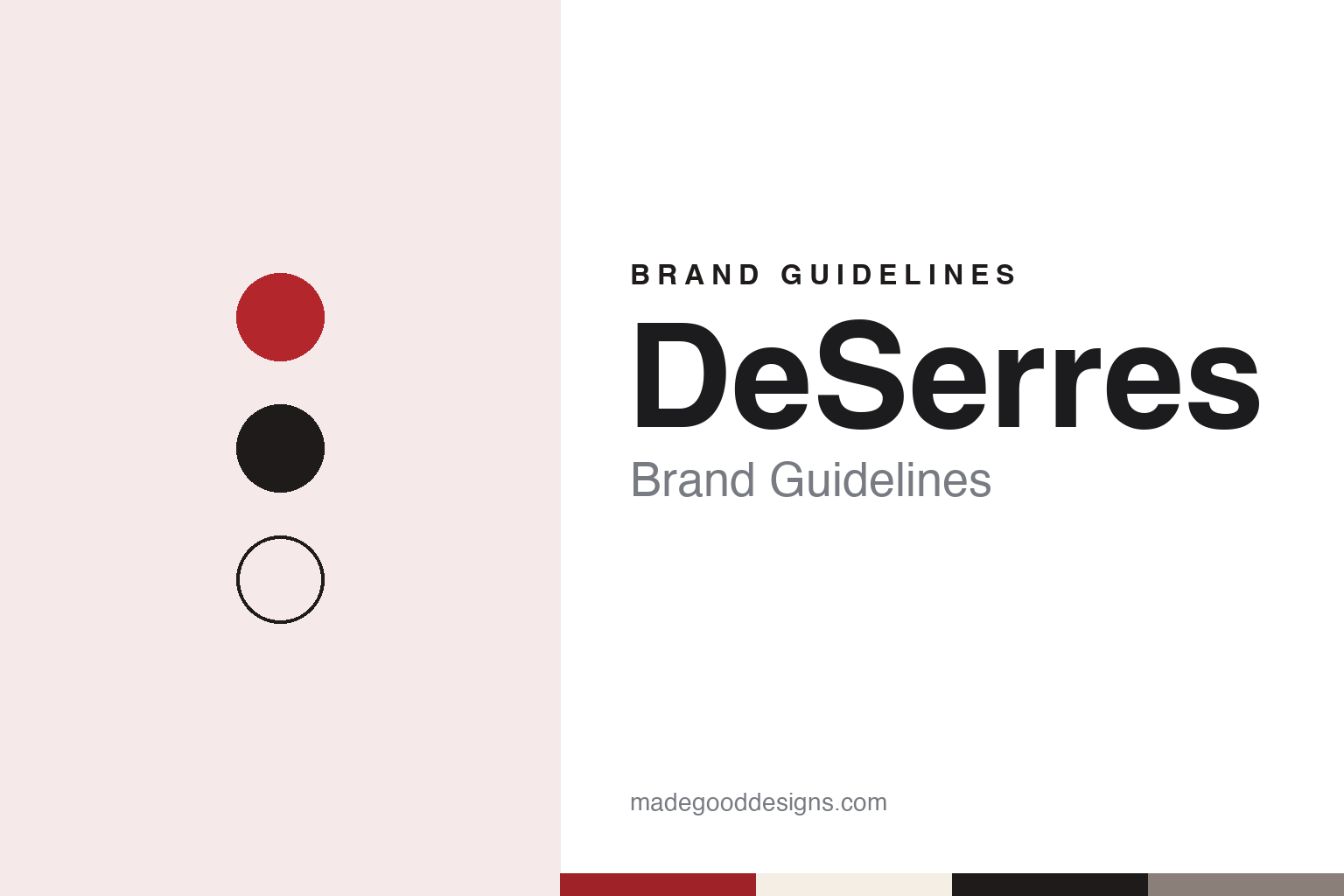
On its website the company describes DeSerres as “the iconic brand with the red palette” and says it has been part of the Renaud-Bray group since 2024. Red is therefore the natural lead in our interpretation, but the tones below are our own: a studio red for large areas, a deeper red that holds up as small text, an ink for body copy, a paper cream for backgrounds and a warm grey for captions. The serif gives the family name a century-old warmth.
For a design guide, DeSerres shows how a family name can carry a business from hardware to graphic arts to art supplies over more than a century. Compare Michaels, a North American creative retailer, and Cultura, a French retailer of cultural and creative goods. For this guide we use a warm red, a deep ink and a paper cream with a serif, an unofficial interpretation; no product or logo is reproduced.
Explore & save
Keep DeSerres’s identity on hand — save it to a board in the Made Good inspiration library.
DeSerres identity set
Pin the DeSerres red, ink and paper cream palette and the warm serif register to your own board.
Source & notes
Frequently Asked Questions
What font can I use to match the DeSerres look?
This guide describes DeSerres’ type as “A warm serif for a century-old family name”. Its type specimen is set in Fraunces from Google Fonts as a stand-in; Fraunces is not DeSerres’ own lettering.
What colours are in the DeSerres palette?
This guide’s DeSerres palette is Studio red #B3262C, Deep red #9E2228, Ink #1E1B1A, Paper cream #F4EEE4 and Warm grey #8A8079. The tones are the guide’s own unofficial interpretation, not official DeSerres hex codes.
When was DeSerres founded?
DeSerres was founded in 1908, in Montreal, Quebec. DeSerres is known for Art supplies, creative hobbies, framing.
Who founded DeSerres?
DeSerres was founded by Omer DeSerres in 1908. DeSerres is known for Art supplies, creative hobbies, framing.
Who owns DeSerres?
DeSerres is owned by Renaud-Bray group (since October 2024). DeSerres is known for Art supplies, creative hobbies, framing.