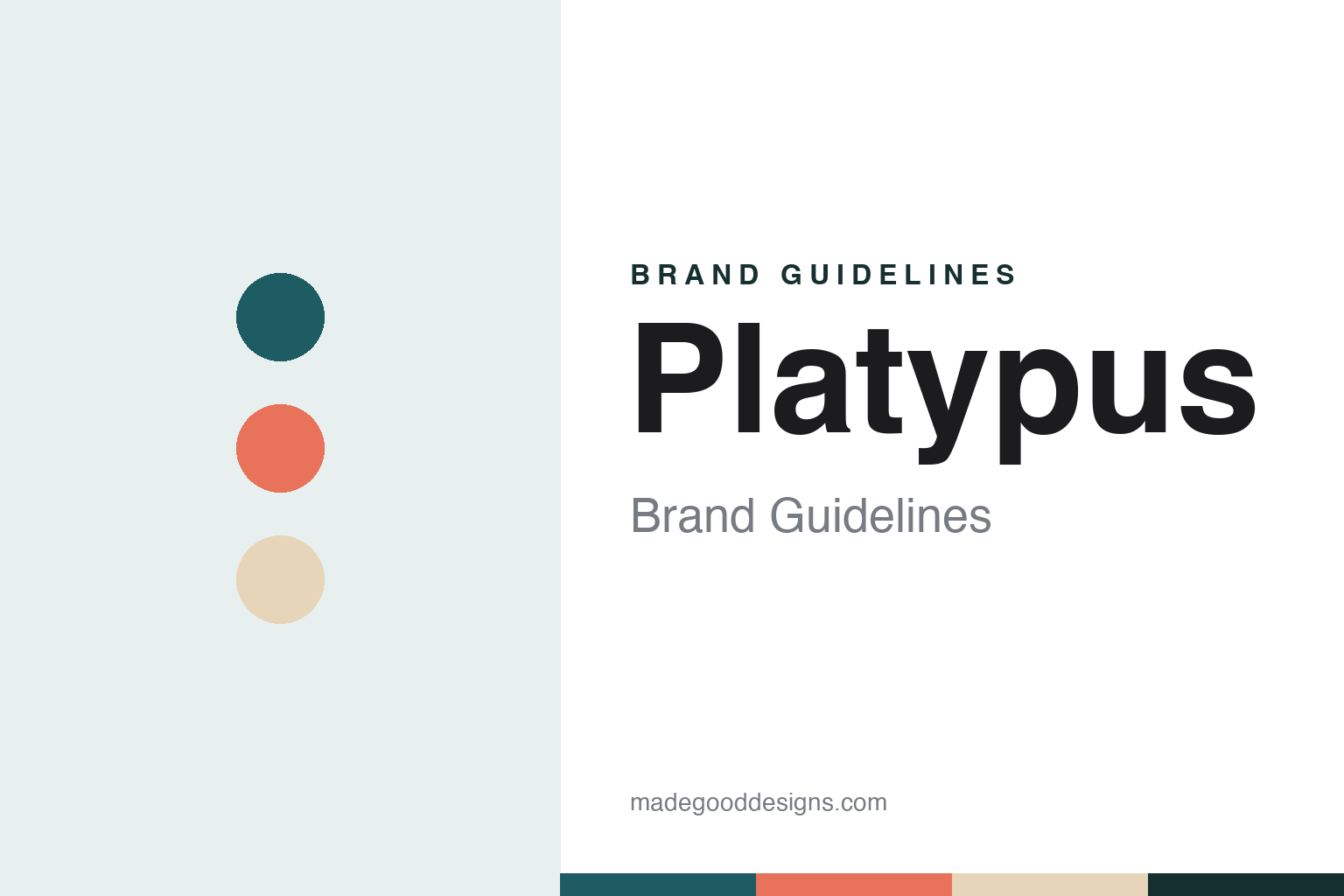
Platypus Brand Guidelines
An Australian shoe chain that built its identity around the store.
Aa
Two constants: a deep teal, bright coral and warm sand palette and a rounded sans register. Abstract homage — not a Platypus product or mark; no sign, logo or store fascia is reproduced.
Since 1998
Eleven stores, then an owner.
Platypus is an Australian and New Zealand footwear chain established in 1998, English Wikipedia says. The owner’s brand page opens with the same year, “Since 1998,” and says the chain set out to dress everyone who walks through its doors in “the freshest footwear from all the biggest brands.”
In 2007 the chain was bought by Accent Group, at a time when Platypus had 11 stores across Australia, Ragtrader reported in August 2021. Accent had begun in 1988 as a small wholesaling business in New Zealand, English Wikipedia says. In 2015 RCG Corporation acquired Accent, and in November 2017 RCG took the name Accent Group Limited; the company is listed on the Australian Securities Exchange.
Platypus is one of several shop banners in that group. English Wikipedia lists Hype DC, Stylerunner and the Sydney sneaker store SUBTYPE among Accent’s own brands, alongside licensed retail businesses such as The Athlete’s Foot. Within the group Platypus is aimed at younger shoppers: in December 2018 Inside Retail described it as a “youth-focused footwear retailer,” and in 2021 its general manager told Ragtrader that Platypus was the “go-to brand for youth footwear” but wanted all Australians and New Zealanders to think of it when looking for a shoe for any occasion.
Its shelves hold mainly other companies’ shoes. Ragtrader named Vans, Adidas, Puma and Nike among the brands in a 2021 Platypus superstore, and in 2018 the trade title counted 33 brands across the chain before a Melbourne flagship added seven more. The voice is Accent’s own: the brand page sets out the tagline “Play Life Loud” as an invitation to stay out late, wake up early, walk there and run back, and “be a champion in a crowd of naysayers.”
Colour
Flagships, superstores and a basketball hoop.
The chain’s store design changed in December 2018 with a flagship at Melbourne Central. Ragtrader reported in November 2018 that the 600-square-metre store on level one would sit directly next to JD Sports, had nine metres of frontage and had been designed by the Victorian retail design and architecture firm ACRD. Plans included a custom DJ booth for live music, gaming consoles running a “Sneaker Invaders” game and a vending machine that handed gifts to customers who bought something. Inside Retail, reporting the opening on 5 December 2018, said the store was more than twice the size of the next biggest Platypus shop, with a photo area, more than 33 footwear and accessory brands, and staff carrying portable point-of-sale devices so they could order what the store did not have in stock. It also served as a click-and-collect and click-and-dispatch hub for online orders in the area. Accent’s chief executive told Ragtrader that the Melbourne Central store would be a blueprint for retail concepts across Australia.
A second flagship followed in Sydney. In April 2019 Ragtrader reported that the new store on Pitt Street was the first Platypus store spread across two levels, and that the upper floor held the Kickstop, an area for customising shoes where customers could have their initials monogrammed in gold or silver foil, free with a footwear purchase. More flagships were planned around the country within a year, the trade title reported.
The larger format then spread well beyond the two cities. By August 2021 Accent had opened the 150th Platypus store, a 600-square-metre “Super Door” holding 1,300 product lines from brands including Vans, Adidas, Puma and Nike, Ragtrader reported. The store included a shoe-recycling station called “Imprint > Footprint”, fitted with a basketball hoop so that customers could dunk old shoes into the collection box. The chain then said it planned to grow to 250 stores within three to five years, with regional locations playing a key part, and that it had expanded into New Zealand with stores and online sales and added services such as endless aisle, click and dispatch, and click and collect. English Wikipedia counts 167 Platypus stores in Australia and 34 in New Zealand as of November 2023.
Typography
Shoe chains and their signs.
Shoe store chains in Europe present themselves first through the shop sign. The name over the door, its lettering and its colours are what a shopper sees from a car park or a high street, and the same mark is repeated on carrier bags, loyalty apps and websites. When a chain changes hands or merges its banners, the sign can change with it: in 2024 the German group Kienast announced that it would rename around 250 of its shops under the Reno name, replacing the logo lettering inside and outside each store, as the company and the trade title Shoez reported.
The chains in this guide come from Germany, the Netherlands, Switzerland, Poland, France and the United Kingdom, and they trade in different formats. As the companies describe them, these run from large shoe centres on retail parks and the edges of towns to smaller units on high streets and in shopping centres, and most now add an online shop and often an app.
Ownership varies as much as format. Some chains are still run by founding families, some are listed on a stock exchange, and some belong to larger shoe-retail groups that run several banners side by side, each with its own sign and its own own-label ranges. Ownership can also change quickly: Reno was sold by its long-time owner in 2022, entered insolvency proceedings in March 2023 and now continues as a brand of the Kienast group, according to WirtschaftsWoche and the company itself.
Each guide sets out what can be checked about one chain: when and where it was founded, who owns it today, how it describes its shops and its own-label ranges, and what its corporate pages say about founders and owners. Where a fact rests only on a company’s own word, the guide says so. The palettes and type pairings are our own unofficial interpretations; no logo or shop sign is reproduced.
Aa
A rounded sans for a chain with a loud tagline. (Specimen set in Rubik, a sans STAND-IN; NOT the Platypus logo.)
Play Life Loud
A listed owner, and an offer on the table.
The owner of Platypus has itself become the subject of a takeover contest. The British retailer Frasers Group bought a 14.65 per cent stake in Accent in August 2024 and raised it to 19.57 per cent in April 2025, when the two companies agreed that Accent would open and run the Sports Direct chain in Australia and New Zealand, English Wikipedia says. In mid-June 2026 Frasers made an unsolicited on-market takeover offer for Accent. Accent’s independent board committee unanimously recommended that shareholders reject it, setting out its reasons in a target’s statement dated 29 June 2026 and in two supplementary statements, according to Accent’s investor pages.
On 28 October 2026 Frasers declared that its offer price would not be raised, Inside Retail reported; the offer period was due to end on 29 January 2027, and Accent’s directors had said they would stand for re-election at the annual meeting on 20 November 2026. The offer was announced in June 2026 and had not been completed at the time of writing, and Platypus remains a brand of Accent Group.
The chain’s identity is carried as much by its stores as by its name. The flagships the trade press described paired a wide range of other companies’ shoes with music, games and in-store services such as monogramming and shoe recycling, and Accent presented the Melbourne Central store as the model for those that followed. The brand page carries the same tone in its copy, telling readers to “find what inspires you and major in it.”
For a design guide, Platypus shows a multi-brand retailer building its identity through the shop rather than the product: a tagline, a store format and a set of services arranged around other companies’ shoes. Compare JD Sports, its neighbour at Melbourne Central, and Foot Locker, another multi-brand sneaker retailer. For this guide we use a deep teal, a bright coral and a warm sand with a rounded sans, an unofficial interpretation; no product or logo is reproduced.
Explore & save
Keep Platypus’s identity on hand — save it to a board in the Made Good inspiration library.
Platypus identity set
Pin the Platypus deep teal, bright coral and warm sand palette and the rounded sans register to your own board.
Source & notes
Frequently Asked Questions
What font can I use to match the Platypus look?
This guide describes Platypus’ type as “A rounded sans for a chain with a loud tagline”. Its type specimen is set in Rubik from Google Fonts as a stand-in; Rubik is not Platypus’ own lettering.
What colours are in the Platypus palette?
This guide’s Platypus palette is Deep teal #1D5C63, Night green #16302F, Bright coral #E8735A, Warm sand #E6D5B8 and Paper #F7F4EF. The tones are the guide’s own unofficial interpretation, not official Platypus hex codes.
When was Platypus founded?
Platypus was founded in 1998, in Australia. This guide lists Accent Group Limited (since 2007) as its owner.
Who owns Platypus?
Platypus is owned by Accent Group Limited (since 2007). This guide dates Platypus to 1998, in Australia.