Domenico Beccafumi thought in light first and outline second. His saints stand in pools of shadow, their robes picked out in flickering highlights; his prints look as if someone had drawn on dark paper with white chalk. The Cleveland Museum of Art sums up his drawings and prints as marked by vibrant compositions and dramatic effects of light. That makes him a useful artist for anyone who designs with layers, tints and limited palettes. More public-domain drawings and prints from the Renaissance are in the MGD museum inspiration collection.
Who was Domenico Beccafumi?
The Metropolitan Museum of Art records him as born in Cortine in Valdibiana, near Montaperti, in 1484 and as dying in Siena in 1551. The Cleveland Museum of Art gives his birth as 1484/86 and his real name as Domenico di Giacomo Pace. Both Cleveland and the Art Institute of Chicago also record his nickname, Mecarino. According to Cleveland, he took the name Beccafumi as a young man from his protector, Lorenzo Beccafumi.
Siena was his base for almost his entire career. The Cleveland Museum of Art lists only brief stays elsewhere: Rome in 1510–12, Genoa around 1533 and Pisa in 1536–38. At home he won the city’s most prestigious public commissions, Cleveland notes, including fresco decoration in the Palazzo Pubblico, designs for the cathedral’s inlaid marble pavement and bronze sculpture for the cathedral. Britannica dates his bronze angels for the cathedral to about 1548, late in his life. The Dayton Art Institute points out that Giorgio Vasari’s 1568 biography remains the main early source for his life; for Vasari himself, see our guide to Giorgio Vasari.
Key works by Domenico Beccafumi
These works have firm museum dates and attributions:
- Designs for the inlaid marble pavement of Siena Cathedral. Britannica dates his work on the floor to 1518–46; the Met holds several later copies of his pavement designs, including the procession border below the Sacrifice of Isaac and figures from Moses Striking the Rock.
- Frescoes in the Palazzo Pubblico, Siena. The Italian art magazine Finestre sull’Arte dates the start of his ceiling for the Sala del Concistoro, the council chamber, to 1529.
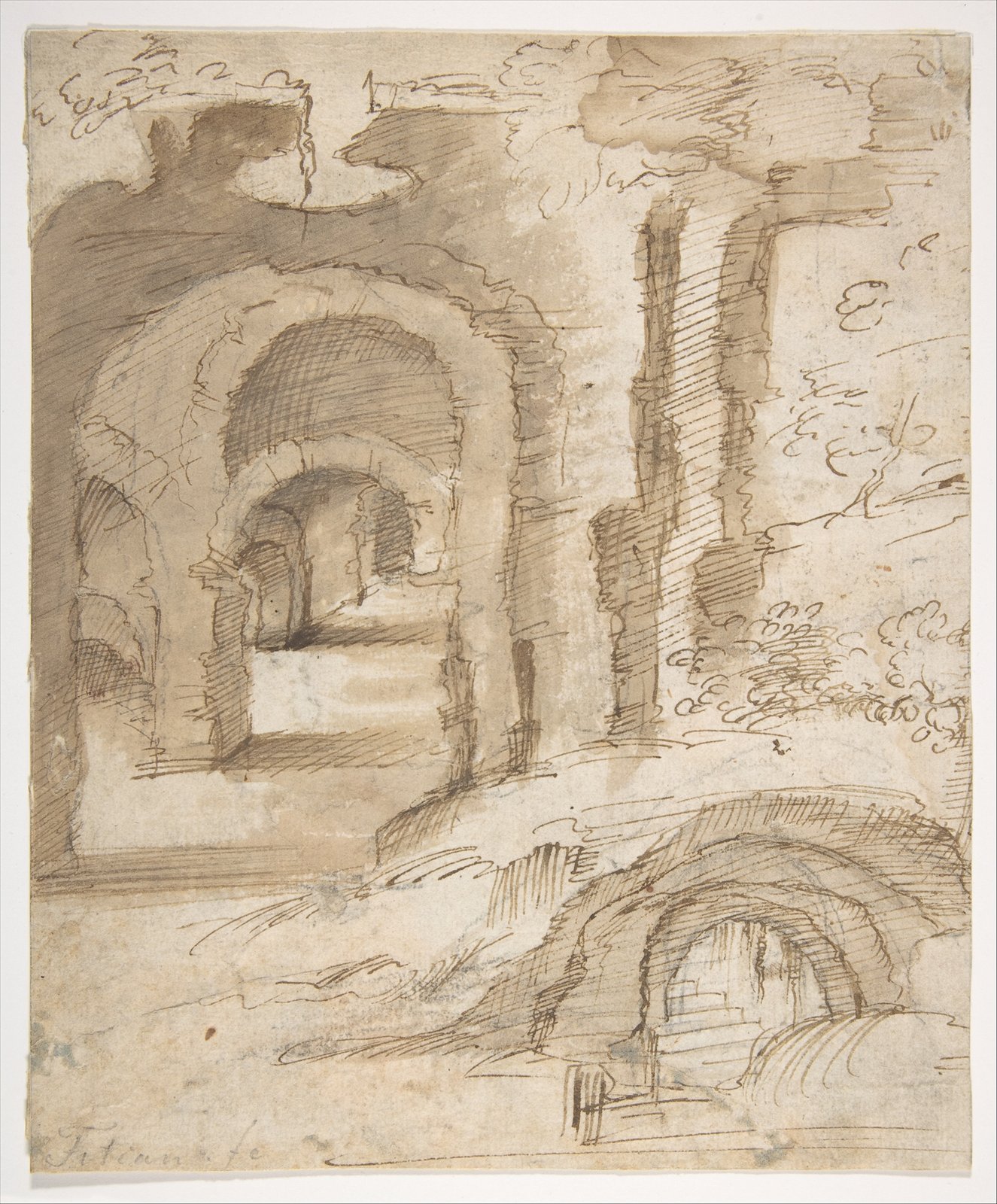
- Landscape with Catacombs, 1530–40, pen and ink with brown wash over black chalk, Metropolitan Museum of Art.
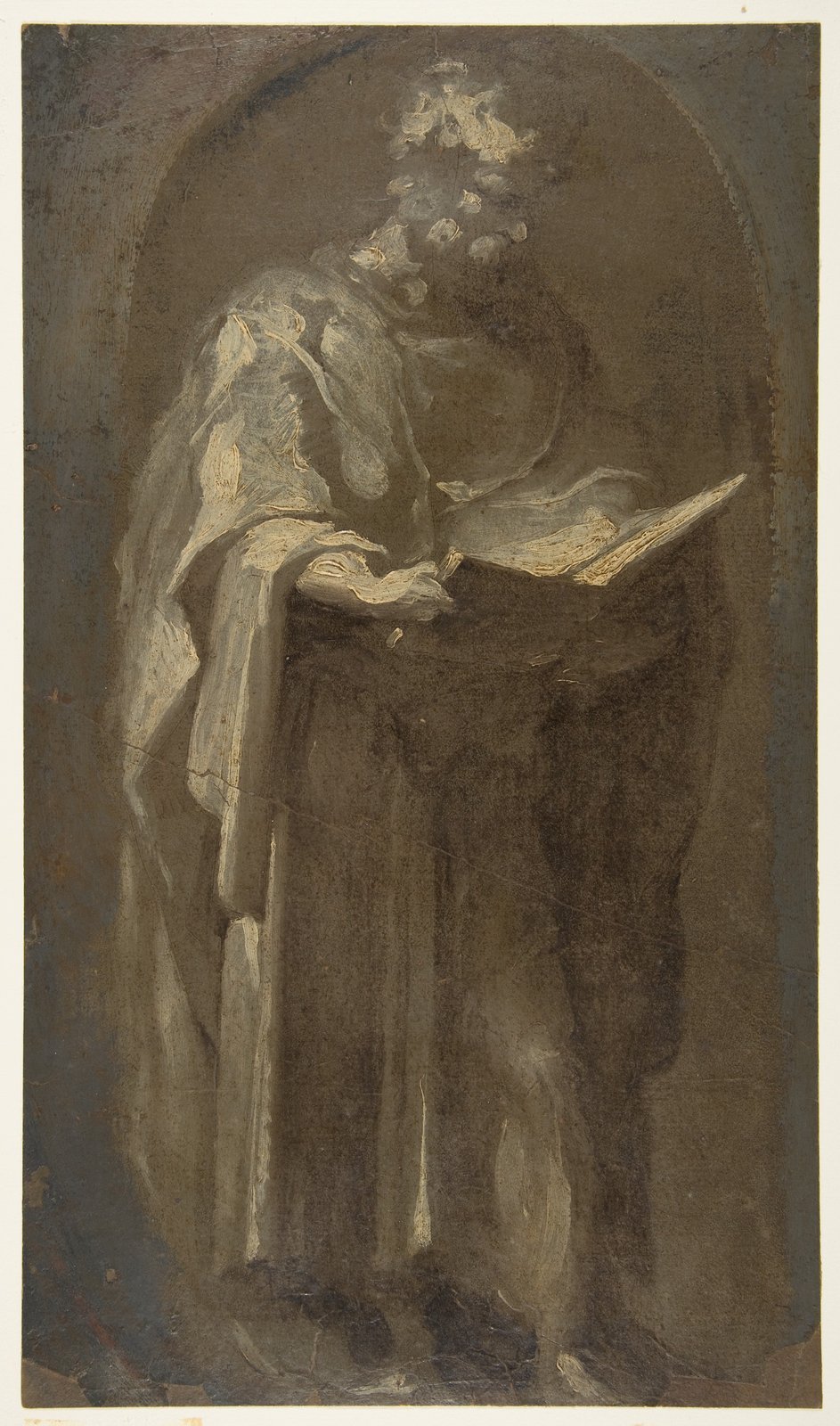
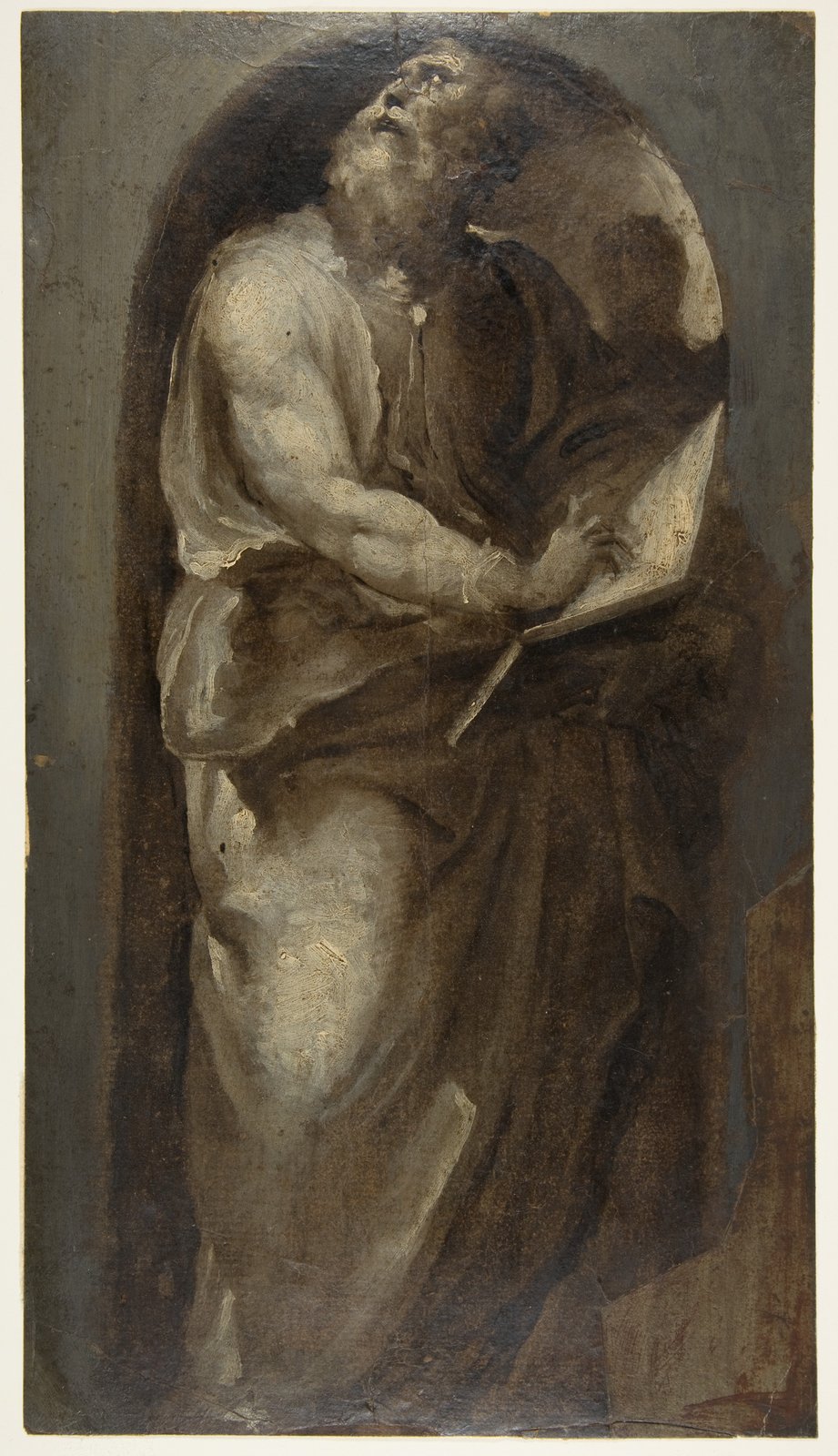
- Saint Matthew and Saint Mark, both 1538, brush and tempera on paper, Metropolitan Museum of Art.
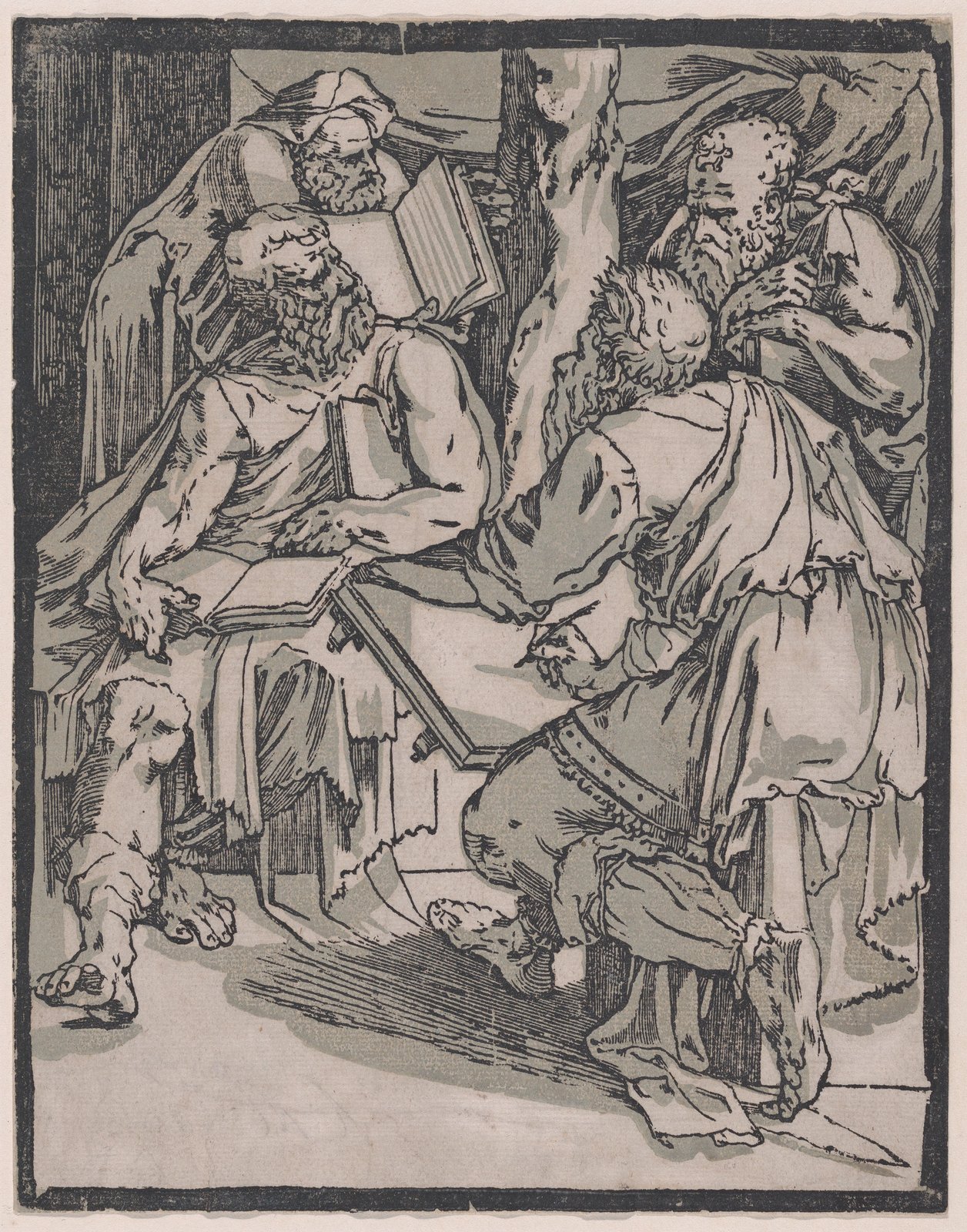
- Four Doctors of the Church, about 1540–50, chiaroscuro woodcut from two blocks, Metropolitan Museum of Art.
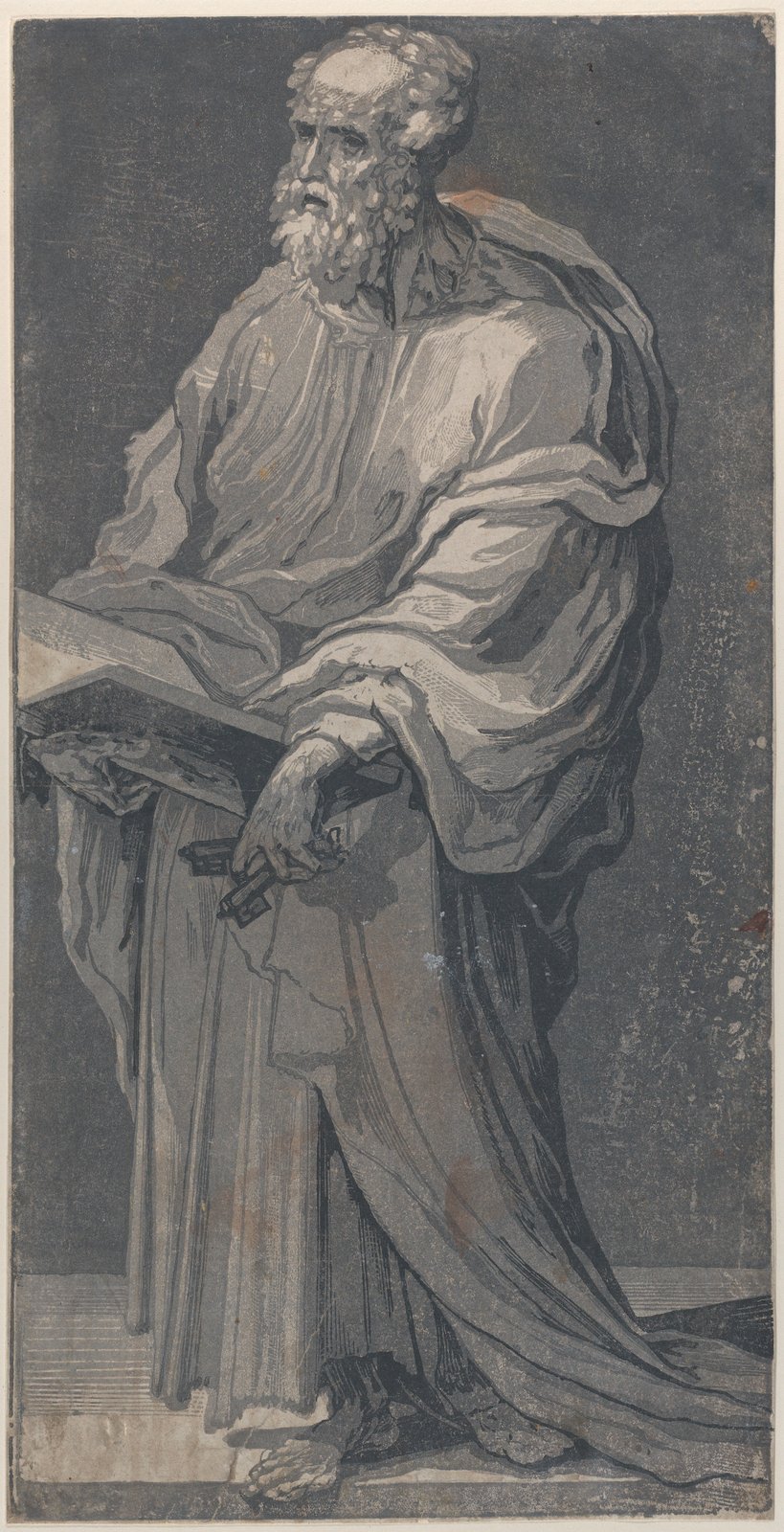
- Saint Peter, about 1547, chiaroscuro woodcut, with impressions at the Met and the Cleveland Museum of Art.
What to look at: drawing with light
Start with the Met’s Saint Mark. It is not a pen drawing at all. The Met describes the medium as brush with brown, beige and cream-coloured tempera and emulsion on paper, and the sheet is about 40 centimetres tall. The saint stands in a round-topped niche, reading a book, and almost everything is described by where the light falls: cream strokes run down the folds of the cloak, while the dark brown ground fills the space around him. There is very little contour line.
Measured from the Met’s scan of this sheet, the darkest ground sits around #403224, the main mid-brown around #6e614b and the brightest cream highlights near #f4f0e4. These are values from a photograph of a nearly five-hundred-year-old drawing, not the original paint, but the structure is clear: one dark, one middle, one light, and the light used sparingly.
Its companion, Saint Matthew, shows the same method in a more dynamic pose. The saint twists and looks upward, pen in hand, and his body makes a long S-curve inside the arch. The elongated proportions and the turning, upward-looking figure are typical of the style called Mannerism, which the Cleveland Museum of Art uses to describe him. Cleveland also notes that he was intensely aware of his contemporary Michelangelo, and the muscular arm here shows it.
Pen, wash and space
His pen drawings use the same thinking with fewer means. In Landscape with Catacombs at the Met, a run of round arches recedes into darkness, each one a little smaller and a little more washed in brown. The paper stays bare for the lit stone, and quick pen loops sketch ruins and plants above. It is a lesson in depth from repetition and value alone, without any measured perspective grid.
Technique: Domenico Beccafumi’s chiaroscuro woodcuts
A chiaroscuro woodcut is printed from several wooden blocks, each inked in a different tone, so the image is built from flat layers rather than from lines alone. The Cleveland Museum of Art says Beccafumi’s first prints were engravings, and that he turned to chiaroscuro woodcuts to reproduce the rich tonal effects of his drawings. Around 1547, Cleveland notes, he completed a series of six apostles that includes Saint Peter.
The way the blocks were cut is the design idea. To get the bright highlights of his drawings, Cleveland explains, he created the effect of thin white hatching lines on a dark ground. Look at Peter’s cloak: the folds are not drawn in black but cut out as pale lines, so the light seems to be scratched out of the shadow. The Met catalogues its impression as printed from four blocks in greys and black, and also holds a separate impression of the key block alone for his Saint Philip, which shows how much of the image depends on the tone blocks underneath.
Measured from the Met’s scan of its Saint Peter, the darkest tone sits near #404447, the two middle greys near #706d6a and #807b76, and the lightest paper-coloured highlights near #d9cec0. Cleveland’s impression of the same design is catalogued as printed in four shades of brown. Same blocks, different inks: Cleveland says he treated each impression as a separate work of art.
The Four Doctors of the Church is simpler, two blocks printed in light green according to the Met. Four seated scholars crowd around books and a tree trunk, and the tone block does most of the modelling. Prints by Beccafumi also include woodcuts of alchemists at work, dated to the 1530s by Cleveland and to about 1540–50 by the Met. For more prints cut in wood, see the museum’s woodcut collection.
The marble floor as graphic design
The cathedral pavement is the most graphic of all his projects. Pictures were made by fitting together marble of different colours, so each scene had to read in a few flat values, much like a print. The Met’s later copies of his designs show tight processions of figures in bands and borders, drawn in pen and wash to record the light and dark stones. Seen this way, the pavement and the chiaroscuro woodcuts are two answers to one problem: how to make a strong image from a handful of tones. For the wider context, see our overview of Renaissance art.
How designers can borrow from Domenico Beccafumi
Draw the light, not the outline
Start an illustration on a dark ground and add highlights as pale strokes. On screen, a dark panel with thin light lines for edges and folds gives a dramatic, engraved look without heavy outlines.
Use three or four stacked tones
His woodcuts are layered like a screenprint or a set of vector fills. Pick one dark, two mid-tones and a light from a single scan with the image colour picker, then build the image from those layers alone.
Swap the ink, keep the blocks
Grey, brown or green, the Saint Peter design works in each. Design a system of tonal layers once, then recolour it for different products or seasons.
Let repetition make depth
The receding arches of the catacomb drawing show that repeated shapes, each a little smaller and darker, create space quickly. The same trick works in pattern, headers and editorial layouts.
Frequently asked questions
What is Domenico Beccafumi known for?
He is known as a Sienese Mannerist painter and sculptor who designed scenes for the inlaid marble floor of Siena Cathedral, painted frescoes in the Palazzo Pubblico, and made chiaroscuro woodcuts with striking effects of light.
When did Domenico Beccafumi live?
The Met gives 1484 to 1551; the Cleveland Museum of Art gives his birth as 1484/86. He died in Siena in 1551.
What is a chiaroscuro woodcut?
It is a print made from two or more wooden blocks, each inked in a different tone, so the image is built from layers of light and shade. Beccafumi’s Saint Peter was printed from four blocks.
Where can I see his prints and drawings?
The Metropolitan Museum of Art holds Saint Matthew, Saint Mark, Landscape with Catacombs and impressions of his woodcuts. The Cleveland Museum of Art also holds an impression of Saint Peter.