Edgars Brand Guidelines
A 1929 Johannesburg store, a retail group, a rescue and a smaller red store.
Aa
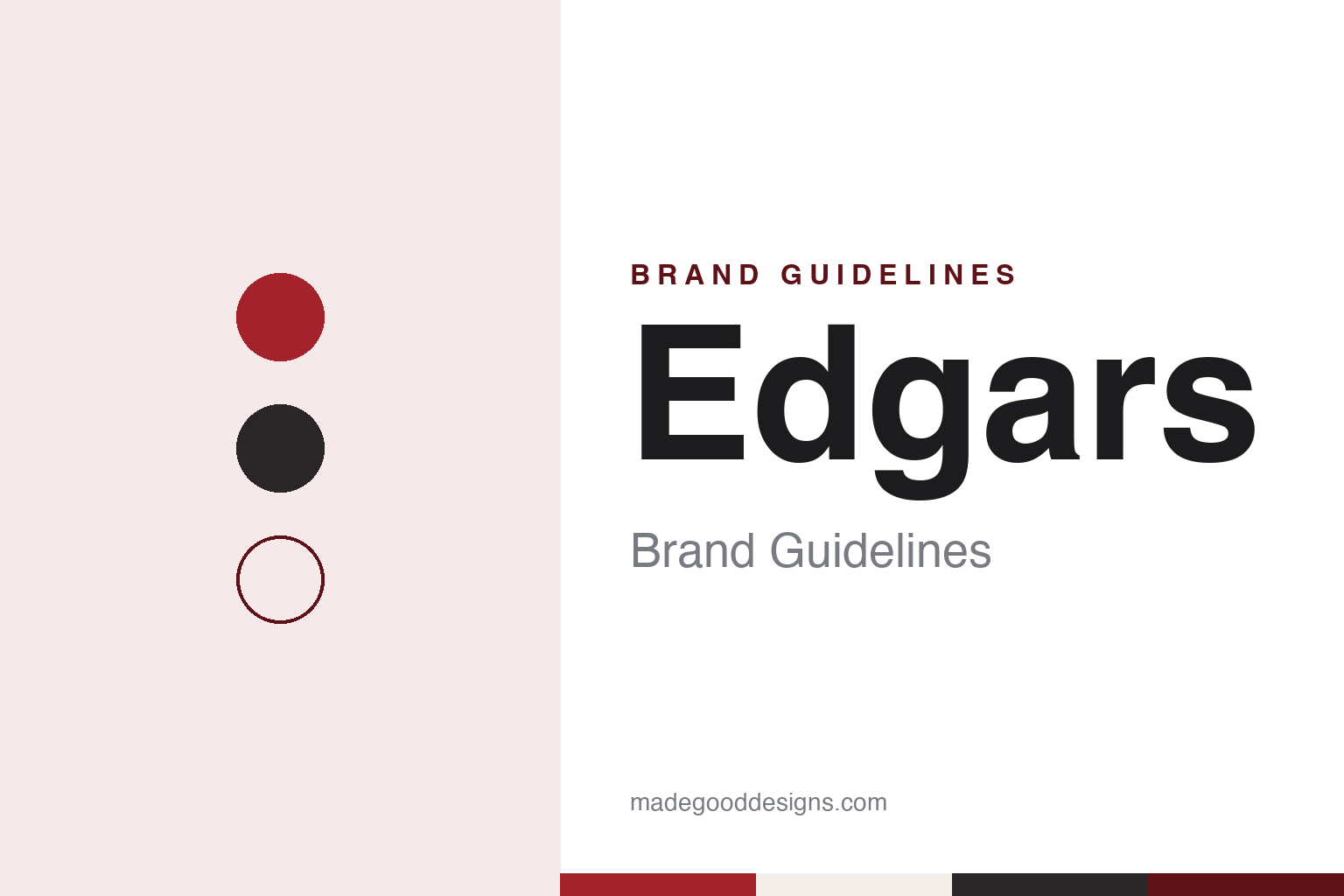
Two constants: a store red, charcoal and shell palette and a department-store grotesque register. Abstract homage — not an Edgars product or mark; no logo, fascia or label is reproduced.
Joubert Street, 1929
A Johannesburg store that grew into a group.
The first Edgars store opened on 6 September 1929 in Joubert Street, in central Johannesburg, and was founded by Sydney Press, English Wikipedia says. Two later press reports fit that founding year: Moneyweb called Edgars a 91-year-old chain in September 2020, and the Sunday Times quoted its owner in July 2026 as saying the brand was 97 years old.
The company grew well beyond one store. English Wikipedia says it was listed on the Johannesburg Stock Exchange in 1949 and opened its first stores outside South Africa, in Botswana, Lesotho and what is now Eswatini, between 1966 and 1969. In 1970 it bought the Ackermans discount chain, which it later sold on to Pepkor. In 1982 the company, still called Edgars, was acquired by South African Breweries.
Over the following decades the group, which came to be called Edcon, gathered a set of chains under one roof. English Wikipedia lists the Edgars department stores, the CNA stationery chain bought in 2002, the Boardmans homeware stores bought in 2004, the Red Square chain launched in 1996 and the discount chain Jet; as of 2014 the group traded through ten retail brands in more than 1,400 stores in eight countries, the same source says.
In 2007 the private equity firm Bain Capital took Edcon private, delisting it from the Johannesburg exchange, English Wikipedia says. In the years that followed the group restructured: it sold the Legit chain to Retailability in 2017, Moneyweb reported, and English Wikipedia says it closed its Boardmans and La Senza stores in 2018.
Colour
Business rescue in 2020, and a new owner in Durban.
In April 2020 Edcon filed for voluntary business rescue, the South African process for restructuring a company in financial distress. As part of the rescue plan the group was broken up and its chains sold separately. In August 2020 Edcon signed a sale agreement with Retailability, a Durban-based fashion retailer, for parts of Edgars, and in September 2020 the Competition Tribunal approved the sale subject to employment-related conditions, Daily News reported on 8 September 2020. Edcon said the plan included the sale of up to 131 Edgars stores and the saving of about 5,200 jobs in the Edgars business, the paper reported. In the same period The Foschini Group agreed to buy select assets of the Jet chain from Edcon’s administrators.
Retailability finalised its purchase of Edgars in September 2020, Moneyweb reported that month. The deal covered 130 stores in southern Africa, 120 of them in South Africa, out of around 190 Edgars stores, with restructured rental terms agreed with landlords. Retailability was founded in 1984 by Clifford Lines, its chair and majority shareholder, with the private equity firm Metier holding a significant minority stake, according to the same report. Its head office is at Mount Edgecombe, north of Durban. The company told Moneyweb it saw Edgars not as a department store chain but as a “fashion emporium,” built on two pillars, fashion and beauty, and that it intended to leave homeware. Edgars stores, traditionally anchor tenants in shopping centres, accounted for about 475,000 square metres of the roughly 600,000 square metres of retail space the enlarged group would hold, alongside its existing Legit, Beaver Canoe and Style chains, the company told Moneyweb.
The turnaround that followed was about size as much as stock. Retailability said in 2023 that 99 of the 113 Edgars stores it took over had been loss-making and that this was no longer the case, Business Day reported in August 2023, adding that the chain had repositioned towards the middle market and was reducing the size of some oversized stores. Edgars began selling online in July 2021, the same report said. By July 2026 Edgars had cut its retail space by more than 100,000 square metres over three years and had more than 100 stores, the Sunday Times reported.
Typography
How South African retailers present themselves.
South African retailers meet most of their customers in shopping centres, high streets and filling-station forecourts, so the store fascia does much of the identity work. A single group often runs several formats under related names, from large food halls and hypermarkets to small convenience shops and standalone clothing or liquor stores, and the name above the door usually tells the shopper which format they have walked into.
Own-label ranges carry the brand inside the store. Grocers and fashion chains sell food, clothing and homeware under their own names or under house labels, so the same letters, colours and type appear on shelf tickets, packaging, carrier bags and staff uniforms as well as on the shopfront. Loyalty cards and store cards extend that identity into wallets and phone apps.
Campaign graphics follow the retail calendar. Weekly specials, seasonal catalogues and back-to-school, holiday and sporting promotions are published in print, in store and online, and the companies’ own websites keep many of those leaflets and campaign pages available to browse. For a designer, these are the plainest record of how a chain uses its palette and type at speed.
The corporate side is just as public. Many of the large South African chains are listed on the JSE, and their investor websites publish annual reports, results presentations and history pages that name founders, parent groups, acquisitions and listing dates. Store counts and country lists in those reports are dated to a financial year, so they describe the business at that moment rather than for all time.
Aa
A department-store grotesque for a fashion and beauty chain. (Specimen set in Archivo, a sans STAND-IN; NOT the Edgars logo.)
Edgars
The red store under a private owner.
Under Retailability, Edgars has become the centre of a group of smaller brands. In April 2023 Moneyweb reported that Retailability had bought the footwear and accessories retailer Tread and Miller and the children’s clothing chain Keedo from Cape Union Mart, and that in 2022 it had brought labels including Aca Joe and Hilton Weiner back into Edgars stores. The same report called Edgars the once troubled “red store.” Retailability also relaunched Boardmans, the Edcon homeware brand closed in 2018, as an online store, Business Day reported in 2023.
Retailability’s other chains have since moved on. In November 2025 Pepkor completed its purchase of the Legit, Swagga, Style and Boardmans businesses from Retailability, a deal first announced in March 2025, Moneyweb reported. Edgars was not part of that sale, and in July 2026 the Sunday Times reported Retailability’s chief executive speaking for the chain.
Beauty has grown into a separate line. By July 2026 the stand-alone Edgars Beauty chain had 18 stores, and Retailability’s women’s fashion chain Kelso had opened its fourth store, at Tygervalley in Cape Town, after a pilot phase, the Sunday Times reported. The same report said Edgars had moved to smaller-format stores during the turnaround, choosing store sizes to suit each market.
For a design guide, Edgars shows how a department-store name can survive the break-up of the group built around it. Compare Foschini, whose group bought Jet from Edcon in 2020, and Ackermans, which Edgars owned in the 1970s. For this guide we use a store red, charcoal and shell with a sans, an unofficial interpretation; no product or logo is reproduced.
Explore & save
Keep Edgars’s identity on hand — save it to a board in the Made Good inspiration library.
Edgars identity set
Pin the Edgars store red, charcoal and shell palette and the department-store grotesque register to your own board.