El Ganso Brand Guidelines
Two Madrid brothers, a London look and a shop on Fuencarral.
Aa
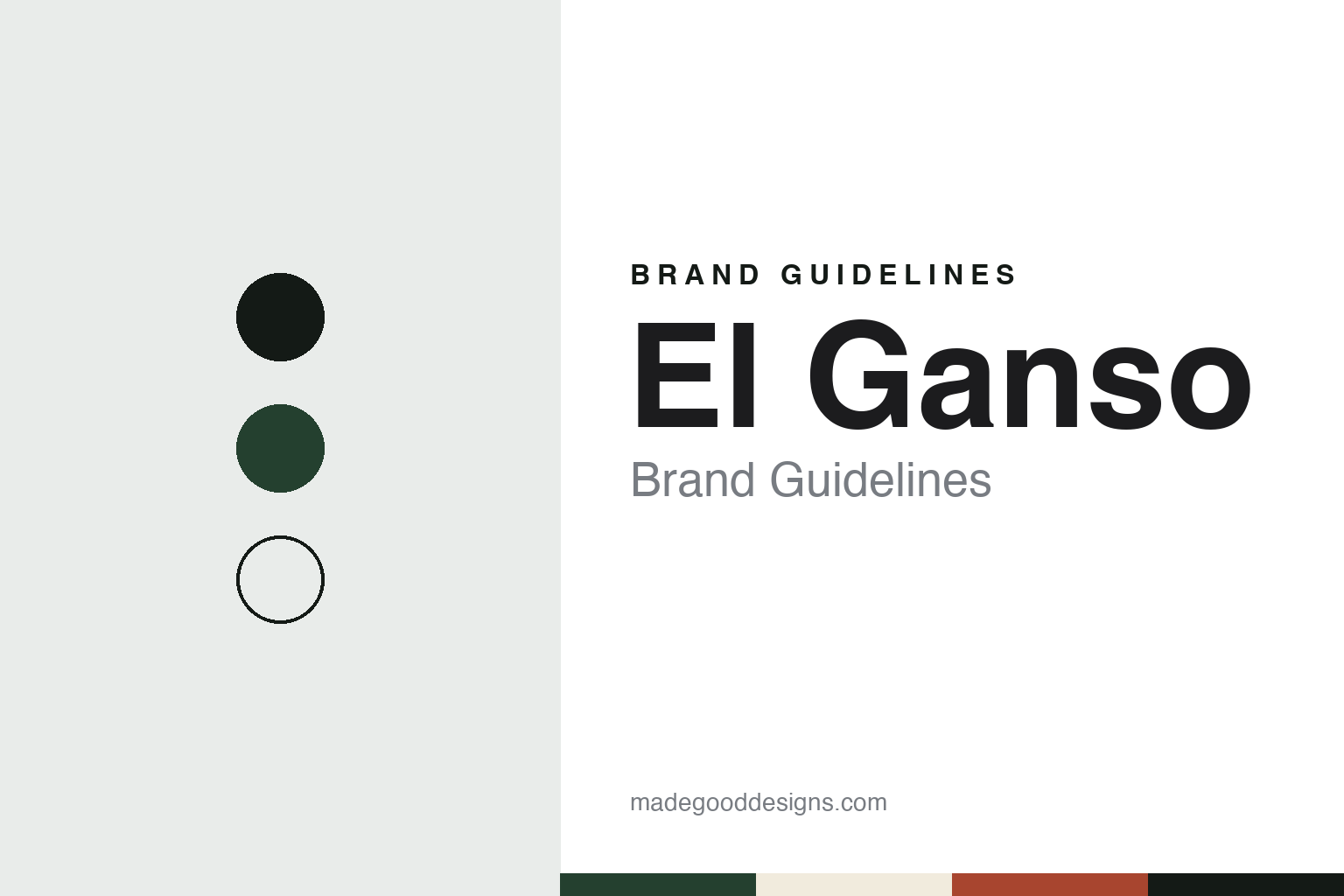
Two constants: a bottle green, cream and brick red palette and a collegiate serif register. Abstract homage — not an El Ganso product or mark; no garment, logo or shopfront is reproduced.
A London style
Summer jobs in London, a business in Madrid.
El Ganso is a Madrid company, started in 2004 by the brothers Álvaro and Clemente Cebrián. A 2013 article by the IESE business school, based on its teaching case “El Ganso levanta el vuelo,” tells the story: as students the brothers spent their summers in London working as waiters and shop assistants to improve their English, and noticed a relaxed, slightly scruffy take on smart dressing that, they felt, did not exist in Spain. After university they worked for large companies, and in the summer of 2004 they decided to found El Ganso, with advice and support from their father, an engineer and IESE MBA.
FashionUnited gave the same founding year in May 2019, and in October 2024 described the brand’s style as sitting between “British” and “preppy.” Its first steps were modest. IESE says the founders began with a run of bold trousers that they took to multibrand shops themselves and left on sale-or-return. FashionUnited recounted early setbacks: the first check shirts lost their pattern after one wash, and at their first trade fair the brothers turned up with an autumn–winter collection when the show was for spring–summer, making theirs, the company recalled, the only stand with coats and trench coats.
A turning point came in the spring of 2005. On a walk in Budapest, IESE says, Clemente Cebrián’s wife noticed a pair of trainers in a shop window; El Ganso began distributing the shoes of their designer, Jeremy Stanford, in Spain, and they sold almost at once. FashionUnited describes the hit as army-style trainers.
Colour
From Fuencarral to Le Marais.
The first El Ganso shop opened in 2006 on Calle Fuencarral in Madrid, according to IESE, and the brand relaunched its clothing with blazers, polo shirts and trousers. More of its own stores followed in Spain. FashionUnited dates the move abroad to 2011, with a first foreign shop in the Marais district of Paris and, in the same year, shops in Lisbon, Santiago de Chile and London. By 2012 the count had reached 32 stores, the 32nd on London’s Carnaby Street, IESE reported.
The brand’s marketing was unusual for a chain. IESE wrote in 2013 that El Ganso did not announce its arrival in new cities and did not sponsor anything, and that the brothers chose shop sites by spending weeks sitting in the street outside a candidate unit, watching how many passers-by carried shopping bags. Portugal, France and the United Kingdom were picked for being close enough to supply at reasonable cost; Chile, IESE said, suited the rotation of end-of-season stock from Europe.
The same case study set out the questions the founders faced at that stage: whether to take outside investors to open in cities such as Milan and Frankfurt, and whether to move production to Asia from Europe, despite worries that customers might react badly to a “made in Asia” label.
Today the collections cover men, women and children, according to FashionUnited, which in August 2026 put the Spanish network at 114 points of sale: 51 shops, two outlets and 61 corners inside El Corte Inglés department stores.
Typography
Design and documentation.
Spain’s high-street chains present themselves through their stores as much as through their advertising. Shop windows, store interiors and the logo over the door are where the fashion groups show each change of identity, and they announce those changes in company statements that trade papers such as FashionUnited then report, describe and date.
Inditex runs its chains as separate store brands, each with its own name, logo and stores. Its group head office is in Arteixo, near A Coruña; Pull&Bear is run from Narón in the same province; Bershka, Massimo Dutti, Oysho and Lefties from the Tordera–Palafolls complex in Catalonia; and Stradivarius from Cerdanyola del Vallès, according to FashionUnited in February 2025. Between 2019 and 2023 the group gave Zara, Stradivarius, its own corporate identity, Pull&Bear and Bershka new logos in turn, and moved their stores towards bright, neutral interiors in which the clothes supply the colour; since then several chains have added warmer materials, zoned rooms and spaces for music and social media.
The perfumery and grocery chains in this series are covered in the same way: by the store formats, own-label ranges and logos they publish, described only as the companies or dated sources name them, and without claims about what their products do.
Ownership is part of each identity too. Marta Ortega Pérez became Inditex’s non-executive chair on 1 April 2022, FashionUnited reported in April 2023; other companies in this series are privately held or run as cooperatives. Each guide that follows takes its founders, owners and listings from corporate pages and dated press, and describes every owner only in its business role.
Aa
A collegiate serif — the register of blazers, checks and club stripes. (Specimen set in Libre Baskerville, a serif STAND-IN; NOT the El Ganso logo.)
El Ganso
An investor in, an investor out.
Outside money arrived in 2015, when L Catterton, the investment firm backed by the Arnault family and LVMH, took a 49 per cent stake, FashionUnited reported. The partnership did not last. In 2018 the Cebrián family bought the stake back and returned to full ownership, through the family company Acturus Capital S.L., based in Boadilla del Monte, near Madrid, according to FashionUnited in May 2019. Writing again in August 2026, the same publication described the relationship between the fund and the brothers as tense from the start, and said the family went on to restructure the company after regaining control.
Part of that restructuring was in the United Kingdom. In 2019 El Ganso said it was closing all its physical shops in London because of Brexit and would serve British customers online and through multibrand stockists, FashionUnited reported. At that time the publication counted about 160 own-brand stores: 119 in Spain, 34 in France, 12 in Mexico and eight in Portugal.
Latin America became the next focus. In October 2024 FashionUnited reported an agreement with Brand Management Group (BMG), a Panamanian distributor, to open franchised El Ganso shops in Ecuador, Panama and Peru, starting with two in Quito, at the Scala Shopping and Quicentro Shopping centres. By August 2026, FashionUnited reported, BMG was running five El Ganso shops in the region, including one at the Multiplaza centre in Panama and one at Jockey Plaza in Lima. On 12 August 2026 the company announced its first shop in Colombia, at the El Retiro centre in Bogotá, also through BMG, FashionUnited reported. The same article said El Ganso sells in France mainly through Galeries Lafayette, runs a Lisbon shop and corners in El Corte Inglés in Lisbon and Porto, works with the Sordo Madaleno group in Mexico, trades directly in Chile with about eight points of sale, and had about 180 points of sale worldwide at the end of 2025.
For a design guide, El Ganso shows how a borrowed national style — British and preppy, in its own description — can become the identity of a Spanish chain. Compare El Corte Inglés, whose department stores carry many of its corners, and Mango, another Spanish fashion name. For this guide we use bottle green, cream and a brick red with a serif, an unofficial interpretation; no product or logo is reproduced.
Explore & save
Keep El Ganso’s identity on hand — save it to a board in the Made Good inspiration library.
El Ganso identity set
Pin the El Ganso bottle green, cream and brick red palette and the collegiate serif register to your own board.