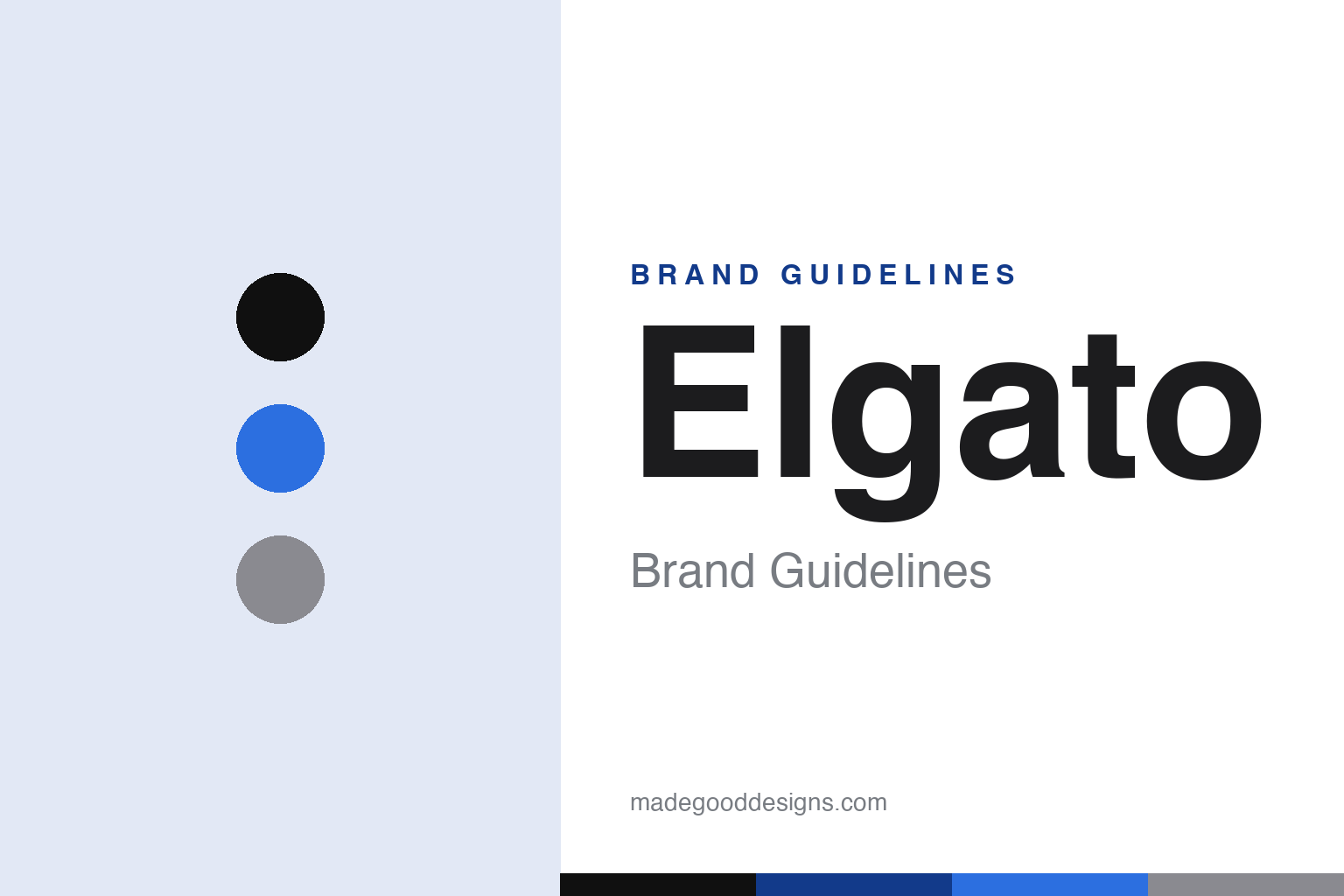
Elgato Brand Guidelines
A Munich company named ‘the cat’ — from Mac TV tuners to the Stream Deck and the creator economy.
Aa
Two constants: a black-and-white palette with a blue accent and a geometric sans. Abstract homage — not the Elgato wordmark or cat icon.
The cat that built creator gear
Elgato powers the creator economy.
Elgato is a lesson in a brand pulled into a new market by its own users. It’s a German company, headquartered in Munich, founded by Markus Fest — and its name is the Spanish “el gato,” “the cat,” reflected in a small cat-head icon. (An honest note: the exact founding year is genuinely muddled across sources — 1992, 1999 and 2010 all appear — so it’s safest to say “founded in Munich in the 1990s” rather than assert a hard year.) Elgato did not begin in streaming gear: its early fame was the EyeTV line — TV-tuner hardware and software that let you watch and record TV on a Mac or PC, with the first EyeTV device in November 2002. (Honest caveats: no official brand-colour hex is published — the blue is approximate — and no named brand typeface is documented.)
The turning point came from Elgato’s own audience: streamers and gamers were repurposing its EyeTV and capture products to record gameplay, effectively pulling the company into the creator market. Elgato leaned in — and in March 2017 launched the Stream Deck, the customisable LCD-key control pad that became its signature product (now a whole family: Mini, XL, +, Pedal, Neo).
Around the Stream Deck, Elgato built the modern creator toolkit: Game Capture cards, the Cam Link (turn a real camera into a webcam — a viral must-have during the 2020 work-from-home boom), Key Light panels, Wave microphones, and collapsible green screens. On ownership: Corsair acquired the Elgato Gaming brand in 2018 — but only the creator/gaming side; the original German parent kept its smart-home division and renamed itself Eve Systems (and EyeTV had already been sold to Geniatech in 2016). The identity is clean and modern: a lowercase “elgato” wordmark, a cat icon, black-and-white with a blue accent. The cat that built creator gear.
Colour
Elgato lives in black, white and blue. Click a swatch to copy the hex.
Elgato’s identity is clean and modern: largely black-and-white with a bright blue accent. The black-and-white reads as professional, sharp and product-focused — letting the hardware (and the creators using it) be the star — while the electric blue adds a spark of energy and a tech-forward, approachable edge that suits a brand serving streamers and video creators. It’s a restrained, contemporary scheme that feels like a modern tech tool rather than a flashy gaming brand, appropriate for gear that sits on a creator’s desk and gets out of the way. The honest caveat: Elgato publishes no official brand-colour hex — the black (near #101010) and the blue accent here are observed approximations, not first-party brand values.
The lesson is restraint plus one energetic accent for a modern tool brand. Elgato’s black-and-white keeps the focus on the product; the blue adds just enough life. For designers, it’s a reminder that a professional tool can be visually calm and still feel current. The takeaways: keep the base restrained and product-focused (black-and-white); add one energetic accent for modern spark (the blue); and treat specific hexes as approximate when no official spec is published.
Typography
The wordmark is a clean geometric sans — modern and product-focused.
Elgato’s clean geometric sans wordmark — the lowercase “elgato,” paired with a small cat-head icon — is modern and product-focused. The even, tidy letterforms read as contemporary, professional and unpretentious, matching a brand whose gear is meant to be practical creator tools, and the lowercase treatment keeps it approachable. The cat icon is a quiet play on the name (“the cat”), giving Elgato an ownable, memorable mark without shouting. Set in black-and-white with a blue accent, the type feels like a modern tech product — exactly the clean, creator-friendly personality Elgato cultivates. Because the exact face is undisclosed, the honest description is “a clean geometric sans,” not a named font. The type behaves like the brand: modern, clean and product-focused.
Aa
A clean geometric sans — modern and product-focused. (Specimen set in Jost, a geometric sans in the spirit of the elgato wordmark; the real face is undisclosed.)
Let your users lead you
Elgato followed its audience.
Elgato is a lesson in following your users into a new market. The company made Mac TV tuners and capture hardware — but when it noticed streamers and gamers repurposing that gear to record gameplay, it didn’t ignore the off-label use; it followed it, building purpose-made creator tools culminating in the Stream Deck (2017). That willingness to let an audience redefine the company is why Elgato became synonymous with the creator economy rather than fading with the TV-tuner era. It’s a textbook example of watching how customers actually use your products and letting that guide the roadmap — the market told Elgato what to build next, and Elgato listened. The pivot reshaped the brand, and its clean, modern identity (built around a friendly cat and a blue accent) travelled with it. Users led; Elgato followed — and won a category.
For designers and brand-builders, Elgato offers a clear takeaway: watch how customers actually use your products, and follow them into new markets. The lessons: notice off-label uses as signals (streamers repurposing capture gear); build purpose-made tools for the audience that emerges (the Stream Deck and creator toolkit); and keep a clean, portable identity that survives a pivot (the cat, black-and-white, blue). It’s also a reminder to keep the facts precise — Elgato is a Munich company named “the cat,” began with EyeTV TV tuners (2002), pivoted to creator gear led by the Stream Deck (2017), and its gaming/creator brand is owned by Corsair (2018), while the original parent became Eve Systems. Elgato followed its users — proof that your audience can show you your next market.
Explore & save
Keep Elgato’s identity on hand — save it to a board in the Made Good inspiration library.
Elgato identity set
Pin the black-and-blue palette and the geometric-sans spirit to your own board.