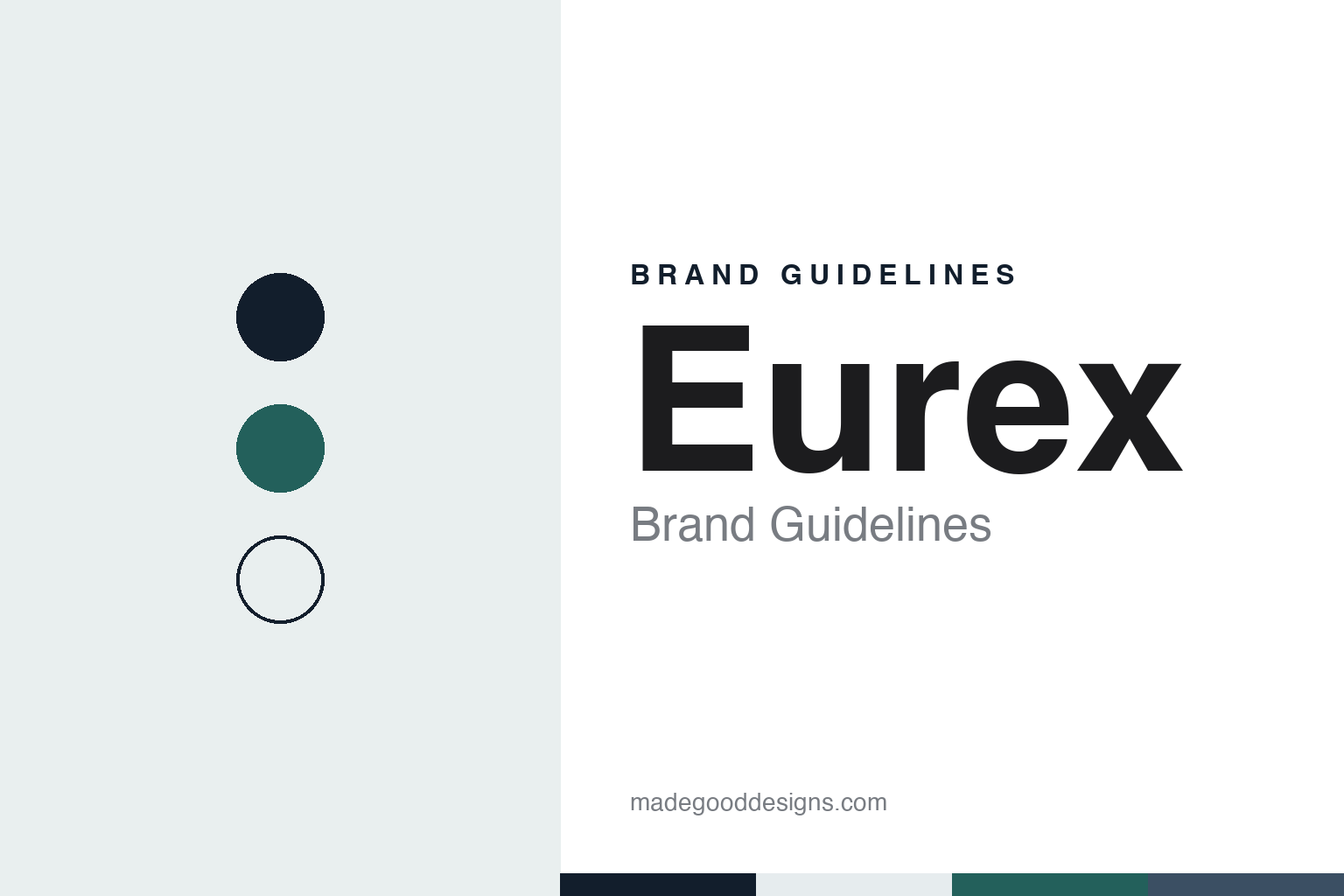
Eurex Brand Guidelines
A German–Swiss derivatives exchange built on screens, not trading floors.
Aa
Two constants: a navy, slate and teal palette and a systematic sans register. Abstract homage — not a Eurex product or mark; no logo, screen or contract document is reproduced.
DTB and SOFFEX
A German–Swiss merger in 1998.
Eurex is the derivatives exchange of the Deutsche Börse group, based in Eschborn, just outside Frankfurt am Main. It was formed in 1998 by merging two electronic futures and options markets: the Deutsche Terminbörse (DTB) in Frankfurt and the Swiss Options and Financial Futures Exchange (SOFFEX). German Wikipedia says Deutsche Börse AG and the SWX Swiss Exchange signed a letter of intent at the end of 1996, announced the joint trading and clearing platform at Bürgenstock in Switzerland on 4 September 1997, and that members of both exchanges have traded on the common platform since September 1998. German Wikipedia gives the full name as European Exchange.
The merger came out of a contest in the 1990s that English Wikipedia calls the “Battle of the Bund”: the electronic DTB drew trading in the German government bond future, the Bund, away from London’s floor-based LIFFE. English Wikipedia describes the DTB as one of the early fully electronic exchanges, with its screens distributed across Europe and into the United States by 1997, and says open-outcry pit trading was still the norm in the United States and Britain when Eurex launched.
For its first fourteen years Eurex was a joint venture. English Wikipedia says the German group held half the voting rights and most of the share capital, and that in January 2012 Deutsche Börse bought the remaining shares in Eurex Zürich AG from SIX Group, becoming sole owner. Today, English Wikipedia says, the exchange is operated by Eurex Frankfurt AG and Eurex Zürich AG, both wholly owned by Deutsche Börse AG; Eurex itself says it is “operated by Deutsche Börse AG” and dates its inception to 1998.
The business spread out early. German Wikipedia records the Eurex Bonds and Eurex Repo platforms from October 2000, futures and options on exchange-traded funds from November 2002, and a Chicago futures exchange, Eurex US, launched in February 2004; from October 2006 the Man Group held a 70 percent stake and ran it as the US Futures Exchange.
Colour
Trading, clearing and repo under one roof.
Eurex describes three linked businesses: the derivatives exchange, the Eurex Repo platform for repurchase agreements, and Eurex Clearing, its central counterparty. On its own pages Eurex lists products across interest rates, equities, equity indexes, dividends, volatility, exchange-traded funds and commodities, including EURO STOXX 50 index futures, DAX and Mini-DAX contracts, VSTOXX volatility futures and the Euro-Bund future, which German Wikipedia names as its most heavily traded contract, at around a million contracts a day.
Eurex Clearing AG stands between buyer and seller. The company says it provides central counterparty services for trades on Eurex, Eurex Repo and the Frankfurt Stock Exchange, including Xetra, as well as for over-the-counter products, and that it clears derivatives, equities, bonds and secured funding. It describes itself as a German company licensed as a credit institution under the supervision of BaFin, the federal financial supervisor, and as a clearing house authorised under the European Market Infrastructure Regulation (EMIR); it adds that in February 2016 the US Commodity Futures Trading Commission granted it status as a derivatives clearing organisation for swaps involving US entities. Eurex says Eurex Clearing serves about 200 clearing members in 22 countries.
Technology is a constant theme. English Wikipedia says the T7 trading architecture, developed by Deutsche Börse, went live in 2013. German Wikipedia records one notable interruption: on 22 February 2016, futures trading in several contracts, including DAX, EURO STOXX 50 and Bund futures, was halted on T7 from 11:09 to 12:50.
The newest step is digital. The TRADE reported on 3 November 2026 that Eurex Clearing will bring native digital instruments into its existing clearing framework, under one rulebook and one risk model, in a move the clearing house says makes it the first “hybrid” central counterparty. Digital issues from the European Stability Mechanism are to become tradable in the GC Pooling segment of Eurex Repo and eligible as margin collateral, working alongside Clearstream’s digital infrastructure.
Typography
Settlement, clearing and custody.
Post-trade institutions do the work that follows a trade: settlement, clearing, custody, collateral management and asset servicing. Central securities depositories, or CSDs, hold securities in book-entry form and settle transfers between accounts; international CSDs such as Euroclear Bank in Brussels and Clearstream Banking in Luxembourg do the same for bonds issued across borders; clearing houses stand between buyers and sellers; and custody banks hold assets for investors. Global Custodian noted in 2010 that this business is sometimes called the “plumbing of the financial system.”
The names can mislead. English Wikipedia points out that neither Euroclear nor Clearstream runs central counterparty clearing, despite the word in their names, which date from a time when clearing and settlement were treated as a single activity. For a designer, that makes plain service pages important: settlement, custody, collateral and fund services each tend to get their own section, written for banks, brokers and central banks rather than private investors.
Much of what these institutions publish is documentation. Clearstream’s website, for example, groups banking licences, articles of association, disclosure reports and regulatory information under the EU’s settlement and digital-resilience rules on one regulation page, alongside due-diligence questionnaires and factsheets. Rulebooks, operating manuals and annual reports sit beside those pages, so for a design system a clear type hierarchy and readable tables do much of the work.
The palettes in this guide lean on deep blue, teal and grey, set with a sans for long technical text, and the imagery stays abstract: networks, links and data rather than people or products. These are unofficial interpretations of our own, not brand colours; no logo, wordmark or document from any institution is reproduced.
Aa
A systematic sans for an exchange that lives on screens. (Specimen set in Archivo, a sans STAND-IN; NOT the Eurex logo.)
Eurex
A pan-European name with a German owner.
Eurex sits inside the family of its parent. On its about page it frames its values as those of the Deutsche Börse group — performance, reliability, integrity, openness and responsibility — and it states a mission “to create better markets.” Its vision, the company says, is to be “the globally trusted home of trading, clearing and risk management.” The name itself is short: a single word drawn from European Exchange, the full name German Wikipedia gives.
The website is a working tool before it is a brochure. Its menus are organised around Markets, Trade, Clear, Data, Support and Rules & Regs, with long lists of product families, trading calendars, margin calculators and production notices; the about pages speak in the language of liquidity, risk management and market integrity. An identity built in its spirit has to survive tables, contract specifications and dense regulatory text.
For a design guide, Eurex shows how a market-infrastructure brand can stay quiet and systematic, letting a short name and a restrained colour system hold together thousands of product pages. Compare the parent group in the Deutsche Börse brand guidelines and its sister settlement house in the Clearstream brand guidelines. For this guide we use deep navy, slate, teal and mist with a sans, an unofficial interpretation; no product or logo is reproduced.
Explore & save
Keep Eurex’s identity on hand — save it to a board in the Made Good inspiration library.
Eurex identity set
Save the Eurex navy, slate and teal palette and the systematic sans register for your own reference.