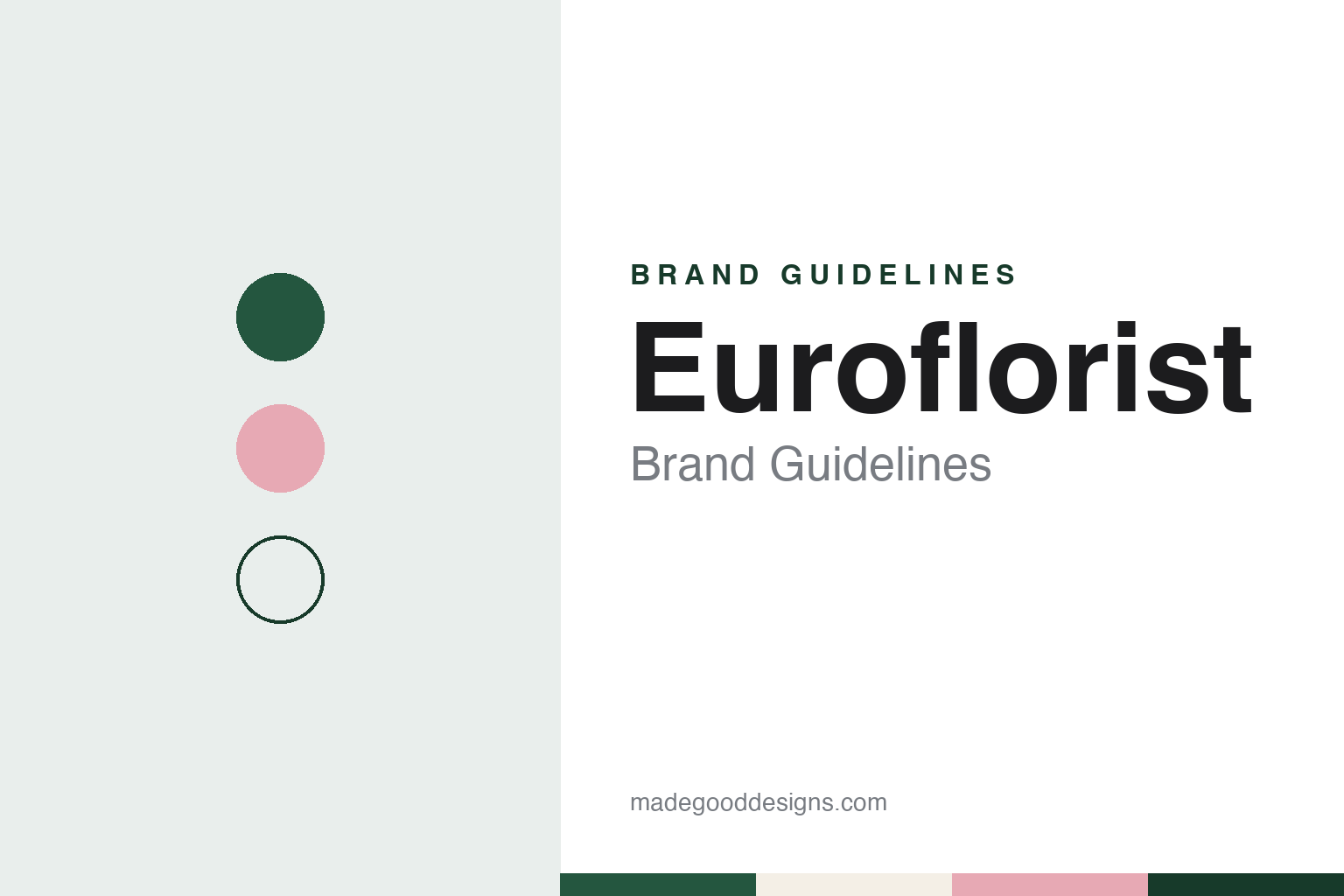
Euroflorist Brand Guidelines
A Malmö flower relay that went online in 1995.
Aa
Two constants: a leaf green, petal pink and paper white palette and a friendly sans register. Abstract homage — not a Euroflorist product or mark; no bouquet, logo or packaging is reproduced.
Svensk Blomsterförmedling
An engineer, an attic in Malmö and a relay for florists.
Euroflorist began in Malmö, in southern Sweden, in 1982. Its founder was Peter Jungbeck, the Swedish trade site Ehandel.se reported in September 2015, and English Wikipedia gives the first name of the business as Svensk Blomsterförmedling. The company’s own history page says Jungbeck, an engineer, started it together with his friend and business partner Lars Hedberg, and that the two worked from an attic on Norra Vallgatan in Malmö before moving to larger premises on Torggatan in the same city.
The idea was technical rather than horticultural. The company says Jungbeck built a system that made it easier for florists to pass orders to one another, so that a bouquet ordered in one place could be made up and delivered by a shop somewhere else. Svensk Blomsterförmedling became the Swedish representative of Teleflor International, the company says, which let Swedish florists send flowers abroad; English Wikipedia dates that partnership to 1984.
In 1990 the business was renamed Euroflorist. Swedish Wikipedia says the new name was chosen to make an international expansion possible, and lists the countries that followed: Denmark in 1993, Poland in 1996, Germany in 2001, Austria in 2002, the Netherlands in 2003, France in 2004, and Belgium and Luxembourg in 2006.
Colour
From fax and telephone to a web shop in 1995.
Before the web, Ehandel.se said in its 2015 profile, Euroflorist sold through the shop counter, the telephone and the fax. The move online began when Jungbeck read about the internet and then attended a seminar at Lund University about the university’s network; the company launched its first web shop in 1995. At first, he told the magazine, Euroflorist had a single computer with an internet connection, used mainly to exchange orders with partners around the world. The company dates the launch to August 1995 and says card payments were at first handled through a Scottish bank, because no Swedish bank was then ready to deal with online shopping.
Valentine’s Day was already a peak in the early years of the web shop, with hundreds of orders, the 2015 profile said. It still is: when Ehandel.se interviewed the heads of Euroflorist and of Interflora in the Nordic countries in February 2026, it called 14 February the most intense day of the year for flower delivery, one that needs planning and logistics at the highest level.
The model is a network. The company says its bouquets are made and delivered by local florists, that its florist members are “selected with great care,” and that it works with more than 54,000 local flower shops inside and outside Europe.
Britain became its biggest market. In 2010 Euroflorist bought Teleflorist, a florist network based in Romsey, which was later renamed eFlorist; Ehandel.se reported in November 2015 that the deal brought a network of about 1,500 florists and an online ordering platform. In 2014 Euroflorist bought out its Polish business, in which it had held a minority stake, the magazine reported, and in November 2015 it bought iFlorist, which Ehandel.se described as England’s third-largest florist network, and which also ran the iHampers and Flowerfete sites. The chief executive at the time told the magazine that iFlorist brought a well-developed business-to-business trade.
Typography
How flower delivery and florist brands present themselves.
Flower delivery brands sell something that changes with every order. The bouquet a customer sees on screen is a photograph of one arrangement, made up again by a florist or a packing team when the order arrives, so the photograph does much of the work of the brand. A bouquet is often given a name and sold in more than one size: in 2019, for example, House Beautiful reported Serenata Flowers bouquets offered in standard, deluxe and grande versions.
Packaging is the other visible surface. Some online florists send flowers in boxes made to fit through a letterbox, and that packaging has become part of how they are described: House Beautiful noted in 2019 that one Bloom & Wild bouquet came “delivered through your door” in the company’s letterbox packaging. Others work through networks of local shops, where the arrangement is made by an independent florist and the brand lives mainly on the website and the order confirmation.
Naming carries much of the rest. Seasonal launches, bouquets named after a month or a festival, gift ranges and, at some companies, subscription schemes can give a brand a calendar to talk about, and the trade revolves around a few peak days; Valentine’s Day is the clearest, which the Swedish trade site Ehandel.se called the most intense day of the year for flower delivery in February 2026.
Behind the shop fronts, ownership is often more concentrated than the brand names suggest. Groups such as Euroflorist run several national web shops and keep separate corporate and investor pages that list the brands they own. This guide sets out what can be checked about each brand — who founded it, who owns it and how it sells — and attributes to the company any claim that rests on its own word alone.
Aa
A friendly, rounded sans for a network of local florists. (Specimen set in DM Sans, a sans STAND-IN; NOT the Euroflorist logo.)
Euroflorist
From one attic to a family of national web shops.
Ownership has changed more than once. In 2021 a group of investors under the name Euroflorist 2.0 AB bought the whole company from the Swedish private-equity firm Litorina, Euroflorist announced. The buyers were led by Magnus Silfverberg, formerly chief executive of Bisnode and Betsson, who became chief executive, and Johan Tjärnberg, then chief executive of Trustly, who was named to chair the board, with co-investors including NEA Partners, Inbox Capital and Tagehus. At that point, the announcement said, the company traded mainly as Euroflorist and eFlorist, ran sites in 11 European countries and had offices in Sweden, Britain, the Netherlands and Poland.
Since then the group has grown by buying other online florists. Through its British subsidiary Flowers Online it signed an agreement in November 2024 to buy Serenata Flowers, and completed the deal on 4 December 2024, the company announced; Ehandel.se reported in March 2025 that the chief executive saw Serenata as a premium brand alongside the more value-for-money eFlorist, and that Euroflorist had launched a new e-commerce platform during 2024. On 1 December 2025 Euroflorist said it had bought and taken over E-Frisch GmbH, which sells flowers online to German customers through the Blumenshop and Pflanzenshop sites. In September 2026 it said it had hired the bank DNB Carnegie to look at financing options so that it could keep buying businesses in the European online market for flowers and gifts.
Today the group runs separate national sites rather than one global shop. Its corporate site lists Euroflorist sites for Sweden, Germany, France, Denmark, Norway, Belgium, the Netherlands, Austria and Poland; eFlorist, Teleflorist and iFlorist in Britain; eFlorist in Ireland; and Gift2Day in Sweden. The same site’s footer names Euroflorist Europe B.V. in Amsterdam, while the group’s financial reports are issued from Malmö by Euroflorist 2.0 Obligation AB, the company behind its bond.
For a design guide, Euroflorist shows how a relay network built in the fax era turned into a family of national web shops under one name. Compare Interflora, another florist relay network, and Serenata Flowers, the British online florist Euroflorist bought in 2024. For this guide we use a leaf green, a petal pink and a paper white with a sans, an unofficial interpretation; no product or logo is reproduced.
Explore & save
Keep Euroflorist’s identity on hand — save it to a board in the Made Good inspiration library.
Euroflorist identity set
Pin the Euroflorist leaf green, petal pink and paper white palette and the friendly sans register to your own board.