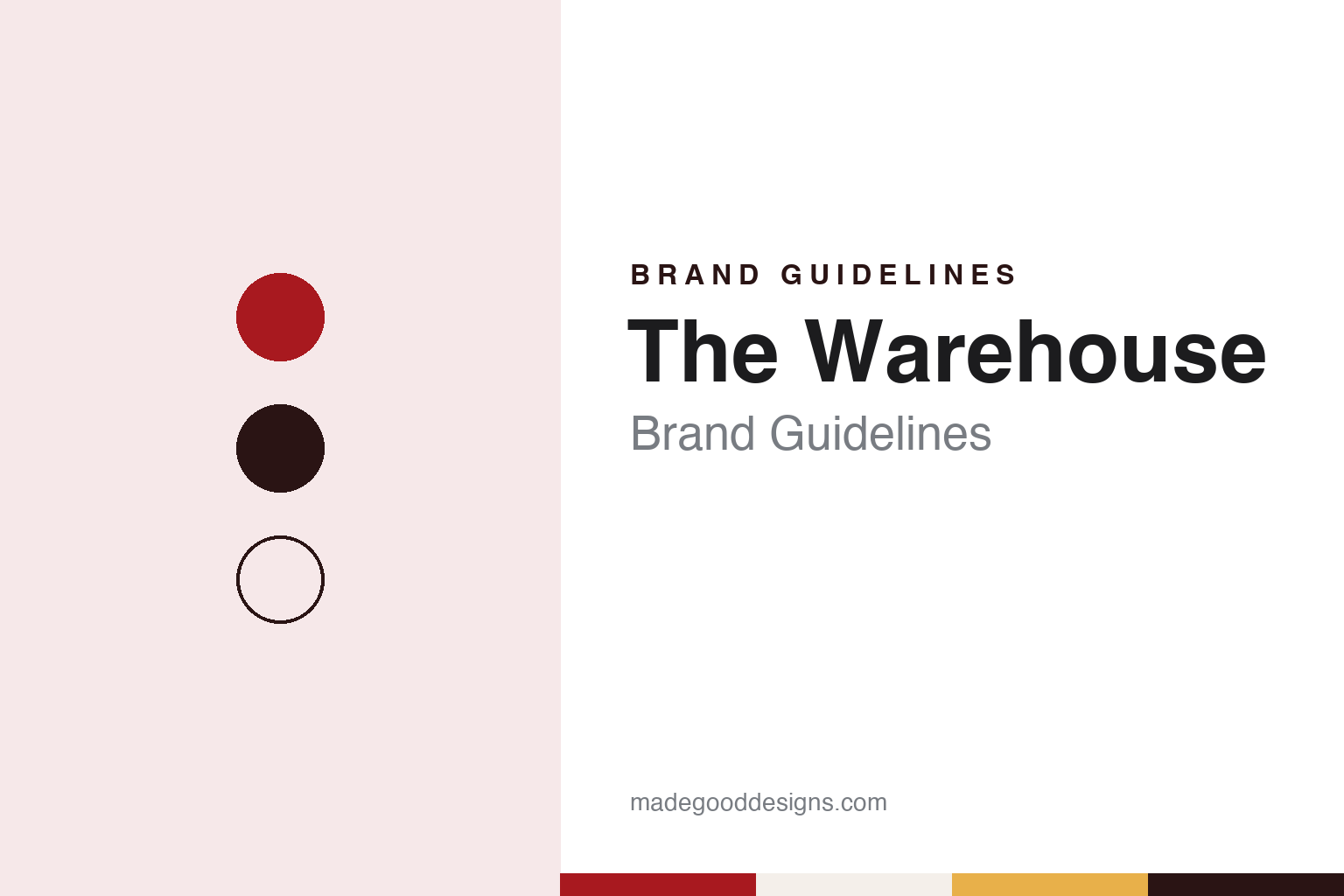
The Warehouse Brand Guidelines
The Red Shed opened on Auckland’s North Shore in 1982.
Aa
Two constants: a red, warm white and dark timber palette and a rounded retail sans register. Abstract homage — not a The Warehouse product or mark; no logo, sign or store fascia is reproduced.
A plain warehouse
Clearance lines on Auckland’s North Shore.
The Warehouse began in 1982 on Auckland’s North Shore. Its founder, Stephen Tindall, had spent twelve years with the retailer George Court & Sons, rising to merchandise director, before setting up a chain of his own, the company says. The company’s timeline places the first store on Wairau Road; the NZX company profile describes the business as starting out in Takapuna, selling imported and manufactured clearance lines. Both are North Shore locations, and both sources agree on the year.
The company describes New Zealand in 1982 as a protected economy with high import tariffs, which kept many goods expensive. Its answer was a plain store: a warehouse-style space piled with a wide range of goods at low prices. The company says towns around the country began asking it to open locally as it grew.
The early timeline is a list of steps that shaped the format. The Warehouse sent out its first nationally distributed advertising mailer in 1990, opened the first Warehouse Stationery store in 1991, and launched The Warehouse card in 1992, the year it opened its first stores of 25,000 and then 50,000 square feet. A green gardening department arrived in 1995, apparel became a major department in 1998, and the same year brought the company’s first shipment of parallel-imported goods. A store of 100,000 square feet followed in 2000.
Tindall was managing director until 2001 and remains a director, according to the company’s founder page. The same page calls the stores New Zealand’s “Red Sheds”, a nickname that RNZ also uses: in September 2026 it described The Warehouse as the group’s “ubiquitous Red Shed brand”.
Colour
A listing, an Australian venture and new formats.
The company floated on the New Zealand Stock Exchange in November 1994, the NZX profile says, and it joined the NZSE40 index in 1995 and the NZSE10 in 2000, according to the company timeline. It now trades under the code WHS; English Wikipedia notes that the earlier code was TWH.
The main venture outside New Zealand was in Australia. In 2000 the company bought two discount variety chains, Clint’s and Silly Solly’s, with 126 stores between them, and ran them as The Warehouse Australia, the NZX profile says. In November 2005 it agreed to sell that business, and English Wikipedia records that the buyers renamed it Australian Discount Retail.
At home the company tried several new formats. English Wikipedia says the brand was relaunched in 2005 with a new lower-case logo, and that The Warehouse Extra opened at Sylvia Park in Auckland in 2006 with full grocery, cafés and bakeries. On 9 October 2008 the company said it would not roll the Extra format out further, as it did not meet its investment criteria, according to the NZX profile; English Wikipedia says the Extra stores closed in 2009, the year a smaller format, The Warehouse Local, opened in Mosgiel.
The shareholder register drew attention in 2008. On 31 July that year the Court of Appeal set aside a High Court clearance that would have allowed Woolworths and Foodstuffs to acquire up to all of the company’s shares, the NZX profile records; it adds that each held 10 per cent of the company.
Online shopping launched in 2009, and by 2012, the company’s 30th year, The Warehouse had its full range online, the company timeline says. A first mobile shopping app followed in 2014, and in 2017 the first Warehouse Stationery shop opened inside a Warehouse store.
Typography
Department, discount and specialty retail.
Australian and New Zealand department, discount and specialty retailers present themselves first through the shop front. Many chains grew by buying older local stores and then putting their own name over the door, so a single fascia in a city mall or a regional town often carries several earlier businesses behind it. Myer, for example, renamed the Grace Bros stores of New South Wales in 2004, two decades after buying the chain. Store names are usually plain: a founder’s surname, a description of what is sold, or a short set of initials.
The calendar does much of the talking. Department stores mark Christmas with window displays, and in Melbourne the Myer windows on Bourke Street have been documented by State Library Victoria since their start in 1956. Discount and specialty chains lean instead on printed and online catalogues, seasonal sales with their own names and colour-coded sale signs, published on the companies’ own channels. Loyalty programmes, cards and apps carry the same name and colours as the stores.
Own-label ranges sit beside the brands a retailer stocks. Many groups sell products under house names, or own fashion and homewares labels that also trade as separate shops, and present them in their own sections of the store and website. A pattern, a single colour or a capitalised wordmark often does the work of recognition: David Jones adopted a black-and-white houndstooth in 1967 so that its packaging would not need the name.
Behind the fascias sit corporate pages. These usually give a founding story and name the founders, the parent group and, for listed companies, the exchange and investor pages with dated announcements. Changes of owner, administrations and store closures appear there and in the business press, which is often the clearest record of how a shop name has passed from one owner to the next.
Aa
A rounded retail sans for a plain-store brand. (Specimen set in Rubik, a sans STAND-IN; NOT The Warehouse logo.)
The Warehouse Group
One red shed among several brands.
From 2013 The Warehouse became one brand in a wider group. That year The Warehouse Group bought Noel Leeming Group and the outdoor retailer Torpedo7, along with several smaller businesses, the company timeline says; R&R Sport and the school-uniform supplier Schooltex followed in 2014. In 2017 the group opened a sourcing office in India, and in 2019 it launched an online marketplace, TheMarket, as its sixth brand. English Wikipedia records that the group sold Torpedo7 to Tahua Partners in February 2024.
The range has been edited as well as widened. English Wikipedia says The Warehouse stopped selling DVDs, Blu-rays, CDs and vinyl records from early 2021 and announced in May 2021 that fireworks would no longer be sold in its stores. The company timeline also lists an Ethical Sourcing Policy introduced in 2004.
The listed parent is The Warehouse Group Limited, based in Northcote on the North Shore. As of November 2026 the NZX profile lists John Journee as chair and Mark Stirton as chief executive. When the group reported its year to August 2026, RNZ said in September 2026 that Noel Leeming and Warehouse Stationery had led the recovery while The Warehouse itself was still struggling. In November 2026 RNZ quoted the research firm IBISWorld as saying that discount retailers such as The Warehouse and Kmart were expanding their footprints in New Zealand.
For a design guide, The Warehouse shows how a plain building can become a brand name: the warehouse look of 1982 turned into the Red Shed, and a lower-case logo arrived in 2005. Compare Noel Leeming, the electronics chain in the same group, and Briscoes, another Auckland-based NZX retailer. For this guide we use a shed red, warm white and dark timber with a sans, an unofficial interpretation; no product or logo is reproduced.
Explore & save
Keep The Warehouse’s identity on hand — save it to a board in the Made Good inspiration library.
The Warehouse identity set
Pin the red, warm white and dark timber palette and the rounded retail sans register to your own board.