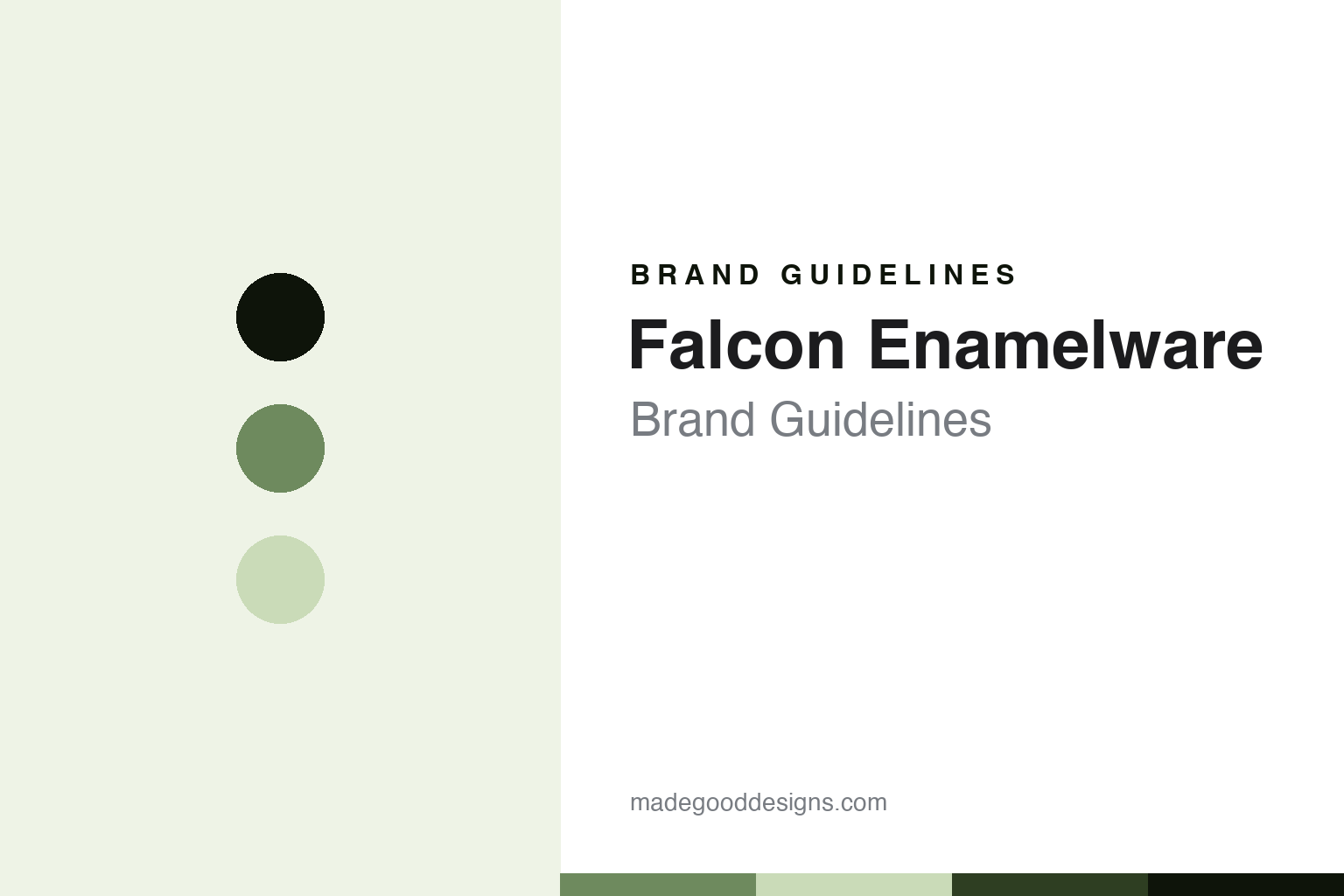
Falcon Enamelware Brand Guidelines
The white-and-blue-rim icon.
Aa
Two constants: a samphire-green palette and a utility-enamel-sans register. Abstract homage — not a Falcon product or mark; no mug silhouette, no white-and-blue-rim colourway, and no logo is reproduced.
The white-and-blue-rim icon
Falcon Enamelware is the British white-with-blue-rim icon, revived from a 1920s name, with its making undisclosed.
Falcon brings the round its icon — the British enamelware name, from the nineteen-twenties, revived in 2011, whose ice-white body and blue rim are among the most recognised in the category, across mugs, jugs, tumblers and baking dishes. Falcon makes enamelware and only enamelware, and its answer to a round about the enamel object is an identity — a white-and-blue-rim look so clear it needs no logo. A brand, icon.
Its identity is the white-and-blue-rim icon. The recognisable colourway, the revived heritage and the undisclosed making are the story here. A brand, icon. The white-and-blue-rim icon.
(Honest notes, so the story stays precise, and the gaps stay honest. Falcon Enamelware, at falconenamelware.com, makes vitreous enamelware — mugs, jugs, tumblers, pie and baking dishes — with the classic mug as its hero, and we report its performance language as the brand’s own marketing. It began in the nineteen-twenties, associated with the maker Joe Kleiner and Sons, in the Black Country near Birmingham, and was revitalised in 2011 with new colours and a thicker-gauge classic mug. On where it is made, the star theme of this round, its manufacturing country is not stated on its own site — the revived brand is designed in England, but the current country of manufacture is not disclosed, so we do not assert it, and while it is widely reported to be made overseas we report that as “not disclosed” rather than hard-state a country we could not confirm. On who owns it, a theme of this round, its current owner is not disclosed either — a revived heritage name under undisclosed ownership. Its designs — including its white-and-blue-rim colourway — are IP we describe but do not reproduce; there is no official brand hex; these tones are an unofficial interpretation.)
Colour
Falcon lives, here, in a samphire green. Click a swatch to copy the hex.
Falcon’s identity is icon, revived and undisclosed — a samphire green, an ink, a pale sage, a deep moss, and a paper. We deliberately show it in a samphire green rather than its signature white-and-blue rim, because that colourway is the brand’s own trade dress: the palette here nods to the enamel category, not to Falcon’s mark. It signals an enamel icon without copying one. The honest caveat: with no published brand hex, these values are an original, unofficial interpretation, and pointedly not the brand’s signature colours.
The lesson is a samphire green signals an icon, revived identity. Falcon’s world is a glazed, fired object. For designers, it is a reminder that a category tone can stand in for a famous colourway without copying it — the tone of enamel, not of a specific rim. Because these tones can fail as small text, keep type dark and let the colour live in the accents, palette and band. The takeaways: build a recognisable look; report the making as undisclosed; name the ownership as undisclosed; and treat any single hex as unofficial.
Typography
The register is a utility-enamel sans — icon, plain, revived.
Falcon’s identity carries an icon, plain, revived spirit — a recognisable utility brand, not a graphics label. A utility-enamel sans captures the mood: clean, plain and confident, the register of a classic enamel mug. Set in a samphire-green palette, the utility-enamel sans feels icon and revived — exactly the personality Falcon carries. It is a glazed object rather than a logo, mirroring vitreous enamel fused to steel. (Falcon’s real pieces and its white-and-blue-rim colourway are things we describe but do not reproduce, and the exact typeface is not ours to use.) Because it is not ours to use, the honest description is “a utility-enamel-sans icon,” shown here in a stand-in. The type behaves like the brand: icon, plain and revived.
Aa
A utility-enamel-sans icon — icon and revived. (Specimen set in Work Sans, a utility-enamel-sans STAND-IN; NOT the Falcon logo, colourway or any mug.)
The enamel
Falcon Enamelware stands for the white-and-blue-rim icon.
Falcon brings the round its icon. A samphire-green palette, a utility-enamel sans and a revived 1920s name make one thing — the white-and-blue-rim icon — the whole identity: icon, revived and undisclosed. The recognisable colourway is the pitch, and the undisclosed making is the honest gap. The point is a look so clear it needs no logo, on a name brought back from the nineteen-twenties.
Put to work, the identity is an icon told straight, as an honest gap — with the making left undisclosed and the colourway not copied. A maker in this spirit would build a recognisable look, report the making as undisclosed, and name the ownership as undisclosed. A reader in this spirit would keep the facts right: Falcon makes vitreous enamelware — mugs, jugs, tumblers, pie and baking dishes — its classic mug the hero; it began in the nineteen-twenties, associated with Joe Kleiner and Sons in the Black Country near Birmingham, and was revitalised in 2011; its manufacturing country is not stated on its site, so no where-made claim is made, and its widely-reported overseas making is reported as “not disclosed” rather than hard-stated; and its current owner is undisclosed. Falcon sits with Crow Canyon on the origin-not-stated side of the round’s where-made thread, between the genuine foundries and the offshore Dansk. The honest editorial moves are to date it to the nineteen-twenties and 2011, to decline a where-made claim its site does not support, to name the ownership as undisclosed, and to show it in a stand-in colour rather than its signature rim.
For designers and brand-builders, Falcon continues the enamel: build a recognisable look — and report the making as undisclosed. The lessons: let a recognisable colourway be the brand, but do not copy it in commentary; decline a where-made claim a site does not support, even when the making is widely rumoured; name an undisclosed ownership as undisclosed; and never reproduce a mug or its signature rim. It is also a reminder to stay precise: Falcon Enamelware is the British white-with-blue-rim icon, revived from a 1920s name, with its making undisclosed — with the palette here an unofficial, deliberately-different interpretation. Read that way, Falcon is less a mug than an icon: recognisable, revived, undisclosed. The lesson for a brand is that a strong look and an honest gap can coexist, and declining an unverified where-made keeps the story earned. Falcon Enamelware made the-white-and-blue-rim-icon the identity — proof that a look can carry a brand, honestly reported.
Explore & save
Keep Falcon Enamelware’s identity on hand — save it to a board in the Made Good inspiration library.
Falcon Enamelware identity set
Pin the samphire-green palette and the utility-enamel-sans register to your own board.