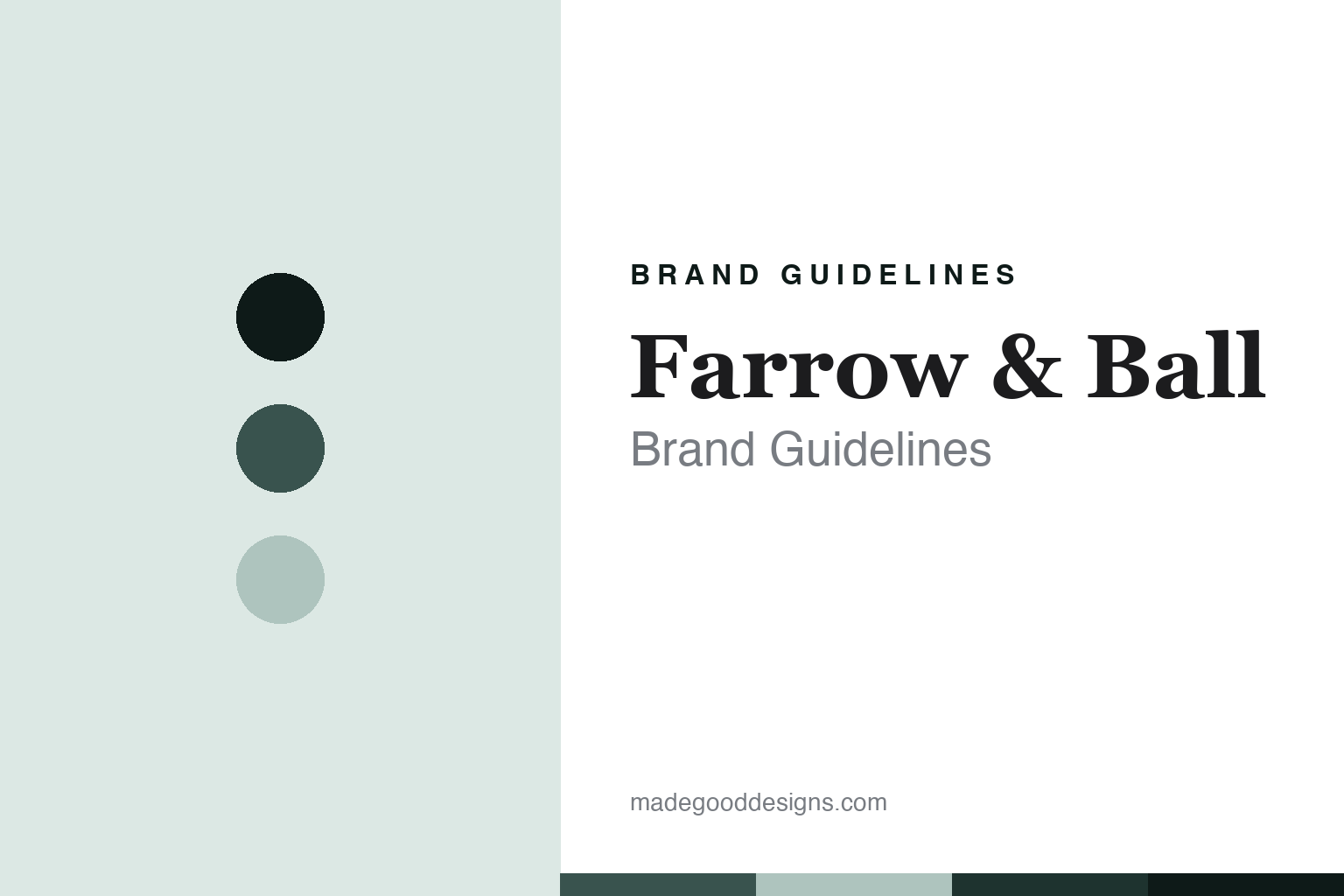
Farrow & Ball Brand Guidelines
English colour, Danish-owned.
Aa
Two constants: a heritage-green palette and a heritage-serif register. Abstract homage — not a Farrow & Ball product or mark; no paint tin, colour card or logo is reproduced.
English colour, Danish-owned
Farrow & Ball is the 1946 Dorset paint house famous for named, numbered colours — still handcrafted in Dorset and now owned by Denmark’s Hempel.
Farrow & Ball opens the paint round as its heritage-luxury node — an English paint house that built a global name on the names and numbers of its colours, still handcrafts every tin in Dorset, and is now owned by a Danish coatings group. Its answer to a round about who owns the paint and where it is made is a heritage-and-ownership one: a storied 1946 English maker, made at home, under a Nordic parent.
Its identity is English colour, Danish-owned. The named-and-numbered colours, the Dorset making and the Hempel ownership are the story here. Made in Dorset, owned in Denmark. English colour, Danish-owned.
(Honest notes, so the founding, the ownership and the making are framed accurately, with the ownership corrected. Farrow & Ball sells paint and wallpaper as its heroes — its curated, named and numbered colours and its Estate Emulsion finish; we report its language as the brand’s own. On origin: Farrow & Ball was founded in 1946 by John Farrow and Richard Ball in Dorset, England, with Wimborne its long-standing home, and we do not assert a founding town beyond Dorset. On headquarters and making: Wimborne, Dorset, where the company says every tin is handcrafted, genuine domestic British manufacturing. On ownership, corrected: Farrow & Ball is owned by Hempel, a Danish coatings group, which completed its acquisition on 3 September 2021, after the brand had passed from family ownership to European Capital in 2006 and the private-equity firm Ares Management in 2014, so we name Hempel as the current owner rather than an out-of-date one. On products: the brand is known for named colours such as Elephant’s Breath, Hague Blue and Railings and for a numbered colour system, and it states it was the first manufacturer to switch to fully water-based paints in 2010. On certifications, attributed to standards rather than health: its paints are water-based and low-VOC, its emulsions carry the lowest, Trace-VOC band, and certain fully water-based ranges are independently certified toy-safe to the EN 71-3 standard, which we frame as a toy-safe certification rather than a blanket health claim. Its name, logo, colour names, numbered system and colour cards are IP we describe but do not reproduce; there is no official brand hex; these tones are an unofficial interpretation.)
Colour
Farrow & Ball lives in a heritage green. Click a swatch to copy the hex.
Farrow & Ball’s identity is heritage-named, Danish-owned and genuinely Dorset-made — a heritage green, an ink, a pale sage, a deep green, and a paper. The palette leans heritage green and deep green: a muted, complex register that nods to the brand’s subtle, named colours rather than a loud logo colour. It signals English colour, Danish-owned — heritage-named, Danish-owned and genuinely Dorset-made. The honest caveat: with no official brand hex, and its colour names its own protected IP, these values are an interpretive, unofficial homage, not first-party colours.
The lesson is a muted heritage green signals a subtle, named-colour identity. Farrow & Ball’s world is the complex, named tone. For designers, it is a reminder that a muted green and a pale sage can carry a heritage, colour-led brand — a subtle tone held as an accent, not a reproduced swatch. Because a mid hue can fail as small text, keep type dark and let the colour live in the accents, palette and band. The takeaways: date the founding to 1946 in Dorset; correct the ownership to the Danish group Hempel since 2021; credit the genuine Dorset making; treat the named colours as protected IP to describe, not reproduce; and attribute the toy-safe EN 71-3 certification precisely.
Typography
The register is a heritage serif — heritage-named, Danish-owned, genuinely Dorset-made.
Farrow & Ball’s identity carries a heritage-named, Danish-owned, genuinely Dorset-made spirit — an English colour house under a Nordic owner. A heritage serif captures the mood: refined, editorial and characterful, the register of a premium colour brand. Set in a heritage-green palette, the heritage serif feels considered and quietly luxurious — exactly the personality Farrow & Ball carries. It behaves like a made, curated thing rather than a loud logo, mirroring a colour-chip and a tint-gradient. (Farrow & Ball’s real products, the name and the named colours are things we describe but do not reproduce, and the exact typeface is not ours to use.) Because it is not ours to use, the honest description is “a heritage-serif brand,” shown here in a stand-in. The type behaves like the brand: heritage-named, Danish-owned and genuinely Dorset-made.
Aa
A heritage-serif brand — considered and quietly luxurious. (Specimen set in Fraunces, a heritage-serif STAND-IN; NOT the Farrow & Ball logo, colour cards or products.)
The paint node
Farrow & Ball stands for English colour, Danish-owned.
Farrow & Ball opens the round as its heritage-luxury node. A heritage-green palette, a heritage serif and a 1946 founding make one thing — English colour, Danish-owned — the whole identity: heritage-named, Danish-owned and genuinely Dorset-made. The named colours are the pitch, the Dorset making is the pride, and the Hempel ownership is the twist. The point is a storied English maker under a Nordic parent, in a round about who owns the paint and where it is made.
Put to work, the identity is the brand told straight, the ownership corrected and the making credited. A brand in this spirit would date the founding to 1946 in Dorset, correct the ownership to the Danish group Hempel since 2021, credit the genuine Dorset making, and treat the named colours as protected IP. A reader in this spirit would keep the facts right: Farrow & Ball is known for named colours such as Elephant’s Breath and Hague Blue and a numbered system; it was founded in 1946 by John Farrow and Richard Ball in Dorset; it is owned by Hempel, a Danish coatings group, which acquired it in 2021 from Ares; it handcrafts its paint in Wimborne, Dorset; and its fully water-based ranges include some certified toy-safe to EN 71-3. Farrow & Ball opens the round, before Benjamin Moore. The honest editorial moves are to date the founding, to correct the ownership, to credit the making, and to attribute the certification.
For designers and brand-builders, Farrow & Ball opens the paint node: build a brand on colour NAMES — and correct an out-of-date owner. The lessons: a brand can turn colour into intellectual property, here Farrow & Ball’s named and numbered colours; a founding is dated to 1946 in Dorset by John Farrow and Richard Ball, with the founding town kept to Dorset rather than an unverified village; an ownership is corrected to the Danish coatings group Hempel since 2021, rather than the outdated assumption of a private-equity or design-group owner, with the Ares era kept as prior; a making is credited as genuine handcrafting in Wimborne, Dorset; and eco claims are attributed to standards, water-based, Trace-VOC, and certain ranges toy-safe to EN 71-3, rather than blanket health claims. It is also a reminder to stay precise: Farrow & Ball is the Hempel-owned, Dorset-made heritage paint brand — with the palette here an unofficial interpretation and the named colours described rather than reproduced. The hook is that IP: Farrow & Ball built a global luxury on the names and numbers of its colours, still handcrafting every tin in Dorset, now owned by Denmark’s Hempel. Read that way, Farrow & Ball is less a single paint than English colour, Danish-owned: heritage-named, Danish-owned, genuinely Dorset-made. The lesson for a brand is that owning the names of colours and correcting the owner reinforce each other, and crediting the making keeps the story earned. Farrow & Ball made English-colour-Danish-owned the identity — proof that named colour can open a round.
Explore & save
Keep Farrow & Ball’s identity on hand — save it to a board in the Made Good inspiration library.
Farrow & Ball identity set
Pin the heritage-green palette and the heritage-serif register to your own board.