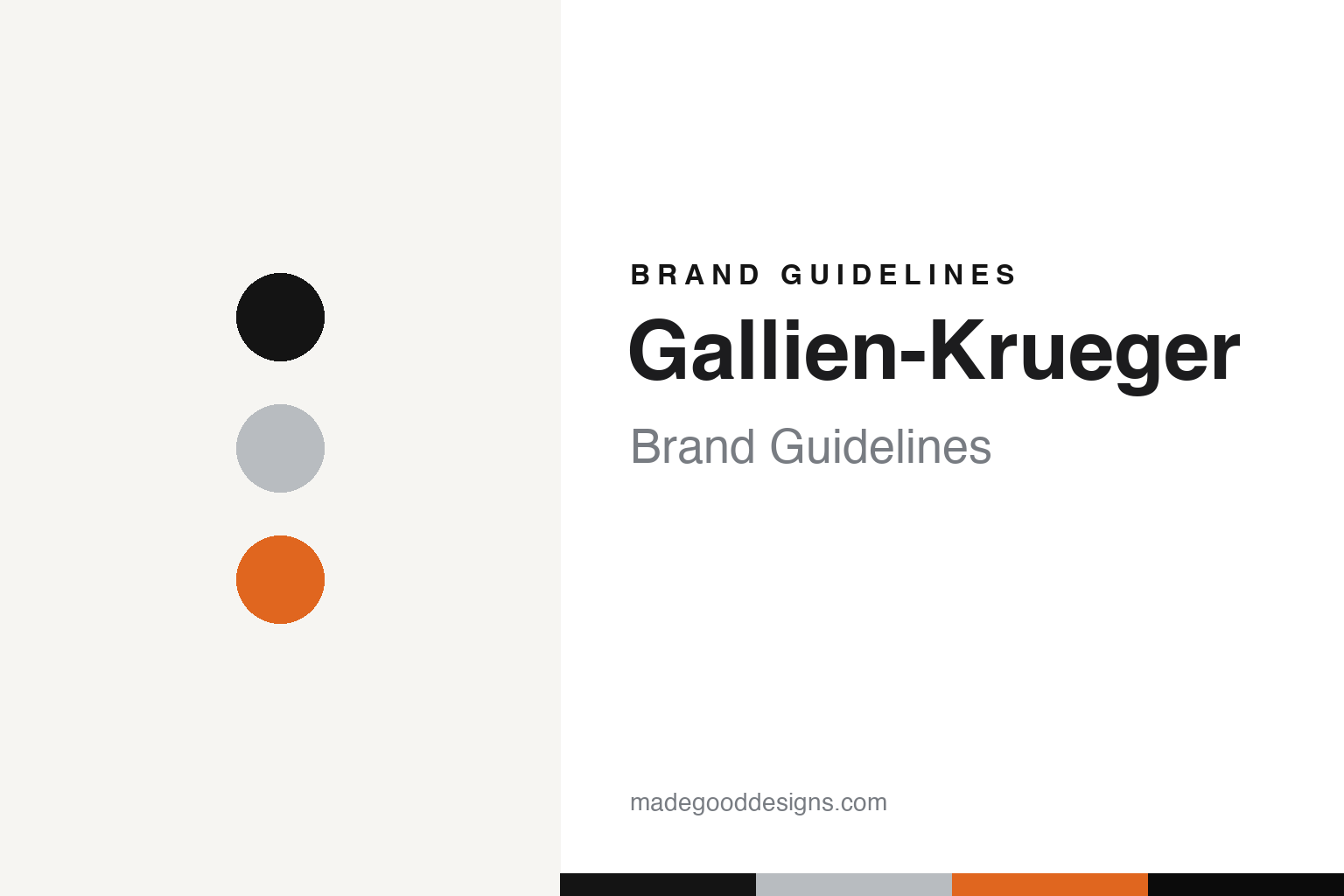
Gallien-Krueger Brand Guidelines
The garage-built bass amp that became an industry standard.
Aa
Two constants: a Gallien-Krueger black, grey and orange palette and an engineering sans register. Abstract homage — not a Gallien-Krueger product or mark; no amplifier, logo or nameplate is reproduced.
GMT
One engineer, one garage, one amplifier.
Gallien-Krueger began with one man rather than two. The company says that “on a sunny afternoon in 1968” Robert “Bob” Gallien walked into his local music store carrying an amplifier he had built in his garage, and that a local club musician named Carlos Santana bought it the next day and took it to Woodstock. English and French Wikipedia place the garage in San Jose, California, and give the company’s first name as GMT; English Wikipedia says Gallien was then working as an engineer at Hewlett-Packard. The firm’s own timeline lists the GMT 226A of 1969 as “the most powerful amp of its day.”
The second name came later. Both Wikipedias say that in the early 1970s Gallien teamed up with the engineer Rich Krueger — a fellow HP engineer, according to the English article — and the company was renamed Gallien-Krueger; Krueger is no longer involved, though his name stayed. Some summaries, including the English Wikipedia infobox, list both men as founders in 1968, which the company’s own account does not support: its FAQ says Gallien-Krueger “started in the garage of our founder, Bob Gallien, in 1968.” The NAMM Oral History Program, which interviewed Gallien in January 2007, lists him as founder and describes him as co-founder of Gallien-Krueger.
Gallien frames himself as an engineer first. “I’m a Stanford educated engineer who worked my way through school as a musician,” he says on the company’s history page, adding that he does not model his designs on other makers’ products. The same page still calls him “Founder and President,” and, as English Wikipedia notes, the logo reads simply GK.
Colour
A timeline of firsts.
The company’s timeline reads as a list of firsts, which we give as its claims. It says the GMT 600B of 1971 was the first instrument amplifier in a metal enclosure and a favourite of “groups like Led Zeppelin”; the GMT 200G of 1974 the first guitar amp with channel switching; the GK 400B of 1975 the first bass amp with a Contour control; and the 200RB of 1981 the first rack-mountable instrument amp.
The model that defined the brand followed. GK dates the 800RB to 1982 — English Wikipedia gives 1983 — and calls it the first instrument bi-amp, the first with a DI output and the first with a removable mains cord, as well as “the most sought after bass amp of the 80’s.” Universal Audio, which sells a plug-in emulation developed by Brainworx, says the 800RB was used on records by the Red Hot Chili Peppers, Radiohead, No Doubt and Guns N’ Roses, and describes its two power amps — one for the lows, one for the highs — split by an adjustable crossover, along with GK’s patented voicing filters.
Smaller formats followed: the 250ML of 1983, which the company describes as 100 watts of stereo power with studio effects in a “lunch-box” enclosure; the 200MB of 1984; the 2000RB of 1995, which GK calls the first 1,000-watt bass head; the Backline 250BL of 2001, by its account the first channel-switching bass amp; and the MB200 of 2011, billed as the world’s smallest and lightest 200-watt bass amp. English Wikipedia says the company stopped making guitar amplifiers in the early 1990s.
Players named by English Wikipedia include Flea of the Red Hot Chili Peppers, Duff McKagan, Tom Hamilton of Aerosmith and Ted Dwane of Mumford & Sons. Jean-Michel Guesdon and Philippe Margotin’s book Pink Floyd All the Songs says David Gilmour used a Gallien-Krueger when recording “Sorrow” and “Learning to Fly.”
Typography
Bass amplification and its owners.
The seven makers here were founded across five decades. Gallien-Krueger is the oldest: Robert Gallien began building amplifiers in his garage in San Jose, California, in 1968, English Wikipedia says. It is now based in Stockton, California, and Wikipedia lists it as privately held.
Eden was founded in 1976 by David Nordschow in Montrose, Minnesota. English Wikipedia says it passed to U.S. Music Corporation in 2002 and to Marshall in 2011, and that in March 2021 the British retailer Gear4music bought the brand and its assets; it gives Eden’s headquarters as York.
Trace Elliot grew out of a music shop in Romford, Essex, at the end of the 1970s; English Wikipedia names Peavey Electronics Europe as its parent, and its products are listed on Peavey’s website. Ashdown was founded in 1997 by Mark Gooday, Trace Elliot’s former managing director, and is based at Heybridge in Essex; since July 2024 the UK companies register has recorded the French music group Algam as its controlling shareholder.
Hartke traces its aluminium-cone speakers to Larry Hartke and Ron Lorman, the company says, and its website carries the names of Samson Technologies and Samson Distribution. Aguilar speaks of its “deep New York City roots.” Darkglass was founded in Helsinki in 2009 by Douglas Castro and Hugo Villarroel, English Wikipedia says. Both now sit with Korg USA: it announced the acquisition of Aguilar in January 2021, and bought a controlling stake in Darkglass in May 2022, Guitar World reported.
This guide sets out what can be checked about each brand — who founded it, who owns it, and what it says about where its products are made — and marks clearly what rests only on the company’s own word.
Aa
An engineering sans — a brand known by two letters, GK. (Specimen set in Archivo, a sans STAND-IN; NOT the Gallien-Krueger logo.)
Gallien-Krueger
Still in Stockton, it says.
Unlike many bass-amp names, Gallien-Krueger has no documented change of ownership in the sources we checked. English Wikipedia lists it as a private company with no parent, the company’s website names none, and it still presents Bob Gallien as founder and president. We also checked Yamaha Guitar Group, which owns Ampeg: its website lists Yamaha, Line 6, Ampeg, Córdoba, Guild, HumiCase and DeArmond as its brands, and Gallien-Krueger is not among them.
The company is based in Stockton, California. On where its amplifiers are made it is direct: asked whether GK products are made in the United States, its FAQ answers, “Yes, we design, manufacture, and ship our products from our factory in Stockton, California,” and says “all of our speakers” are made there too; its history page claims “uninterrupted U.S. production for over 40 years.” We give those as the company’s claims. The current range runs from the RB Legacy and Fusion S heads — the Fusion S with what GK calls a six-stage tube preamp — to MB and MicroBass combos, Neo IV and CX cabinets and the Plex preamp pedal, and the company has publicised Keanu Reeves of Dogstar playing a Fusion 1200S and an RB Legacy head.
For a design guide, Gallien-Krueger shows how a brand built on engineering firsts can let its model numbers carry its identity: 800RB, 250ML and 200MB say more than any slogan. Compare Ampeg, the American bass-amp name now in Yamaha’s guitar group, and Markbass, the Italian maker of lightweight bass amps. For this guide we use black, aluminium grey and a signal orange with a sans, an unofficial interpretation; no product or logo is reproduced.
Explore & save
Keep Gallien-Krueger’s identity on hand — save it to a board in the Made Good inspiration library.
Gallien-Krueger identity set
Pin the Gallien-Krueger black, grey and orange palette and the engineering sans register to your own board.