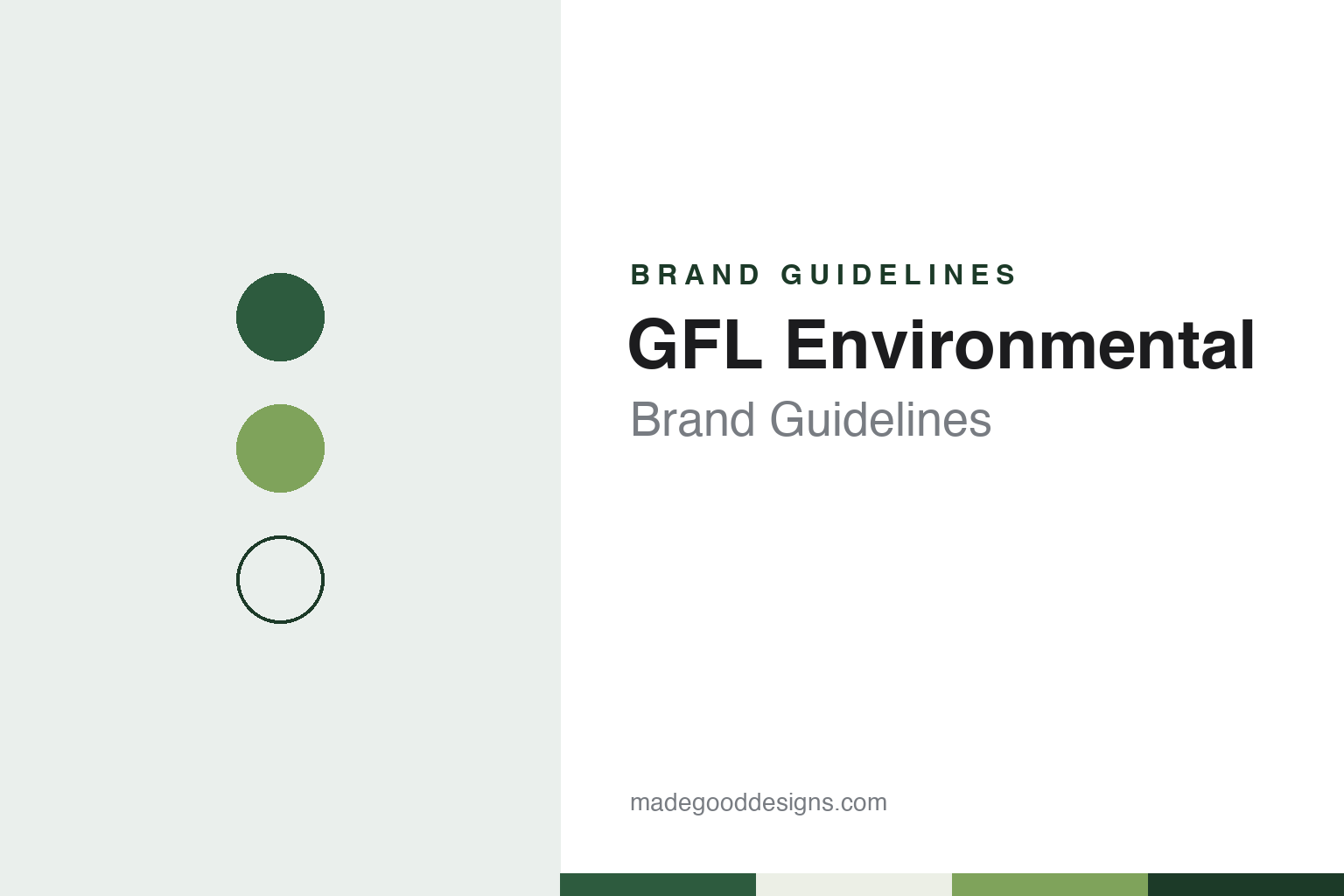
GFL Environmental Brand Guidelines
Three letters for Green For Life, from Vaughan to Miami Beach.
Aa
Two constants: a GFL Environmental green and sage palette and an industrial grotesque register. Abstract homage — not a GFL Environmental asset or mark; no truck, logo or wordmark is reproduced.
Green For Life
An initialism, a founder and a string of Ontario mergers.
GFL Environmental takes its name from an initialism: GFL stands for Green For Life, according to English Wikipedia. The company was founded in 2007 in Vaughan, Ontario, by Patrick Dovigi, who still leads it as founder and chief executive, GFL’s own press releases say. English Wikipedia describes the starting point as a merger of several Ontario environmental-services firms, among them Direct Line Environmental, National Waste Services and Enviro West, put together by a founder who wanted to combine smaller Canadian waste companies into one group.
The first years were built on acquisitions inside Canada. English Wikipedia lists Turtle Island Recycling in Toronto in 2011; the waste-collection business of Contrans Group in 2014, which brought GFL to Edmonton and Slave Lake in Alberta; and, the same year, the business that Waste Management ran in Nova Scotia, New Brunswick and Newfoundland and Labrador. In February 2016 GFL completed the purchase of Matrec, the waste division of the Montreal-based TransForce, which English Wikipedia calls the largest acquisition in the company’s history at that point and which took GFL into Quebec and eastern Ontario.
Municipal contracts gave the name a public face. In 2011 GFL won a seven-year contract to collect household garbage from roughly 165,000 homes in west Toronto, between Yonge Street and the Humber River, English Wikipedia says; collection began in August 2012. Halifax awarded it three residential contracts in January 2015, and Windsor, Ontario, which first contracted GFL in 2010, kept it on in 2016 for a further seven years. Alongside collection, GFL excavated the site of the Pan Am Aquatics Centre in Toronto, which opened for the 2015 Pan Am Games, and bought Anchor Shoring Group in January 2016.
Colour
South into the United States, then a narrower focus.
The move south began in September 2016, when GFL bought Rizzo Environmental Services of Michigan, which collected for more than 40 municipalities in southeast Michigan and northern Ohio, according to English Wikipedia. In October 2018 it announced the purchase of Waste Industries; in July 2019 it bought Soil Safe, a Maryland company that turns contaminated soil into an engineered soil product; and in August 2020 it announced the acquisition of WCA Waste Corporation of Houston, completed on 1 October 2020, which took GFL into 11 more states, with regional operations centred on Texas, Missouri and Florida.
The company went public in March 2020 with an initial public offering on the Toronto Stock Exchange, English Wikipedia says; its press releases now give listings on both the New York Stock Exchange and the TSX under the ticker GFL. Further deals followed: Terrapure Environmental in August 2021, without its battery-recycling business, and Sprint Waste Services, with assets in Texas and Louisiana, in May 2022. In April 2022 GFL, funds managed by HPS Investment Partners and Patrick Dovigi set up Green Infrastructure Partners, an infrastructure group that English Wikipedia links to GFL’s 2022 purchase of Coco Paving and its affiliates.
From 2025 GFL narrowed its focus to solid waste. On 7 January 2025 it announced an agreement to sell its Environmental Services business to funds managed by affiliates of Apollo and by BC Partners, keeping an equity stake, and on 3 March 2025 it said the sale had closed. In August 2025 it announced that Green Infrastructure Partners would be recapitalised with investment from funds managed by Energy Capital Partners, with GFL keeping a minority interest. Waste Dive reported in February 2026 that GFL had spun off its environmental-services division and sold a significant stake in Green Infrastructure Partners the year before, while keeping a stake in each.
Typography
Collection, recycling and the language of waste firms.
Waste and environmental-services companies speak to several audiences at once. A household wants a pickup day and a holiday calendar; a town council wants a collection contract; a hospital wants a compliant route for regulated medical waste; investors want results and a sustainability report. Their websites tend to separate those audiences into service pages: residential and commercial collection, recycling, roll-off containers, landfills and transfer stations, special and hazardous waste, medical waste and document shredding.
The plants are named the way the companies describe them. Waste Connections’ 2026 sustainability report speaks of collecting and treating landfill biogas for “beneficial use” and of a growing network of renewable natural gas facilities; trade coverage such as Waste Dive reports these plants, along with leachate-treatment systems, through quarterly results and project announcements. Where this guide uses terms such as recycling operation, energy-from-waste plant or landfill-gas plant, it follows the wording of the company or of a dated report, and environmental claims are given as the company’s own description.
Much of a waste brand is seen on the street rather than on a screen: on collection trucks, containers and depots, and in the photography of fleets and yards that fills sustainability reports. Mobile apps now carry part of the load, sending collection reminders and service alerts, as Waste Connections says its WasteConnect app does. Greens, blues and ambers recur in this guide’s own palettes for the sector; those palettes are unofficial interpretations, not company colours, and no truck livery, logo or mark is reproduced.
Ownership matters as much as identity. Large groups grow by buying local haulers, and specialist names often survive inside them: Stericycle, the medical-waste company bought by WM in 2024, now forms WM’s Healthcare Solutions business. Each guide sets out who founded a company, who owns it now and what rests only on the company’s own word.
Aa
An industrial grotesque — a register for route sheets and depot signs. (Specimen set in Archivo, a sans STAND-IN; NOT the GFL Environmental logo.)
GFL Environmental
A Canadian company with a Florida headquarters.
In January 2026 the company changed its address. On 21 January GFL said it had moved its executive headquarters from Vaughan to Miami Beach, Florida, while remaining incorporated in Ontario and keeping shared-services hubs in Vaughan and in Raleigh, North Carolina. It gave two reasons: wider eligibility for United States share indices, and a business in which, it said, the United States produced more than two thirds of revenue. Waste Dive reported the move the following month, noting that GFL kept its offices in Canada. On 25 June 2026 GFL said it had joined the Russell 1000 and Russell 3000 indices.
The acquisitions continued. On 1 September 2026 GFL closed the purchase of SECURE Waste Infrastructure, welcoming more than 2,000 SECURE employees, it said. In its October 2026 releases GFL described itself as “the fourth largest diversified environmental services company in North America,” working from facilities across Canada and 19 U.S. states with more than 17,000 employees. On 8 October 2026 it said its Montréal-East material recovery facility had won the National Waste & Recycling Association’s 2026 Recycling Facility of the Year award, the third time since 2020 that one of its sorting plants had received it, by the company’s count. On 10 November 2026 GFL said a special committee of its board had reviewed unsolicited proposals to take the company private, and that the board had decided unanimously that GFL would remain a public company.
The name carries a statement in three capital letters: “Green For Life,” shortened to GFL in the company’s ticker and throughout its press releases. When Waste Dive covered WasteExpo 2025 in Las Vegas, its photograph showed a GFL truck on display outside the convention hall.
For a design guide, GFL Environmental shows how a three-letter initialism can carry a company through two decades of acquisitions and a move across a border. Compare Waste Connections, another North American solid-waste company, and WM, whose Atlantic Canada business GFL bought in 2014. For this guide we use a deep green, a moss green and a pale sage with a sans, an unofficial interpretation; no product or logo is reproduced.
Explore & save
Keep GFL Environmental’s identity on hand — save it to a board in the Made Good inspiration library.
GFL Environmental identity set
Pin the GFL Environmental green and sage palette and the industrial grotesque register to your own board.