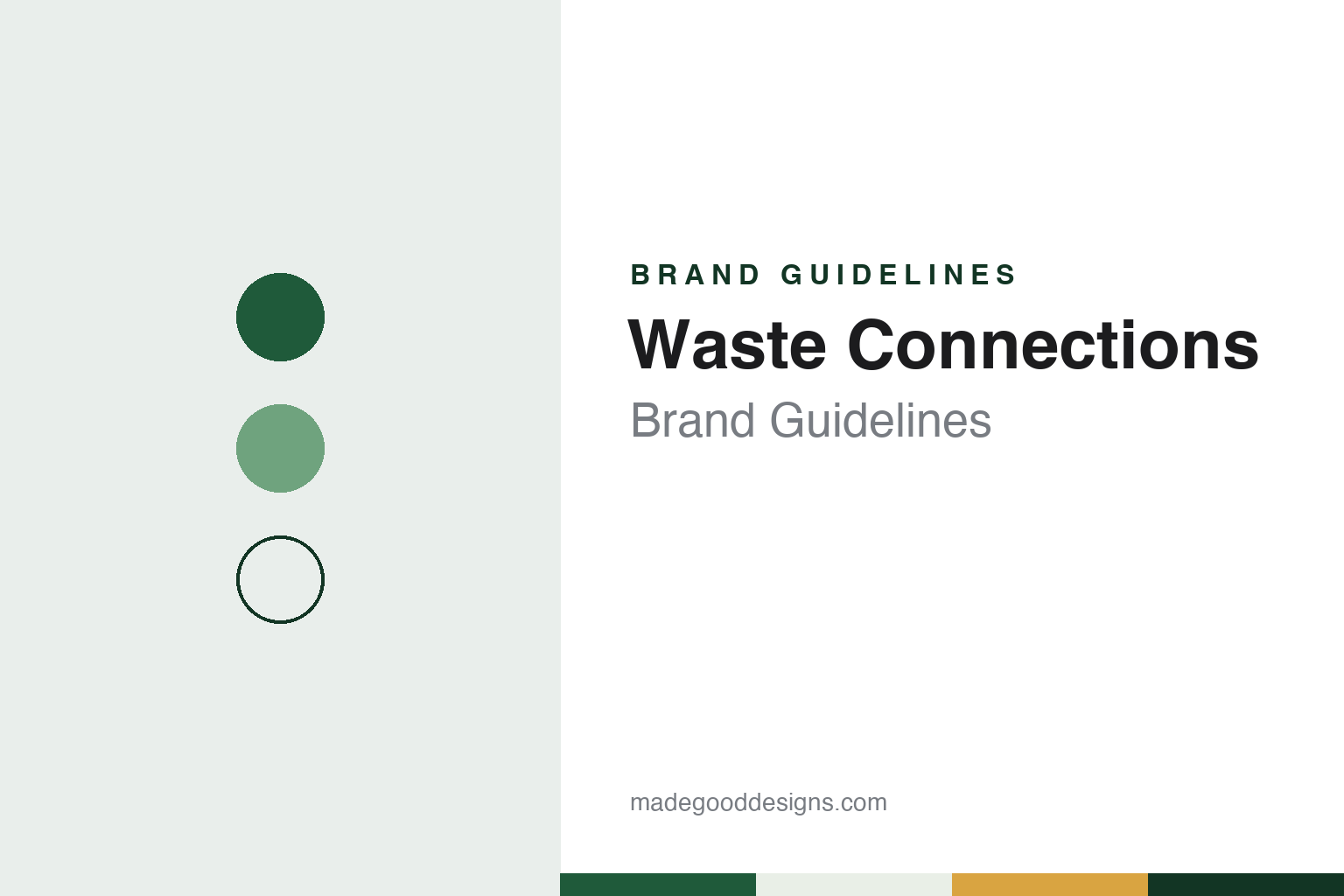
Waste Connections Brand Guidelines
A 1997 Folsom start that became a cross-border waste company.
Aa
Two constants: a green, sage and amber palette and a utility sans register. Abstract homage — not a Waste Connections asset; no truck, logo or mark is reproduced.
Folsom
Four founders and a fast listing.
Waste Connections began in 1997 in Folsom, California, east of Sacramento. English Wikipedia says it was founded by a group with experience in the industry in Washington and Idaho: James Cutler, Brad Bishop, Frank Cutler and Ron Mittelstaedt. Mittelstaedt is still president and chief executive, according to the company’s 2026 sustainability report and to Waste Dive’s coverage of its results in July 2026.
The company moved quickly. Within about a year of its founding it went public, with an initial public offering in May 1998, English Wikipedia says. It then grew through acquisitions, first in California and the western United States; by 2011, according to the same article, it had operations in 32 states.
In December 2011 Waste Connections announced that it would move its headquarters from Folsom to The Woodlands, Texas, north of Houston, English Wikipedia says, citing McClatchy. In September 2012 it bought R360 Environmental Solutions, a Texas company that handled waste from the oil industry, which gave it the non-hazardous oilfield waste business it still describes on its website.
The company’s own description of itself is local. Its About page says that “the solid waste service business is a local business managed by professionals living and working in the communities we serve,” and gives its aim as helping customers, employees and shareholders “Connect with the Future.” Its statement of values ends with the line that it remains “a different breed.”
Colour
Collection, landfills and gas.
Waste Connections describes itself as a provider of solid-waste collection, transfer, recycling and disposal services “in mostly exclusive and secondary markets across the US and Canada.” In Waste Dive’s report of July 2026, the company’s finance chief set its mostly exclusive Western region against what she called its competitive region. Its website lists residential pickup, roll-off containers, compactors, portable toilets, landfills and transfer stations, special-waste and e-waste disposal, and coal-ash work, alongside intermodal rail services for cargo and waste containers in the Pacific Northwest.
English Wikipedia says the company ran 82 solid-waste landfills as of September 2019, and that most of its work comes from municipal contracts and from direct service to homes and businesses. On its About page the company says it has more than 80 recycling operations, which it says processed more than two million tons of fibre, metals and plastics, and that it uses about 50 recycling robots.
Landfill gas is a growing part of the story. The 2026 sustainability report describes collecting and treating landfill biogas for beneficial use and an expanding network of renewable natural gas plants. In July 2026 Waste Dive reported Mittelstaedt as saying that about a third of the planned RNG portfolio was running, that a new plant had come online that month, and that all of them were expected to be operating by early 2027.
Leachate is another theme. Waste Dive reported on 7 July 2026 that the company planned a foam-fractionation system to treat PFAS in leachate at its Anson Landfill in Polkton, North Carolina, due online by the end of 2026, similar to one already installed at its Bethlehem Landfill in Pennsylvania. One landfill has drawn long regulatory attention: the Chiquita Canyon Landfill in Los Angeles County, where an elevated subsurface temperature event began in 2022. The site stopped taking waste in 2025, and in June 2026 a Waste Connections subsidiary sued the county over the closure, while the county’s own 2024 suit against the operator was still under way, Waste Dive reported in August 2026.
Typography
How the sector presents itself.
Waste and environmental-services companies speak to several audiences at once. A household wants a pickup day and a holiday calendar; a town council wants a collection contract; a hospital wants a compliant route for regulated medical waste; investors want results and a sustainability report. Their websites tend to separate those audiences into service pages: residential and commercial collection, recycling, roll-off containers, landfills and transfer stations, special and hazardous waste, medical waste and document shredding.
The plants are named the way the companies describe them. Waste Connections’ 2026 sustainability report speaks of collecting and treating landfill biogas for “beneficial use” and of a growing network of renewable natural gas facilities; trade coverage such as Waste Dive reports these plants, along with leachate-treatment systems, through quarterly results and project announcements. Where this guide uses terms such as recycling operation, energy-from-waste plant or landfill-gas plant, it follows the wording of the company or of a dated report, and environmental claims are given as the company’s own description.
Much of a waste brand is seen on the street rather than on a screen: on collection trucks, containers and depots, and in the photography of fleets and yards that fills sustainability reports. Mobile apps now carry part of the load, sending collection reminders and service alerts, as Waste Connections says its WasteConnect app does. Greens, blues and ambers recur in this guide’s own palettes for the sector; those palettes are unofficial interpretations, not company colours, and no truck livery, logo or mark is reproduced.
Ownership matters as much as identity. Large groups grow by buying local haulers, and specialist names often survive inside them: Stericycle, the medical-waste company bought by WM in 2024, now forms WM’s Healthcare Solutions business. Each guide sets out who founded a company, who owns it now and what rests only on the company’s own word.
Aa
A plain utility sans for routes, depots and reports. (Specimen set in Archivo, a sans STAND-IN; NOT the Waste Connections logo.)
Waste Connections
A merger that moved a home base north.
The largest step came in 2016. In January 2016 Waste Connections agreed to combine with Progressive Waste Solutions of Canada; English Wikipedia, citing Reuters, says Waste Connections shareholders received 70 per cent of the combined company, which moved its tax headquarters to Canada. The combination went ahead, and the Canadian business was later renamed Waste Connections of Canada, and the shares trade in Toronto under the symbol WCN.
Growth by acquisition has continued. English Wikipedia, citing Waste Dive, says the company completed 24 acquisitions in 2024 and 13 in 2023, including Royal Waste Services in New York City, and that the 2024 deals added 30 facilities in Canada. English Wikipedia calls it the third-largest waste company in North America. In 2026 the sustainability report counted more than 25,000 employees and more than 1,000 alternative-fuel vehicles in the fleet, and set out a vision the company calls “Connecting with a Sustainable Future,” built around people, planet and communities; the environmental aims there are the company’s own description.
Day to day, the brand reaches most customers through pickup schedules, holiday calendars and its WasteConnect mobile app, which the website says sends collection reminders and service alerts. The sustainability report sits on its own site, with a data hub alongside the full report.
For a design guide, Waste Connections shows how a company built from many local haulers presents a single name across two countries. Compare Republic Services, another large US collector, and GFL Environmental, its Ontario-based rival. For this guide we use a deep route green, a darker pine, sage and an amber with a sans, an unofficial interpretation; no product or logo is reproduced.
Explore & save
Keep Waste Connections’s identity on hand — save it to a board in the Made Good inspiration library.
Waste Connections identity set
Pin the Waste Connections green, sage and amber palette and the utility sans register to your own board.