Stericycle Brand Guidelines
A 1989 medical-waste company that grew into shredding and joined WM.
Aa
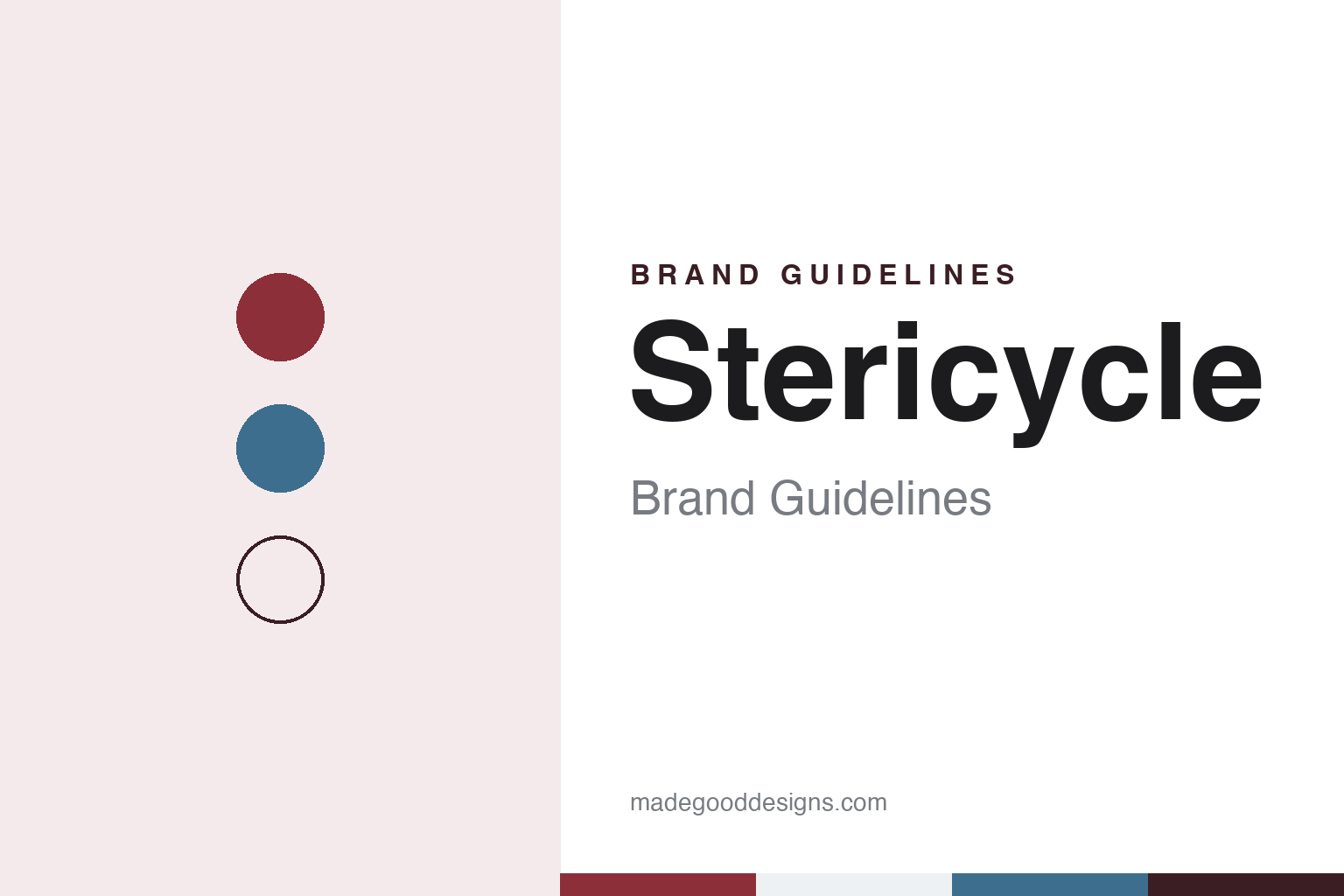
Two constants: a red, plum and blue palette and a clinical sans register. Abstract homage — not a Stericycle asset; no container, truck, logo or mark is reproduced.
A business plan
Medical waste becomes a regulated trade.
Stericycle was founded in 1989 by James Sharp, a doctor, on the basis of a business plan aimed at the medical waste that washed up on the shores of New York and New Jersey in the late 1980s, an episode English Wikipedia calls the “Syringe Tide.” That episode led to the Medical Waste Tracking Act, signed in 1988, which English Wikipedia says established regulated medical-waste management as an industry. The company’s head office is in Bannockburn, Illinois, north of Chicago.
English Wikipedia says the company grew quickly after Mark Miller became president and chief executive in 1992. It listed on NASDAQ in 1996, under the symbol SRCL, and began its international business in 1997 with a joint venture in Mexico. In 1999 it took on about 200,000 customers from Allied Waste Industries, after Allied bought Browning-Ferris Industries, and launched Steri-Safe, a compliance-training programme for healthcare workplaces.
The 2000s brought new lines of work. In 2003 Stericycle entered sharps-waste management by buying the business of Scherer Healthcare; in 2004 it began medical-waste work in the United Kingdom; in 2008 it bought its first hazardous-waste company; and in 2010 it started a communications business with the purchase of NotifyMD, English Wikipedia says. The 2014 purchase of PSC Environmental Solutions led to a separate unit, Stericycle Environmental Solutions, for hazardous waste.
Its core customers were hospitals, blood banks and drug makers, and a long list of small businesses: clinics, dental and veterinary practices, home-care agencies and body-art studios among them, according to the same article. Medical-device makers, consumer-goods manufacturers and retailers were other key customers, it adds.
Colour
Shred-it and a narrower focus.
In 2015 Stericycle bought Shred-it, the document-shredding company, in what English Wikipedia calls its largest acquisition. Shred-it added secure destruction of paper and hard drives to the medical-waste business, and it remained a separate brand: in Austria, Belgium, France, Germany, the Netherlands and Luxembourg, English Wikipedia says, only the shredding service was offered.
The company then narrowed. In 2020 it sold its environmental solutions division, the hazardous-waste unit built from the PSC purchase, to Harsco, now called Enviri, Waste Dive reported in June 2026. English Wikipedia lists a number of countries where Stericycle no longer operates, from Argentina and Brazil to Japan, Australia and Singapore, and says it kept full services in the United States, Canada, Ireland, Spain and Portugal.
Its services, as English Wikipedia lists them, cover regulated medical waste, sharps, pharmaceutical waste, drug disposal, hazardous waste in some markets, and compliance training delivered mainly through online courses. In spring 2022 it launched Safeshield, a medical-waste container for storage and transport, as part of a redesign that English Wikipedia says aimed to cut the number of container types from more than 150 to fewer than 20. In 2021 it began a reverse-logistics partnership for medical waste with UPS Healthcare.
Its earlier operations later drew a federal case. In June 2026, Waste Dive reported, Stericycle agreed a one-year deferred prosecution agreement with the US Department of Justice and a separate civil settlement with the Drug Enforcement Administration over how its former environmental solutions business handled controlled substances collected from pharmacies and hospitals between 2015 and 2020. The same report said Enviri was not party to the agreement.
Typography
How the sector presents itself.
Waste and environmental-services companies speak to several audiences at once. A household wants a pickup day and a holiday calendar; a town council wants a collection contract; a hospital wants a compliant route for regulated medical waste; investors want results and a sustainability report. Their websites tend to separate those audiences into service pages: residential and commercial collection, recycling, roll-off containers, landfills and transfer stations, special and hazardous waste, medical waste and document shredding.
The plants are named the way the companies describe them. Waste Connections’ 2026 sustainability report speaks of collecting and treating landfill biogas for “beneficial use” and of a growing network of renewable natural gas facilities; trade coverage such as Waste Dive reports these plants, along with leachate-treatment systems, through quarterly results and project announcements. Where this guide uses terms such as recycling operation, energy-from-waste plant or landfill-gas plant, it follows the wording of the company or of a dated report, and environmental claims are given as the company’s own description.
Much of a waste brand is seen on the street rather than on a screen: on collection trucks, containers and depots, and in the photography of fleets and yards that fills sustainability reports. Mobile apps now carry part of the load, sending collection reminders and service alerts, as Waste Connections says its WasteConnect app does. Greens, blues and ambers recur in this guide’s own palettes for the sector; those palettes are unofficial interpretations, not company colours, and no truck livery, logo or mark is reproduced.
Ownership matters as much as identity. Large groups grow by buying local haulers, and specialist names often survive inside them: Stericycle, the medical-waste company bought by WM in 2024, now forms WM’s Healthcare Solutions business. Each guide sets out who founded a company, who owns it now and what rests only on the company’s own word.
Aa
A clear clinical sans for labels, routes and compliance pages. (Specimen set in Public Sans, a sans STAND-IN; NOT the Stericycle logo.)
Stericycle
From NASDAQ to WM.
Stericycle’s years as a listed company ended in 2024. In June 2024 it accepted an offer from WM, the company formerly called Waste Management, and the purchase was completed in November 2024, making Stericycle a wholly owned subsidiary of WM, English Wikipedia says. Waste Dive described Stericycle in 2026 as operated by WM following that 2024 purchase.
Not everything went with it. In January 2025 the Spanish group Urbaser completed its purchase of Stericycle’s biosanitary waste businesses in Spain and Portugal, a deal announced in October 2024, English Wikipedia says.
Inside WM the business now reports as the Healthcare Solutions segment. On 28 October 2026 Waste Dive reported that the segment’s third-quarter revenue had risen year on year for the first time since the acquisition, according to WM’s executives, after earlier quarters with billing and systems problems that they said had largely been fixed. The executives expected volumes to recover in 2027, more slowly in medical waste than in the secure document destruction side that WM also acquired from Stericycle.
English Wikipedia describes Stericycle today as a WM subsidiary that also offers secure information destruction through Shred-it. English Wikipedia also records the company’s community work, including a medicine mail-back envelope called Seal&Send, distributed through programmes with the National Safety Council from 2018 and with the Rural Community Assistance Partnership in 2020.
For a design guide, Stericycle shows how a specialist service brand keeps its name after it is absorbed into a larger owner. Compare WM, its owner since 2024, and Clean Harbors, another US firm in regulated and hazardous waste. For this guide we use a muted red, a deep plum, a clinic blue and steel grey with a sans, an unofficial interpretation; no product or logo is reproduced.
Explore & save
Keep Stericycle’s identity on hand — save it to a board in the Made Good inspiration library.
Stericycle identity set
Pin the Stericycle red, plum and blue palette and the clinical sans register to your own board.