Ghurka Brand Guidelines
An American house, made across borders.
Aa
Two constants: a khaki palette and a field sans register. Abstract homage — not a Ghurka design or wordmark.
An American house, made across borders
Ghurka is a Connecticut house whose chestnut-leather-and-twill bags are made in the USA and abroad.
Ghurka is a lesson in the American house with a global workshop. Founded in Connecticut in 1975, it built its look on khaki twill and a warm chestnut leather, with a vintage, expeditionary spirit. Its answer to “where is the leather made?” is the honest, mixed one common to American heritage brands: an American house that makes some pieces in the United States and some abroad. A domestic name, a cross-border making.
Its identity is the expeditionary American house. Ghurka’s chestnut leather, its twill-and-leather pairing and its plainly mixed manufacturing are the picture it presents. A heritage, told with an honest map. A brand whose name nods to history and whose making spans several countries.
(Honest notes, so the story stays precise. Ghurka was founded in 1975 in Norwalk, Connecticut, by Marley Hodgson, whose designs drew on antique British-Gurkha regimental luggage; the name references the Gurkha soldiers of Nepal, a heritage we note with respect rather than appropriate. After several changes of hands, the brand is today under Cleveland-based ownership. On where it is made we are careful: production spans the United States and workshops abroad, in places such as Italy, Spain and South Africa, so the truthful description is “an American house made across borders,” not “made in the USA” alone. Its numbered-style marque and its designs are its IP, described but never reproduced, and there is no official brand hex — these tones are an unofficial interpretation. This is design commentary and does not promote any product.)
Colour
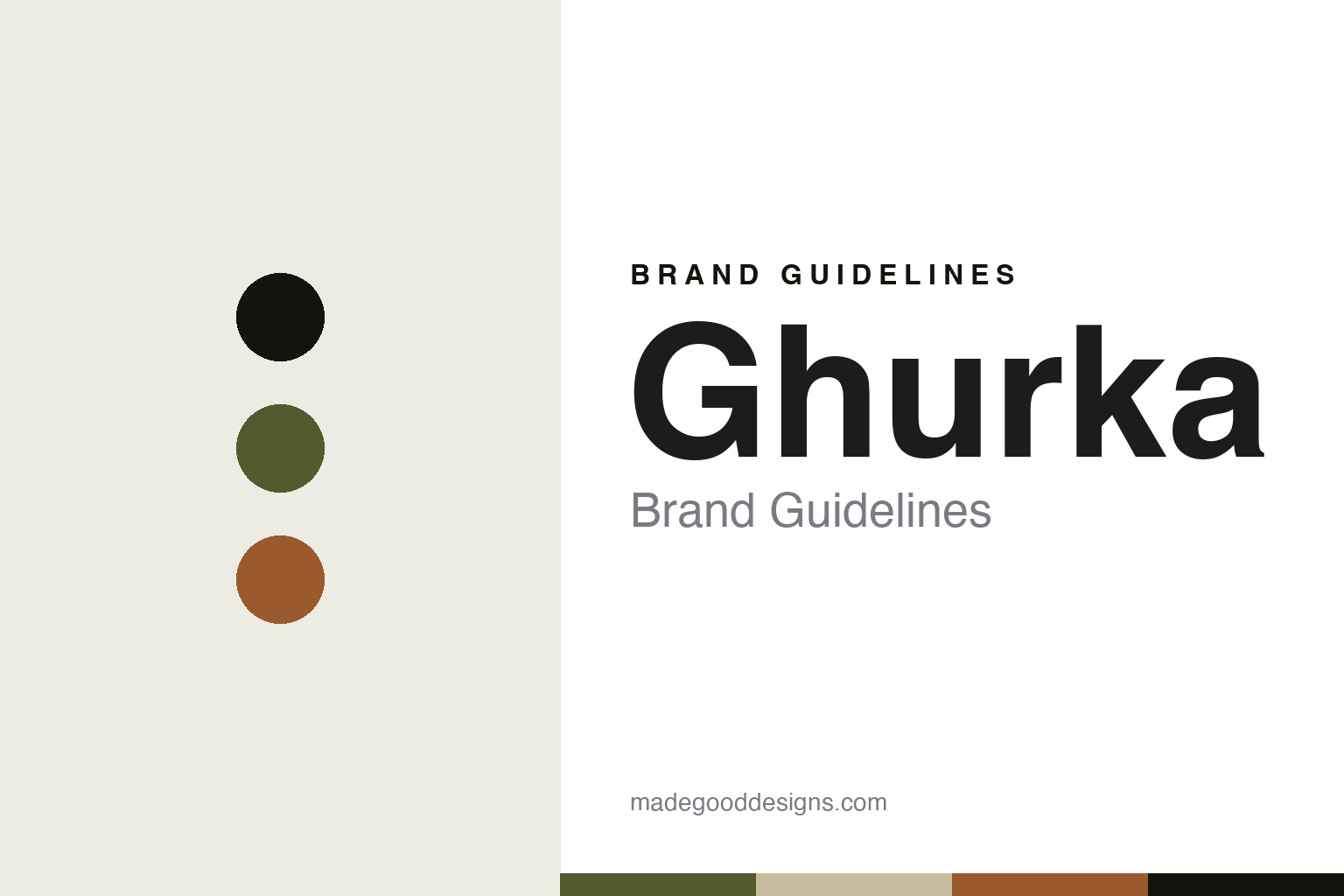
Ghurka lives in a khaki palette. Click a swatch to copy the hex.
Ghurka’s identity is expeditionary, warm and American — a khaki, an ink, a twill tan, a chestnut, and a chalk. The palette leans khaki and chestnut: the register of a twill-and-leather bag with a vintage, field spirit. It signals heritage and adventure over show. The honest caveat: with no published brand hex, these values are an original, unofficial interpretation, not first-party colours.
The lesson is a khaki palette signals an expeditionary, American identity. Ghurka’s world is a twill-and-chestnut, Connecticut-rooted, made-across-borders object. For designers, it is a reminder that a field khaki and a warm chestnut can carry a brand built on a look and a history — the khaki of a military twill and the chestnut of aged leather. Because these tones can fail as small text, keep type dark and let the colour live in the accents, palette and band. The takeaways: build a look; honour a history with respect; be honest where it is made; and treat any single hex as unofficial.
Typography
The register is a field sans — sturdy, upright, utilitarian.
Ghurka’s identity carries a sturdy, upright, utilitarian spirit — a field object, not a delicate one. A field sans captures the mood: solid, plain and confident, the register of an expeditionary American house. Set in a khaki palette, the field sans feels sturdy and upright — exactly the personality Ghurka carries. It is utilitarian rather than showy, mirroring a twill-and-leather bag built for travel. (Ghurka’s real designs and wordmark are things we describe but do not reproduce, and the exact typeface is not ours to use.) Because it is not ours to use, the honest description is “a field-sans spirit,” shown here in a stand-in. The type behaves like the maker: sturdy, upright and utilitarian.
Aa
A field-sans spirit — sturdy and upright. (Specimen set in Barlow, a field-sans STAND-IN; NOT the Ghurka wordmark or any bag design.)
Where the leather is made
Ghurka stands for the American house with a global workshop.
Ghurka is a lesson in being an American house honest about a global workshop. A khaki palette, a field sans and twill-and-chestnut bags carry an expeditionary heritage — while the making spans the United States and several countries abroad. The candour is the differentiator. The differentiator is a refusal to lean on the flag alone: an American-founded house that says its making crosses borders.
Put to work, the identity is honest geography as design. A maker building in this spirit would let a strong look and a real history carry the brand, be candid that production spans countries, and treat any historical reference with respect rather than as a costume, so the customer buys into a genuine story. It would keep the twill-and-leather look as its constant. It would name the countries it makes in rather than imply a single origin. The lesson Ghurka teaches is that an American heritage brand can be honest about a global workshop: the look gives it identity, and the candour gives it credibility. The heritage is the personality, and the honest map is the proof.
For designers and brand-builders, Ghurka offers a clear takeaway in this round about where the leather is made: a national identity and a global workshop can coexist — say so. The lessons: build a durable look; honour history respectfully; be honest about cross-border making; and never imply a single origin you do not have. It is also a reminder to stay precise: Ghurka is a Connecticut house founded in 1975 by Marley Hodgson, now Cleveland-owned, made across the US and abroad — with the palette here an unofficial interpretation. Ghurka made the honest global workshop the maker — proof that candour about origin can be the difference.
Explore & save
Keep Ghurka’s identity on hand — save it to a board in the Made Good inspiration library.
Ghurka identity set
Pin the khaki palette and the field-sans register to your own board.