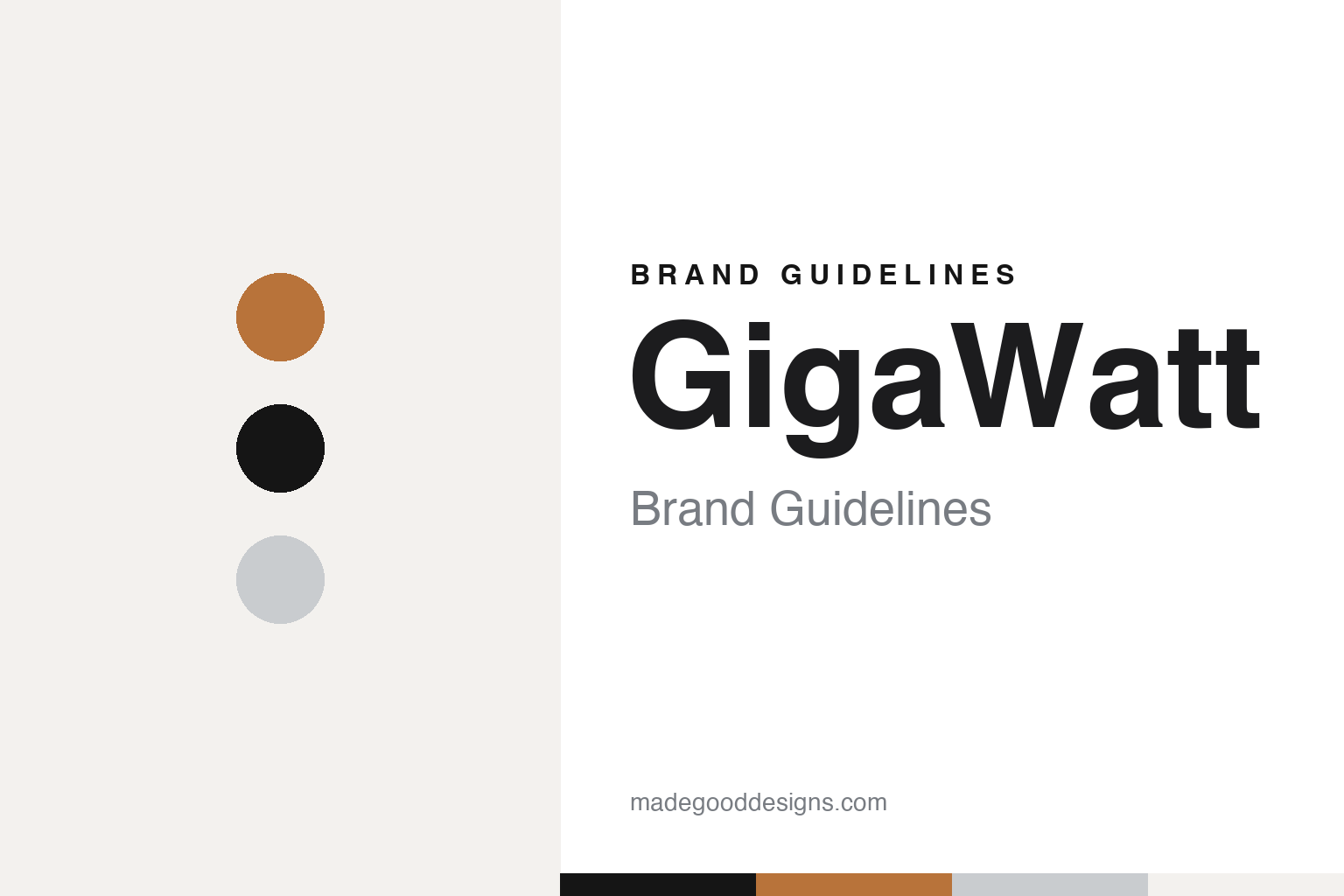
GigaWatt Brand Guidelines
The Zgierz specialist that makes power, and nothing else.
Aa
Two constants: a GigaWatt copper, silver and black palette and a technical sans register. Abstract homage — not a GigaWatt product or mark; no conditioner, socket, logo or nameplate is reproduced.
Power Audio Laboratories
From a basement in Łódź to Zgierz.
GigaWatt is a Polish maker of mains power conditioners, filtered power strips and power cables, and it makes nothing else — no amplifiers, sources or speakers, as the reviewer Dawid Grzyb noted on HifiKnights in 2018. The company styles its name with a capital W. Its products carry the address of P.A. Labs on Marii Skłodowskiej-Curie Street in Zgierz, a town bordering Łódź in central Poland, and the company says GigaWatt is a registered word-and-figure mark of P.A. Labs.
The company dates its history to 1998. Its founder, Adam Szubert, whom it describes as an electronics engineer and audio enthusiast, co-founded a firm called Power Audio Laboratories, or PAL, and was its chief designer. In a 2022 interview with Wojciech Pacuła of HighFidelity.pl, Szubert said the first conditioner was built because “in 1998 there was nothing like it on the market in Poland,” and that the first design office and assembly line were in the basement of an apartment block — “basement production,” he called it, since few people then had garages. The first unit was a large toroidal transformer packed into an off-the-shelf plastic case with two sockets. A year later PAL rented a room on Puszkina Street in an industrial district of Łódź and began building conditioners in its own metal cases, the Powerbox and Power AC families.
Szubert says showing at the Audio Show in Warsaw in 2002 made the firm known. In 2007, “for technical, organisational and premises reasons,” he told the magazine, the PAL brand ended and GigaWatt replaced it; HighFidelity.pl’s news item of 20 August 2007 described a new brand formed by separating PAL’s design and construction division. The Internet Archive’s first capture of gigawatt.eu, in December 2007, is an “under construction” page already giving the Zgierz address. In 2024 the magazine described Szubert as the owner and chief designer, and P.A. Labs as the owner of the brand; the sources we checked record no outside sale.
Colour
Copper bars, US breakers and slow upgrades.
GigaWatt began with three products, HighFidelity.pl reported: the PC-3 conditioner, developed from PAL’s Powerbox, and two filtered strips, the PF-2 and PF-1. The flagship PC-4, developed under the working name Powergate, appeared at the Audio Show in 2008, and the PF-2 received the magazine’s Award of the Year for 2008. The range has since grown to premium and “Compact” conditioners, strips, power cables and accessories such as anti-vibration feet. The top model, the PowerMaster, was presented at the High End show in Munich in May 2023; a limited PowerMaster 25th Anniversary Edition was tested by HighFidelity.pl in December 2024 at €33,000, with “Made in Poland” in the specification box.
The company describes its engineering in physical terms. It says all its devices distribute current through bars of solid polished copper, 30 square millimetres in section, designed and made in-house from oxygen-free and electrolytic copper of at least 99.99 per cent purity, with silver-plated bars in the top models, and that its largest conditioners use a hydraulic-magnetic breaker made in the United States by Carling to GigaWatt’s specification. In 2022 Szubert said the latest PC-4 had moved to a fully aluminium case.
Its pace is unusual. Reviewers note that GigaWatt revises existing models — EVO, EVO+, SE — rather than launching new ones each season. On HifiKnights in 2022 Marek Dyba wrote that the PowerPrime, the first of the Compact series, “introduced a new aesthetics, new look,” with a new front panel that the company said would set the direction for later models; the 12-socket PowerControl followed almost four years later, delayed by the pandemic and component shortages. Grzyb, reviewing the PC-3 SE EVO+ in 2019, put it more bluntly: GigaWatt “aren’t into hifi bling,” putting “function not form on the pedestal.” Pacuła, by contrast, called its products handsome and professionally made.
Typography
Polish hi-fi, documented.
Poland’s audio industry was built by the state. From 1961 most of the country’s electronics works were grouped in UNITRA, a state industrial union run from Warsaw; from 1971 its factories carried “Unitra-” names, Polish Wikipedia records. The loudspeaker works at Września, near Poznań, renamed Tonsil in 1960, held a monopoly on loudspeakers and microphones throughout the communist period.
After 1989 the unions were dissolved and many factories failed. Tonsil became a joint-stock company, was one of the first five companies listed on the Warsaw Stock Exchange in 1991, and was declared bankrupt in 2004.
The old names have since been revived by new owners. A Września entrepreneur, Sławomir Wieszczeciński, bought the Tonsil brand rights in 2012 and the company says its speakers are again made entirely in the town. The Unitra trademark passed to a new Warsaw company backed by Michał Kiciński, a co-founder of the games firm CD Projekt, which showed prototypes of new Unitra hi-fi in 2022, Benchmark.pl reported; a separate company, Unitra S.A., descended from the state’s foreign-trade arm, now manages property.
A generation of small private makers grew up alongside them, from the 1990s onwards. Several work around Warsaw: Lampizator at Głosków, south of the city; Struss at Parzniew, to the west; and TAGA Harmony at Reguły, on its south-western edge. GigaWatt makes power products in Zgierz, next to Łódź, and Equilibrium, a loudspeaker and cable brand, belongs to Audiothlon of Zielona Góra, according to the magazine Hi-Fi i Muzyka.
This guide sets out what can be checked about each brand — who founded it, who owns it, and what it says about where its products are made — and marks clearly what rests only on the company’s own word.
Aa
A technical sans — the face GigaWatt’s website loads from Google Fonts. (Specimen set in Jura, a sans STAND-IN; NOT the GigaWatt logo.)
GigaWatt
Made in Zgierz, with help.
Where GigaWatt’s products are made is clearer than for most small makers, but not simple. The company says most of its materials and components are made in-house or to its own exclusive specification. HifiKnights described a stand-alone facility in Zgierz in 2018, and Grzyb called the hardware “100% in-house made” the following year. Szubert was more precise in 2022: the “specifics and complexity” of the designs, he told HighFidelity.pl, rule out making everything from scratch, so most parts are ordered from suppliers in Poland and abroad — though not off the shelf, since most are made on lines dedicated to GigaWatt. The fair summary is products designed and built in Zgierz from parts largely made to its specification. In the same interview he said the company had bought a plot of almost two hectares in the Zgierz Industrial Park for a new site, “a topic for years.”
Recognition has come mainly from the trade press. HighFidelity.pl lists Awards of the Year for GigaWatt in 2009, 2010, 2015, 2018 and 2019; it gave the PowerMaster a Statement Award for 2024 and put it on a list of the 20 best Polish products in the magazine’s history, and GigaWatt says the PF-2 SE EVO+ strip won the magazine’s Best Product award for 2025. Pacuła counts GigaWatt as one of two Polish audio firms making products in long series and widely known abroad; the other is Pylon Audio. In 2018 HifiKnights reported sales in almost 40 countries.
For a design guide, GigaWatt shows how a specialist can let its materials — bare and silver-plated copper, aluminium cases, plain front panels — carry the identity. Compare LampizatOr, whose Pacific converter sat in Grzyb’s 2019 review system, and Pylon Audio, the other Polish firm HighFidelity.pl named as widely known abroad. For this guide we use copper, silver and black with a technical sans, an unofficial interpretation; no product or logo is reproduced.
Explore & save
Keep GigaWatt’s identity on hand — save it to a board in the Made Good inspiration library.
GigaWatt identity set
Pin the GigaWatt copper, silver and black palette and the technical sans register to your own board.