Golin Brand Guidelines
A Chicago agency whose founder’s surname stayed on the door for seventy years.
Aa
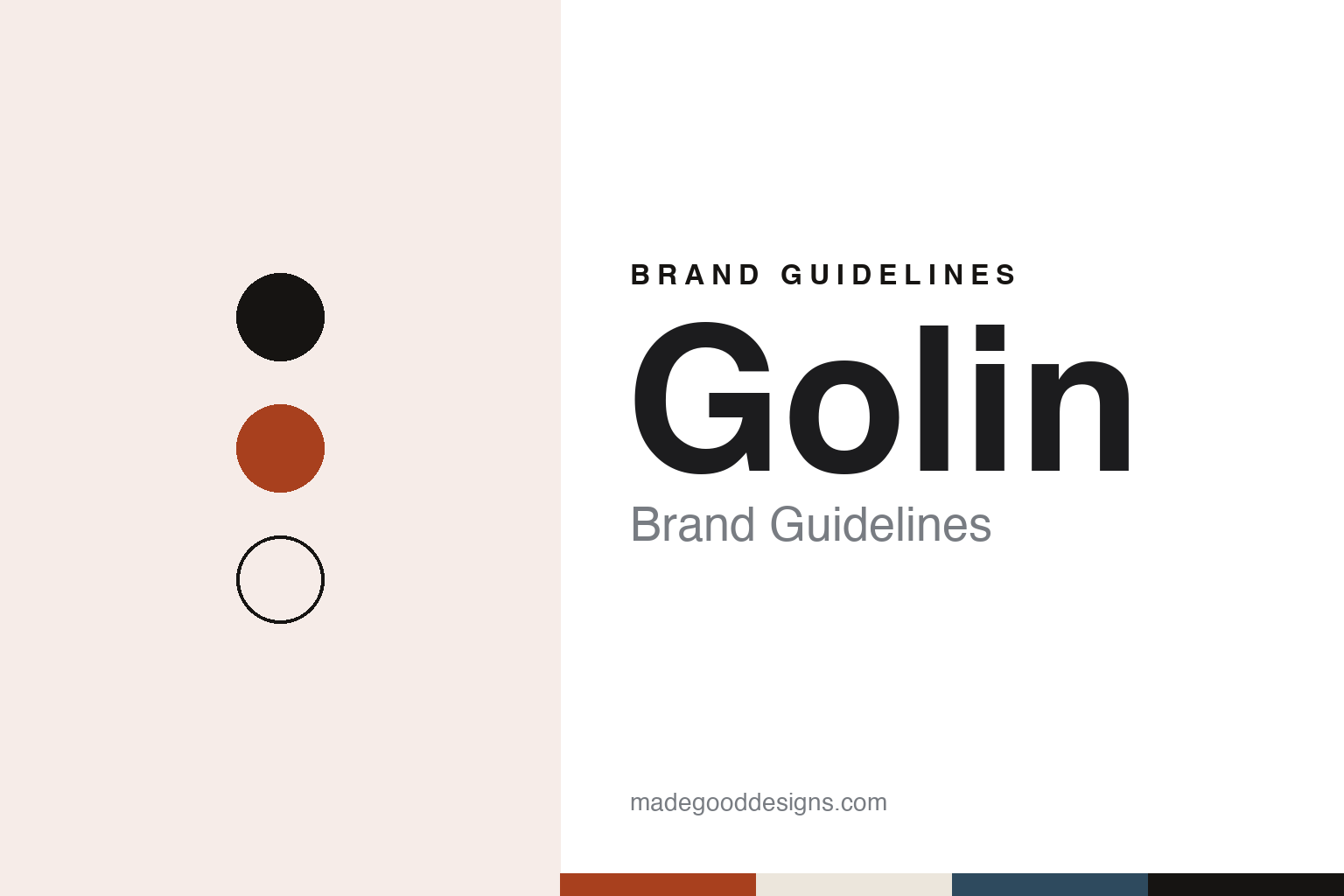
Two constants: a brick orange, ink and stone palette and a plain sans register. Abstract homage — not a Golin or Golin Ketchum asset; no logo or mark is reproduced.
Chicago, 1956
A six-person Chicago firm and a phone call.
Golin’s story begins in Chicago in 1956. That year Al Golin, who had been a publicist in the Chicago office of MGM Studios, handling publicity for visiting stars such as Clark Gable and Spencer Tracy, the Tribune said, joined Max Cooper & Associates as a junior partner; the Chicago Tribune described it in April 2017 as a small, six-person public relations firm. He became a partner in 1958, the Tribune reported. The agency counts its age from 1956: it marked its 60th anniversary in 2016, the same newspaper said.
The name changed as the firm grew. Marketing-Interactive reported in April 2017 that Max Cooper & Associates became Cooper, Burns & Golin and then Cooper & Golin; that Golin later became sole owner and renamed it Golin Communications; and that in 1978 Tom Harris joined him to form Golin/Harris Communications. The agency later traded as GolinHarris, and in 2017 the Tribune said it was “now known simply as Golin.” Through each change, the Tribune noted, Golin’s own name stayed on the door.
The client most closely tied to the agency is McDonald’s. In 1957, both publications reported, Golin made a cold call to Ray Kroc, who had recently opened a McDonald’s restaurant in suburban Des Plaines; Kroc invited him to his office and put the agency on a monthly retainer. The Tribune called the relationship arguably the longest-lasting client-agency partnership in the PR industry, and quoted a 1977 telegram in which Kroc thanked Golin for his help. Marketing-Interactive described the agency’s history as “inexorably tied” to that of McDonald’s and said in 2017 that the relationship had run for 60 years. The Tribune also recalled that Golin persuaded the painter Norman Rockwell to make a painting for the cover of a McDonald’s annual report.
Colour
Interpublic, fifty offices and a book about trust.
Golin did not stay independent. English Wikipedia says that during Larry Weber’s years at the Interpublic Group, which bought his Weber Group in late 1996, Interpublic acquired 21 public relations companies, among them Shandwick International and GolinHarris. From then on Golin was one of Interpublic’s specialist agencies; English Wikipedia lists it in the group’s Marketing Specialists unit, beside Weber Shandwick, FutureBrand and Jack Morton Worldwide, and describes it as an agency specialising in public relations, digital marketing and content development.
By April 2017 both the Tribune and Marketing-Interactive put Golin at more than 50 offices and 1,200 employees worldwide. Besides McDonald’s, the clients they named included Unilever, Nintendo and Texas Instruments. Fred Cook was the agency’s chairman at that time, the Tribune reported, and Al Golin still kept an office in Chicago, where he counselled colleagues and clients.
Al Golin set out his approach in a 2003 book, Trust or Consequences: Build Trust Today or Lose Your Market Tomorrow. As the Tribune summarised it, its tenets included finding a job you love, the idea that happy employees make for happy clients, and doing the right thing because it is the right thing to do.
Golin’s practice areas carried forward into the merged agency. In 2026 the Golin Ketchum website lists five: brand and consumer, corporate affairs, food, agriculture and nutrition, health, and technology.
Typography
Design and documentation.
Public relations and communications agencies sell advice, so their visual identity is mostly carried by what they publish about themselves. Case-study pages, award announcements and research reports do much of the work that a product range does for a manufacturer. FleishmanHillard, for example, announced in October 2026 that a campaign it made with Icelandair had been named the top entry in PRovoke Media’s Global SABRE Awards, and the guides in this set treat such pages as the agency’s own dated claims.
Names change more often than logos in this field, usually after a merger. Founders’ surnames are joined, shortened or dropped, and a hyphen can disappear: FleishmanHillard closed up its two founders’ names in 2013, English Wikipedia says. When holding groups rearrange their agencies, one firm may also keep another as a dedicated brand inside it, as FleishmanHillard did with Porter Novelli in February 2026.
Many firms present their offices and their people rather than objects. Partner profiles, office lists and pages on how the firm is owned and run take the place of a catalogue; Brunswick’s site, for instance, gives a page to each of its offices and describes the firm as a partnership. Some firms also publish magazines or research series under their own names, which become a second visible identity beside the logo.
Ownership and leadership are recorded on corporate pages, in company registers and in trade and business press, and they change with each acquisition, investment or appointment. The guides in this set give office, staff and partner counts only as a dated source states them, name the owner as of that source, and treat colours and typefaces as an unofficial interpretation unless the agency has published its own.
Aa
A plain sans for a surname-led agency. (Specimen set in Inter Tight, a sans STAND-IN; NOT the Golin or Golin Ketchum logo.)
Golin Ketchum
Two agency names joined under one holding group.
The end of Golin as a stand-alone brand came through a holding-group deal. English Wikipedia says Omnicom completed its acquisition of Interpublic on 26 November 2025. On Monday 9 February 2026 Omnicom Public Relations announced a restructured portfolio: Golin, which had been with Interpublic, would merge with Omnicom’s Ketchum, while Porter Novelli would become a brand within FleishmanHillard, MARKETECH APAC reported on 12 February 2026. Golin’s chief executive, Matt Neale, was named CEO of the combined agency and Ketchum’s US chief executive, Tamara Norman, its global president, MediaNews4U reported on 11 February; at that point the name was still under review. Omnicom Public Relations said the changes would be made in phases through 2026, and that in the meantime clients would keep working with the agency brands and day-to-day teams they knew; Weber Shandwick was left unchanged.
On 10 June 2026 the combined agency launched as Golin Ketchum, which the company said marked the completion of the integration. Golin no longer operates under its own name: golin.com now redirects to the Golin Ketchum website, which says the agency was formed in 2026 from the merger. The launch brought a new visual identity. The company says its palette is anchored by a red-orange it calls “Flare,” and that its mark is an abstraction of the agency’s initials; Neale said the double name was chosen to honour the history and reputation of both firms. Golin Ketchum says it still works through local market teams supported by specialist practices, with existing client teams kept in place. It says it won a PR Lions Gold at Cannes in June 2026, for Specsavers’ “The Relationship Aid,” and was named Large Agency of the Year at the PRWeek Awards UK in October 2026.
For a design guide, Golin shows how a founder’s surname carried a Chicago agency through seventy years of renames and two owners before being paired with another agency’s name; compare it with Ketchum and Interpublic. For this guide we use a brick orange, ink and a warm stone with a sans, an unofficial interpretation; no product or logo is reproduced.
Explore & save
Keep Golin’s identity on hand — save it to a board in the Made Good inspiration library.
Golin identity set
Pin the brick orange, ink and stone palette and the plain sans register to your own board.