GoodLife Fitness Brand Guidelines
A single London, Ontario club that grew into a Canadian group of gym brands.
Aa
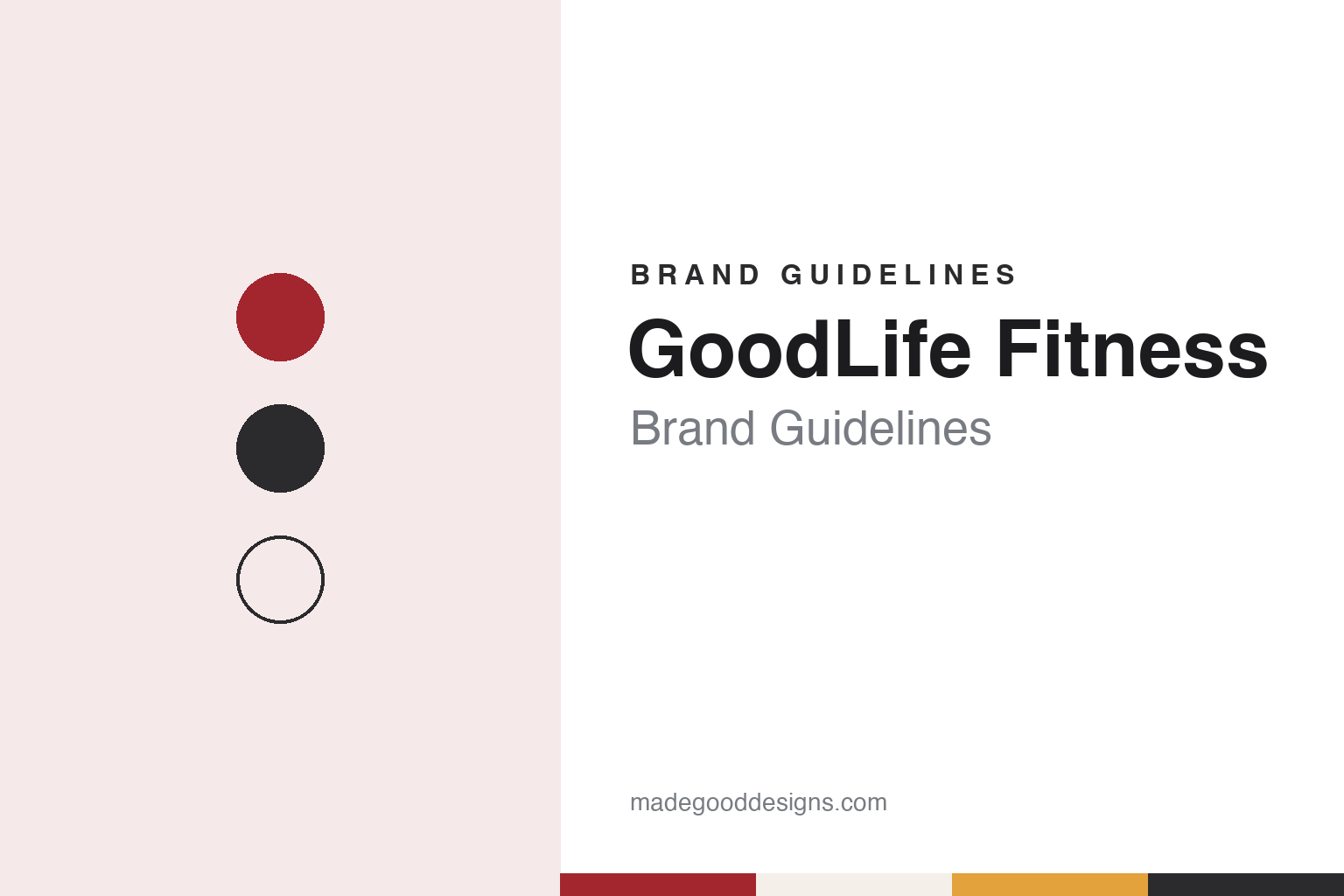
Two constants: a deep red, charcoal and warm white palette and a rounded sans register. Abstract homage — not a GoodLife Fitness asset; no logo, sign or club interior is reproduced.
One club in London
A single gym in southwestern Ontario, 1979.
GoodLife Fitness began in London, Ontario, in 1979. The company’s own timeline says its first club opened in the city that year, and English Wikipedia says the founder, David Patchell-Evans, bought the gym in which he had been training. The company still calls him “Patch” and names him founder and chairman of the GoodLife Group, which a February 2026 announcement published by the investment firm Apollo describes as headquartered in London, Ontario.
The early timeline is mostly the company’s own account. It says GoodLife opened its first “For Women” club in 1983, set up the GoodLife Kids Foundation in 1998, and celebrated 100 clubs across Canada in 2005. Independent reporting gives snapshots of the scale along the way: in February 2005, CBC News described the chain as having more than 90 outlets in seven provinces, and in August 2011 it reported 275 clubs and 750,000 members.
Much of the growth came through acquisitions. English Wikipedia lists the Alliance and Family Fitness chains in 2007–2008, the Nubody’s family of clubs in Eastern Canada in 2009, and seven independently operated Gold’s Gym locations in Calgary, Airdrie, Peterborough, Vaughan and Scarborough in December 2012. On 1 April 2013 GoodLife announced the purchase of Extreme Fitness, an operator in the Greater Toronto Area, which English Wikipedia says took the GoodLife count above 300 clubs, 82 of them in the Toronto area. In Quebec, the company’s timeline says it acquired Énergie Cardio in 2009; English Wikipedia describes the 2009 arrangement as a partnership.
Colour
Several price points under one group.
GoodLife today is a group of brands rather than a single chain. Alongside the GoodLife Fitness clubs, the company says it launched Fit4Less, a low-cost format, in 2011, and Econofitness in Quebec in 2013. English Wikipedia counts more than 200 clubs under the GoodLife Fitness name and more than 450 locations across all its banners, and calls the business the largest health club company in Canada. The February 2026 announcement gave a group total of more than 400 clubs and 1.5 million members nationwide; the company’s timeline says membership first passed one million in 2014.
Group classes are a large part of the offer. In June 2005, English Wikipedia says, GoodLife became the official Canadian agent for the choreographed exercise-to-music programmes of Les Mills International, and in February 2013 it announced an exclusive Canadian arrangement for a branded workout series. The chain has also appeared on television, taking part in Undercover Boss Canada and Canada Sings, according to English Wikipedia.
Programmes for young people sit close to the brand. The company says it has offered more than one million free summer memberships to teenagers aged 12 to 17 since 2010, and that the GoodLife Kids Foundation is a registered charity aimed at children with special needs. It also says it donates equipment and expertise to northern, remote and Indigenous communities.
The chain has also dealt with regulators. In February 2005, CBC News reported, a federal Competition Bureau investigation found that GoodLife’s advertising of membership offers had failed to disclose additional mandatory fees; the company paid a penalty, agreed to publish corrective notices in newspapers and on its website, and agreed not to make further false or misleading representations. In August 2011 CBC News reported that the Canadian Radio-television and Telecommunications Commission had fined GoodLife for using automated calls, without members’ prior consent, to tell them about new club openings, under telemarketing rules introduced with the national Do Not Call List in 2008. English Wikipedia adds that a proposed class action filed in October 2016, over wages owed to some non-managerial employees of its Ontario clubs, ended in a settlement approved by the court in July 2018.
Typography
How gym chains present themselves.
Gym and health-club chains sell a place, so much of their visual identity lives in photographs of the clubs themselves: the equipment floor, the class studios, the changing areas and, increasingly, the details of a refit. The companies publish this imagery in their own press rooms and on club pages, and when a chain modernises, the new interior often becomes the story; RSG Group’s 2024 release on McFit described steel, concrete and wood rather than a new logo.
Many chains split one name into tiers and sub-brands. A club brand may run a premium line and a value line under separate colours, give its class formats their own names, or sell a training programme through its member app. Fitness First’s German owner, for example, separates BLACK and RED clubs, and the UK business launched a training service called “able” inside its app in 2025.
Campaign identities change faster than logos. Slogans, ambassadors and sports sponsorships give a chain public visibility for a few years, while a wordmark and its colours may last a decade or more. Where a rebrand is documented, it is usually in trade or marketing press at the time of the launch, and that is where the guides in this set look for it.
Ownership is often the least visible layer. Corporate websites, press releases and trade magazines record which investor owns a chain, how many clubs it counts and in which countries, and those figures change with each purchase or sale. The guides in this set give club, member and country counts only as a dated source states them, and name the owner as of that source.
Aa
A rounded sans for a friendly club voice. (Specimen set in Figtree, a sans STAND-IN; NOT the GoodLife Fitness logo.)
The GoodLife Group
A founder-owned business takes in an outside investor.
For most of its history GoodLife stayed in its founder’s hands. The company’s timeline describes it in 2003 as an individually owned fitness company, and the February 2026 announcement still called Patchell-Evans the founder and owner of the GoodLife Group. That announcement, dated 2 February 2026 and published by Apollo, said the group had obtained a strategic minority investment led by Apollo-managed funds, that Patchell-Evans would remain chairman, and that Jeff van Haeren would continue as president and chief executive.
The company sets out its purpose as “to elevate quality of life through the power of movement and connection,” and lists core values that include caring, trust, integrity and happiness. Its about page also carries a land acknowledgement naming the Indigenous peoples of the London area, and a statement under Canada’s supply-chain reporting law. The company’s timeline says Patchell-Evans was inducted into the Canadian Business Hall of Fame in 2020.
The company uses the GoodLife name across its clubs, its youth foundation and the group itself, while presenting Fit4Less and Econofitness under their own names.
For a design guide, GoodLife Fitness shows how a founder-led chain from one Ontario city built a family of club brands at different price points under a single group name. Compare Planet Fitness, the American low-cost franchise, and Life Time, another large North American club operator. For this guide we use a deep red, charcoal and warm white with an amber accent and a rounded sans, an unofficial interpretation; no product or logo is reproduced.
Explore & save
Keep GoodLife Fitness’s identity on hand — save it to a board in the Made Good inspiration library.
GoodLife Fitness identity set
Pin the deep red, charcoal and warm white palette and the rounded sans register to your own board.