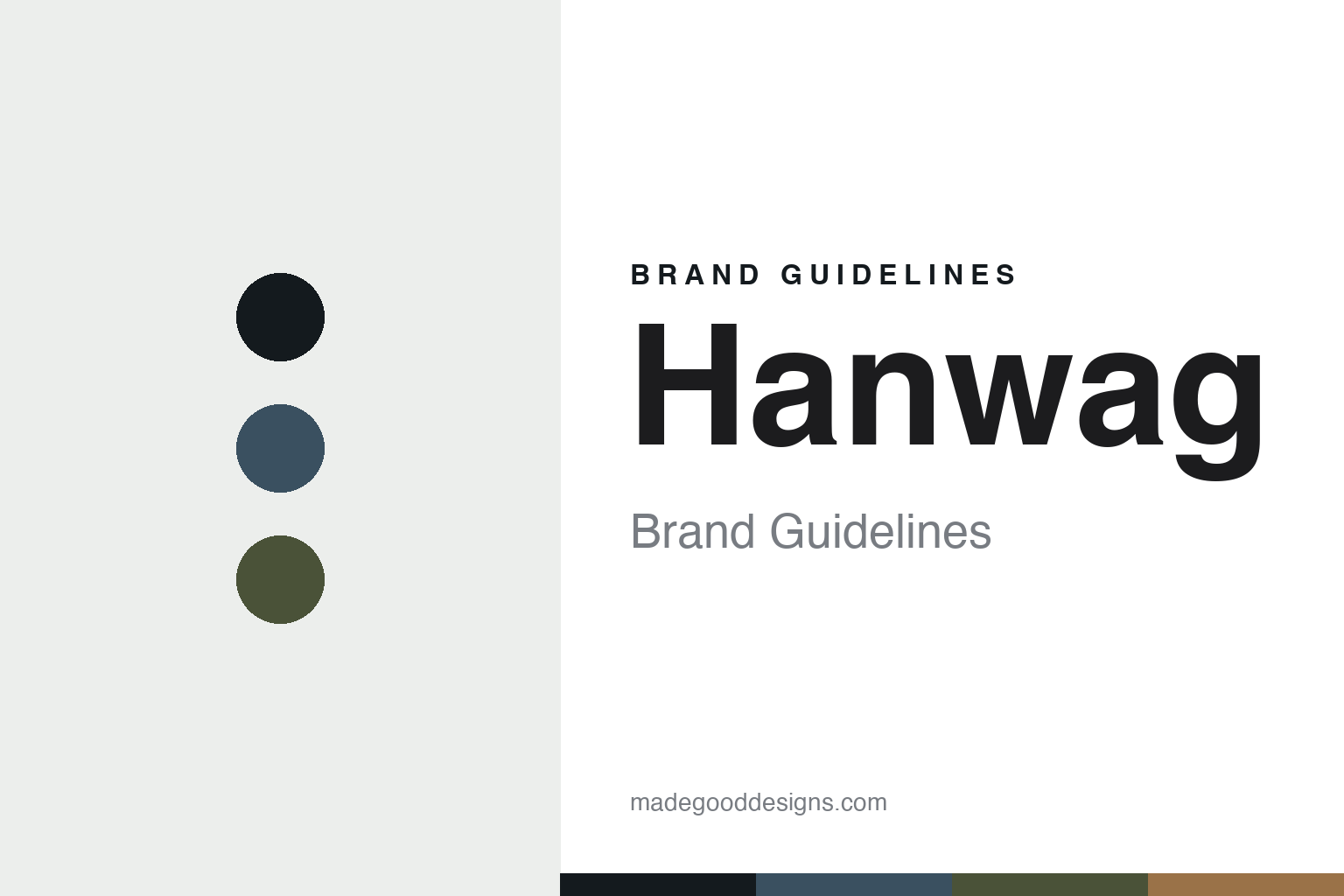
Hanwag Brand Guidelines
Bavarian boots.
Aa
Two constants: a stone-blue-and-loden palette and a Bavarian sans register. Abstract homage — not the Hanwag footwear.
Bavarian boots
Hanwag makes leather mountain boots — and its name is its founder’s.
Hanwag is a lesson in a founder’s name as identity. Founded in 1921 in Vierkirchen, Bavaria, by Hans Wagner, its very name is his: HANWAG = HANs WAGner. He was one of three Wagner brothers who each founded a Bavarian boot company — Hans’s Hanwag, Lorenz’s LOWA and Adolf’s Hochland, a genuine shoemaking dynasty (though the companies are separate today).
Its identity is premium leather hiking, mountaineering and ski-touring boots, made in Europe — the most demanding models in Vierkirchen, with shaft-sewing in Croatia and Hungary. Its best-known boot is the Alaska GTX backpacker, and the brand is known for anatomical and wide-fit lasts. The models lean on mountains and regions — Alaska, Tatra, Banks, Makra.
(Honest notes: Hanwag isn’t independent — it’s been part of Sweden’s Fenix Outdoor group (Fjällräven) since 2004, though the sale required preserving the Vierkirchen site and name, which is why it still makes boots in Germany. LOWA (Lorenz Wagner’s brand) is a separate company today. We frame “made in Europe” rather than “all Germany,” and there’s no official brand hex, so these tones are an unofficial interpretation.)
Colour
Hanwag lives in a stone-blue-and-loden palette. Click a swatch to copy the hex.
Hanwag’s identity is alpine, crafted and Bavarian — an ink, a stone blue, a loden green, a leather tan, and a chalk. The palette pairs a mountain stone blue with a loden green — the register of a Bavarian mountain boot. It signals the Alps and leather craft rather than fashion. The honest caveat: with no published brand hex, these tones are an original, unofficial interpretation, not first-party values.
The lesson is a stone blue with a loden green signals a Bavarian mountain boot. Hanwag’s world is a leather boot on alpine ground. For designers, it is a reminder that a cool alpine base with a loden and leather warmth reads as crafted and mountain-rooted — right for a Bavarian bootmaker. The takeaways: source the palette from the Alps (stone blue, loden, leather); keep it crafted; let the boot and the last lead; and treat any single hex as unofficial.
Typography
The register is a Bavarian sans — sturdy, alpine, considered.
Hanwag’s identity carries a sturdy, alpine, considered spirit — leather boots and a founder’s name. A Bavarian sans captures the mood: it is clean and dependable, the register of German craft. Set in a stone-blue-and-loden palette, the Bavarian sans feels sturdy and alpine — exactly the personality Hanwag carries. It is considered rather than loud, mirroring a mountain boot. (Hanwag’s real footwear is work we describe but do not reproduce, and the exact typeface is not ours to use.) Because it is not ours to use, the honest description is “a Bavarian sans spirit,” shown here in a stand-in. The type behaves like the brand: sturdy, alpine and considered.
Aa
A Bavarian sans spirit — sturdy and alpine. (Specimen set in Readex Pro, a clean sans STAND-IN; NOT the Hanwag footwear.)
A name as identity
Hanwag stands for a Bavarian bootmaker’s name.
Hanwag is a lesson in making the founder’s name the identity. A stone-blue-and-loden palette, a Bavarian sans and a leather mountain boot make a bootmaker’s name the whole brand — sturdy, alpine, crafted. The name is the differentiator. The differentiator is a HANs-WAGner, Bavarian-boot identity.
For designers and brand-builders, Hanwag offers a clear takeaway: build the name into the boot. The lessons: sign the work (HANWAG); keep the making in Europe (Vierkirchen); build a flagship (the Alaska); and fit real feet (anatomical, wide lasts). It is also a reminder to stay accurate: it’s Fenix-owned, LOWA is a separate brother-brand today, and the palette here is an unofficial interpretation. Hanwag made a name the brand — proof that a maker’s signature can be the difference.
Explore & save
Keep Hanwag’s identity on hand — save it to a board in the Made Good inspiration library.
Hanwag identity set
Pin the stone-blue-and-loden palette and the Bavarian-sans register to your own board.


