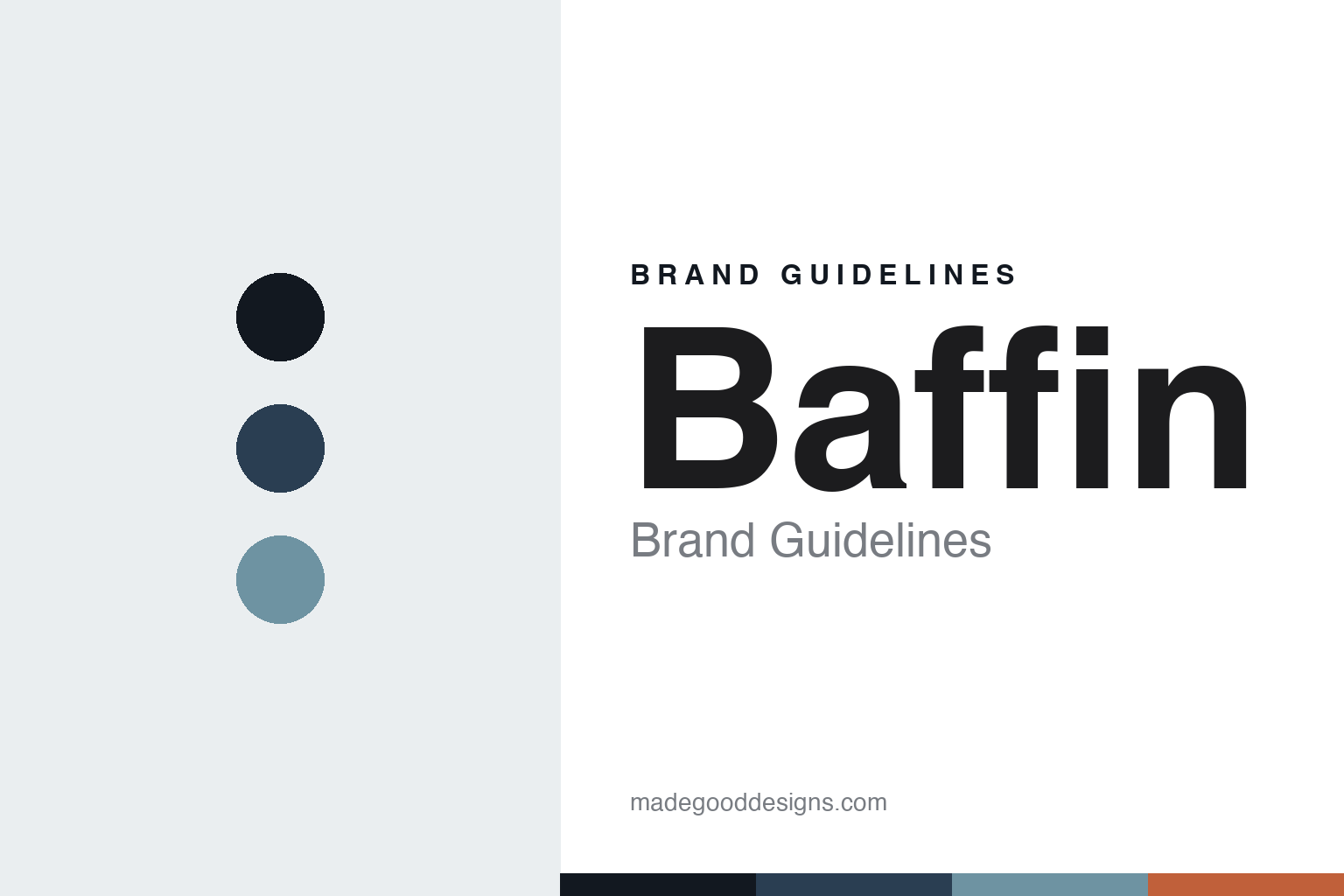
Baffin Brand Guidelines
Polar-proven.
Aa
Two constants: a polar-navy-and-glacier palette and an expedition sans register. Abstract homage — not the Baffin footwear.
Polar-proven
Baffin builds boots for the coldest places on Earth.
Baffin is a lesson in an extreme as identity. Founded in 1979 in Stoney Creek, Ontario, by Paul Hubner and the Hubner family, it makes extreme-cold and polar-expedition boots — “Engineered in Canada, tested worldwide.”
Its identity is the removable multi-layer inner-boot liner system: a technical, multi-part construction that keeps feet warm in the harshest conditions, with liners sold on their own and boots validated on real polar expeditions (the North and South Poles, Antarctica, Siberia). The flagship is the Impact extreme-cold boot, alongside a dedicated Made-in-Canada collection and grip and cushioning technologies (IceBite, B-Tek).
(Honest notes: Baffin’s ownership is layered and recent — founded independently in 1979, acquired by Canada Goose in 2018, then sold to the Canadian family firm L.P. Royer in 2026, so it’s Canadian-owned again but not the founding family (and this is weeks-old). The famous “-100°C” figure is a brand claim tied to the Impact — the current range is framed around a “-45 to -60°C” tier. “Made in Canada” is a dedicated line, not the whole range. There’s no official brand hex, so these tones are an unofficial interpretation.)
Colour
Baffin lives in a polar-navy-and-glacier palette. Click a swatch to copy the hex.
Baffin’s identity is polar, technical and rugged — an ink, a polar navy, a glacier blue, an ember orange, and a snow. The palette pairs a polar navy with a glacier blue, warmed by an ember orange — the register of an extreme-cold boot. It signals the Arctic and survival rather than fashion. The honest caveat: with no published brand hex, these tones are an original, unofficial interpretation, not first-party values.
The lesson is a polar navy with a glacier blue signals an extreme-cold boot. Baffin’s world is the Arctic. For designers, it is a reminder that a cold, deep palette warmed by one ember accent reads as polar and technical — right for an expedition brand. The takeaways: source the palette from the ice (navy, glacier, snow); add one warmth (ember); let the system lead (the liner); and — because a bright ember fails as small text — keep type dark and let the orange live in the palette and band; treat any single hex as unofficial.
Typography
The register is an expedition sans — technical, rugged, cold-ready.
Baffin’s identity carries a technical, rugged, cold-ready spirit — a polar boot and a liner system. An expedition sans captures the mood: it is condensed and engineered, the register of survival gear. Set in a polar-navy-and-glacier palette, the expedition sans feels technical and rugged — exactly the personality Baffin carries. It is cold-ready rather than decorative, mirroring an extreme-cold boot. (Baffin’s real footwear is work we describe but do not reproduce, and the exact typeface is not ours to use.) Because it is not ours to use, the honest description is “an expedition sans spirit,” shown here in a stand-in. The type behaves like the brand: technical, rugged and cold-ready.
Aa
An expedition sans spirit — technical and rugged. (Specimen set in Rajdhani, a technical sans STAND-IN; NOT the Baffin footwear.)
An extreme as identity
Baffin stands for the boot that survives the Pole.
Baffin is a lesson in making an extreme the identity. A polar-navy-and-glacier palette, an expedition sans and a liner system make the coldest conditions the whole brand — technical, rugged, polar. The extreme is the differentiator. The differentiator is an extreme-cold, liner-system identity.
For designers and brand-builders, Baffin offers a clear takeaway: own the hardest case. The lessons: solve the extreme (polar cold); build a real system (the removable liner); prove it (expeditions); and keep the claim honest. It is also a reminder to stay accurate: ownership passed through Canada Goose to L.P. Royer, “-100°C” is a brand claim, “Made in Canada” is one line, and the palette here is an unofficial interpretation. Baffin made an extreme the brand — proof that the hardest case can be the difference.
Explore & save
Keep Baffin’s identity on hand — save it to a board in the Made Good inspiration library.
Baffin identity set
Pin the polar-navy-and-glacier palette and the expedition-sans register to your own board.