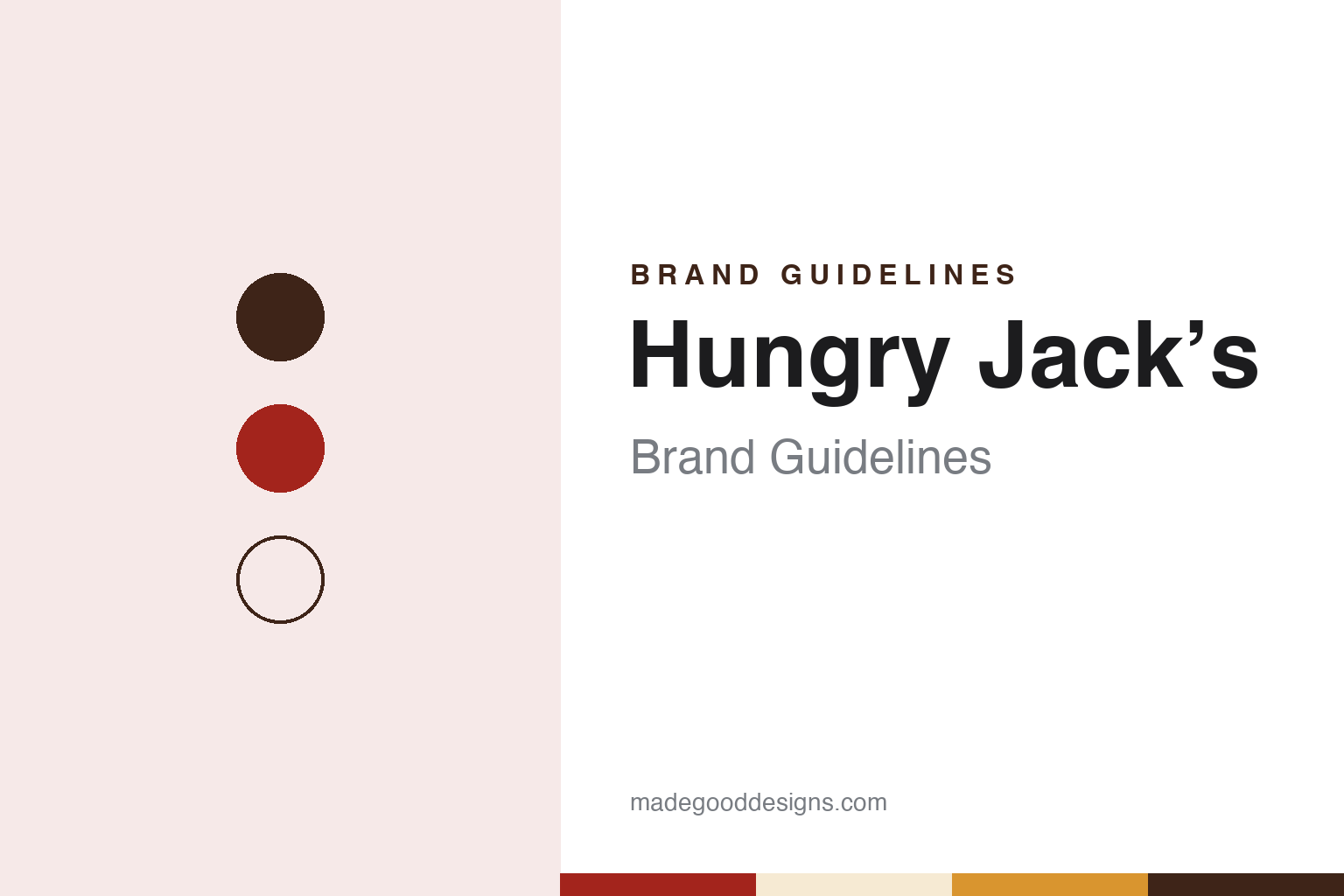
Hungry Jack’s Brand Guidelines
Burger King’s Australian name since 1971.
Aa
Two constants: a flame red, bun gold and grill brown palette and a rounded heavy sans register. Abstract homage — not a Hungry Jack’s or Burger King product or mark; no logo, burger or pack is reproduced.
Innaloo, 1971
A Burger King franchise that could not use the name.
Hungry Jack’s is the name under which Burger King’s burgers are sold in Australia. Its founder, Jack Cowin, bought the rights to the Burger King franchise for Australia in 1970, English Wikipedia says, and found that the name was already registered there by an Adelaide drive-in business that had been trading under it since 1962. That Adelaide chain grew to 17 restaurants, mainly in South Australia, realcommercial.com.au reported in July 2025, and its owner agreed to sell the stores to the American company but would not sell the name.
The answer was a new name. According to English Wikipedia and realcommercial.com.au, Cowin chose from a list of trademarks held by Burger King and its then parent company, Pillsbury, and settled on “Hungry Jack,” a Pillsbury pancake-mix brand in the United States; English Wikipedia says he turned it into the possessive form, Hungry Jack’s. The first restaurant opened at Innaloo, in Perth, on 18 April 1971, under Cowin’s company Hungry Jack’s Pty Ltd, English Wikipedia says. The company’s own website also dates its first restaurant to Innaloo in 1971 and describes Cowin as its founder and still its biggest shareholder.
Expansion followed state by state. By the end of the 1970s there were 26 stores in three states, English Wikipedia says. The first New South Wales restaurant opened in central Sydney in October 1981, and in 1986 the chain entered Victoria by buying 11 restaurants from the Wendy’s Hamburgers chain and converting them. Hungry Jack’s Pty Ltd is a wholly owned subsidiary of Competitive Foods Australia, the private company owned by Cowin, according to English Wikipedia.
Colour
Two companies, one franchise, and a 2001 appeal.
The relationship with Burger King turned into a dispute in the 1990s. English Wikipedia’s account of the case says Burger King, which wanted to enter the Australian market directly, opened outlets at some Shell service stations from 1995, and later withdrew approval for third-party franchisees and stopped approving new Hungry Jack’s restaurants. In November 1996 it moved to terminate the development agreement on the ground that Hungry Jack’s had not opened the required number of new stores each year.
Hungry Jack’s sued and won at trial. On 21 June 2001 the New South Wales Court of Appeal decided that Burger King could not terminate the agreement, finding among other reasons that it had broken an implied term of good faith, English Wikipedia says. The case, reported as Burger King Corporation v Hungry Jack’s Pty Ltd (2001) 69 NSWLR 558, is described by English Wikipedia as significant in Australian contract law for its treatment of good faith.
Burger King then stepped back. In July 2002 it transferred its Australian operations to Trans-Pacific Foods, its New Zealand franchise group, and in September 2003 it reached an agreement with Hungry Jack’s under which the remaining Burger King restaurants in Australia were renamed Hungry Jack’s and Hungry Jack’s Pty Ltd became the sole master franchisee of both brands, English Wikipedia says. realcommercial.com.au reported that Burger King later acquired the original Adelaide trademark and licensed the Burger King name back to Hungry Jack’s.
The menu shows both sides of that arrangement. English Wikipedia says the Whopper and TenderCrisp ranges are the Burger King trademarks sold at Hungry Jack’s, alongside local lines such as a breakfast menu introduced in 2005 and 2006 and the Jack’s Café coffee brand, piloted in Western Australia and rolled out nationally in June 2022. In late 2019 the chain launched the plant-based Rebel Whopper with the Australian food company v2food, English Wikipedia says.
Typography
The Australian burger trade.
Australian and New Zealand food chains usually present themselves through a small set of repeated parts: a shopfront and sign that can be read from across a car park, a menu built around a few named products, and a story about the suburb where the first shop opened. Roast and charcoal chicken, burgers, pies, muffins, juice, pizza and patisserie each have their own version of that formula, but the structure is shared.
Many of these brands are franchised, and their own pages say so plainly. A typical corporate site explains that each restaurant or café is run by a local franchisee, lists stores by suburb and state, and keeps a separate page for prospective franchise partners. Store formats are named rather than described: drive-thru, shopping centre, strip store, express counter. Store counts appear in trade press with a date attached, and they move as shops open and close.
Ownership is often layered. Several chains sit inside larger groups or private equity portfolios, so one parent may hold more than one brand in the same category; Craveable Brands, for example, owns Red Rooster, Oporto and Chicken Treat. Founders tend to stay in the brand story long after a sale, and company pages keep the founding year, the first shop and the first signature product in view.
Expansion abroad is a recurring chapter, from New Zealand to Asia, the Middle East, Britain and the United States, and the record is uneven, with some markets opened and later left. For designers, these brands are useful studies in how a local takeaway turns its name, colours and a handful of signature items into a system that franchisees can repeat from one suburb to the next.
Aa
A rounded heavy sans for a possessive name. (Specimen set in Rubik, a sans STAND-IN; NOT the Hungry Jack’s logo.)
Hungry Jack’s
A 1994 logo, a Big Jack and a 2023 judgment.
Visually, Hungry Jack’s still follows an older Burger King look. English Wikipedia says its logo is based on the 1994 Burger King logo, even though Burger King has revised its own logo in other markets since, and that a redesign based on the 1999 Burger King logo was prepared in 2000 but never used.
Its most visible recent dispute was with McDonald’s. In mid-2020 the chain introduced the Big Jack, and in August 2020 McDonald’s Australia sued, arguing that the Big Jack and Mega Jack names infringed its Big Mac and Mega Mac trademarks, SBS News reported. On 16 November 2023 the Federal Court dismissed the trademark claim, finding that Big Jack was not deceptively similar to Big Mac, SBS News and the Queensland Law Society’s Proctor reported. The court also found that Hungry Jack’s had contravened the Australian Consumer Law with television advertising that claimed the Big Jack held 25 per cent more Australian beef than a Big Mac, both publications reported.
A Hungry Jack’s executive told the court there was an “element of cheekiness” in the Big Jack name, SBS News reported, and the court was not persuaded that the name had been chosen to mislead consumers. English Wikipedia says the Big Jack and its variants left the menu in late 2021 and later returned as a limited-time item.
Size figures depend on the source and date. English Wikipedia gives 440 stores as of September 2021, about three quarters of them company-owned; realcommercial.com.au reported more than 400 locations in July 2025; and the company’s website said in November 2026 that it had more than 500 restaurants nationwide. Sponsorships listed by English Wikipedia include naming rights to the National Basketball League and the AFL’s West Coast Eagles and Adelaide Football Club.
For a design guide, Hungry Jack’s shows how a local name can carry a global franchise’s products for more than fifty years. Compare Burger King, whose burgers it sells, and McDonald’s, its opponent in the Big Jack case. For this guide we use flame red, bun gold, grill brown and sesame cream with a rounded sans, an unofficial interpretation; no product or logo is reproduced.
Explore & save
Keep Hungry Jack’s’s identity on hand — save it to a board in the Made Good inspiration library.
Hungry Jack’s identity set
Pin the Hungry Jack’s flame red, bun gold and grill brown palette and the rounded heavy sans register to your own board.
Source & notes
Frequently Asked Questions
What font can I use to match the Hungry Jack’s look?
This guide describes Hungry Jack’s’ type as “A rounded heavy sans for a possessive name”. Its type specimen is set in Rubik from Google Fonts as a stand-in; Rubik is not Hungry Jack’s’ own lettering.
What colours are in the Hungry Jack’s palette?
This guide’s Hungry Jack’s palette is Flame red #A3241C, Bun gold #D9952F, Grill brown #3E2418, Sesame cream #F6EAD3 and Paper #FBF7F0. The tones are the guide’s own unofficial interpretation, not official Hungry Jack’s hex codes.
When was Hungry Jack’s founded?
Hungry Jack’s was founded in 1971, in Innaloo, Perth. Hungry Jack’s is known for Whopper, Big Jack, Jack’s Café.
Who founded Hungry Jack’s?
Hungry Jack’s was founded by Jack Cowin in 1971. Hungry Jack’s is known for Whopper, Big Jack, Jack’s Café.