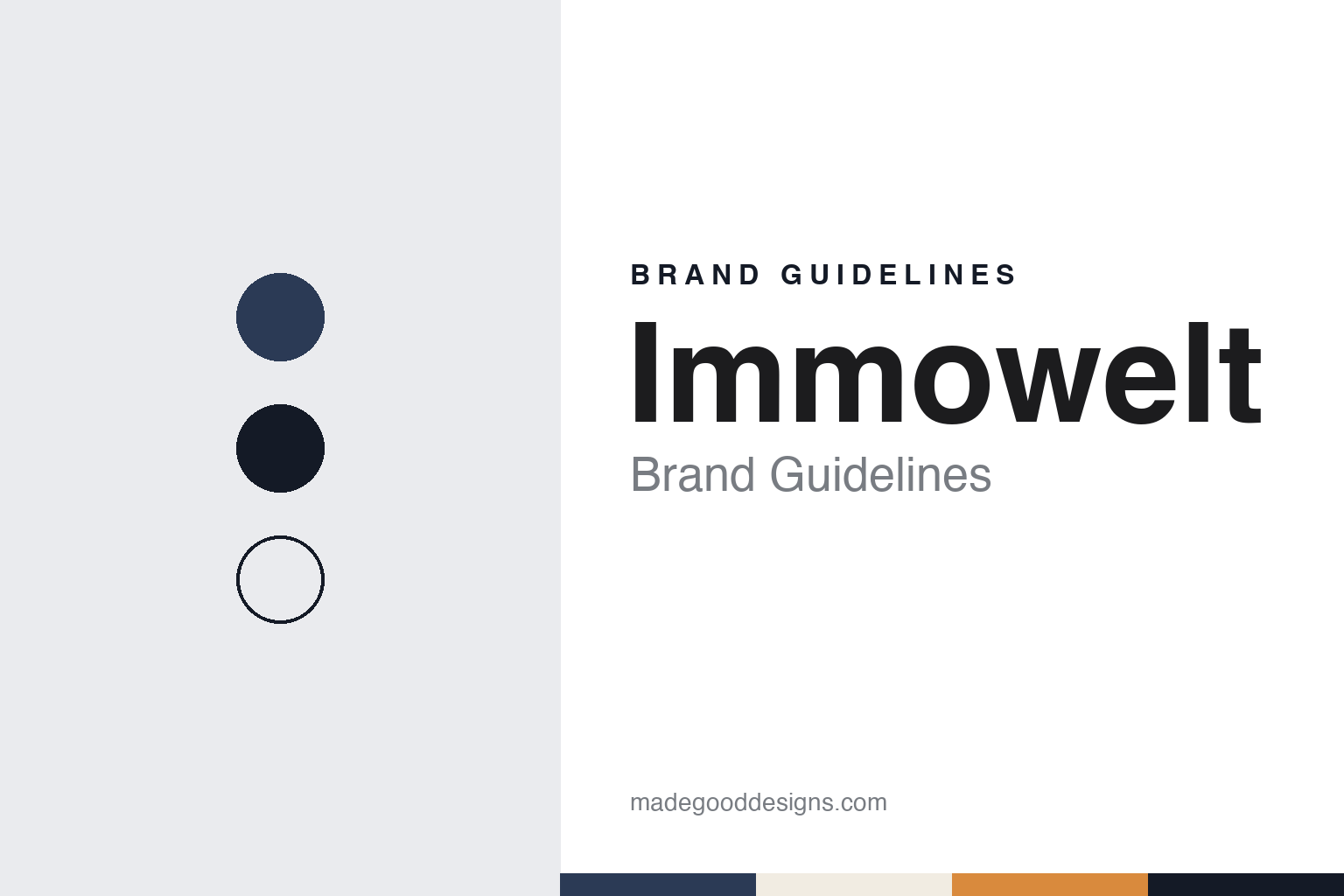
Immowelt Brand Guidelines
A Nuremberg software firm that became a national property portal.
Aa
Two constants: a slate blue, sandstone and terracotta palette and a geometric sans register. Abstract homage — not an Immowelt product or mark; no logo, app screen or listing is reproduced.
Data Concept
Agent software first, a portal second.
Immowelt began as a software company, not a website. In 1991 Carsten Schlabritz and Jürgen Roth founded Data Concept GmbH in Nuremberg, the Immobilien Zeitung’s jobs service reported in November 2018, and the firm’s own history says its first products were the Makler 2000 family of programs for estate agents. The company spells its brand in lower case, as immowelt.
The portal came five years later. The company says immowelt.de went online in 1996 and quickly became a popular marketplace for flats, houses and commercial property. In 2000 the publishing group Georg von Holtzbrinck joined Data Concept as a strategic partner, the company says, and the business was renamed Immowelt AG.
Through the 2000s Immowelt widened both sides of its business: the sites people search and the software agents use. According to the company’s history, it added the portals bauen.de and wohngemeinschaft.de in 2007 and launched estatePro, customer-management software for property professionals, in the same year. In 2009 it went into Austria with immowelt.at and introduced estateOffice, which it describes as the successor to Makler 2000; a cloud product, estateSmart, followed in 2016.
That pairing of a consumer portal with professional tools is the thread that runs through the brand. Agents who used the company’s software were also the people placing listings on its portal, and the company’s present-day descriptions still put estate agents, private sellers and searchers side by side as its customers.
Colour
Immonet, Axel Springer and AVIV.
The decisive merger came in 2015. On 11 February 2015 the trade magazine Horizont reported that Axel Springer would combine its own portal group, Immonet, part of Axel Springer Digital Classifieds, with Immowelt under a new holding company, Immowelt Holding AG, in which Axel Springer would hold a controlling 55 per cent. The previous main shareholders, the Münchner Markt Gruppe, and the founders stayed on as strategic partners, the magazine said. Carsten Schlabritz became chief executive of the combined group, with Jürgen Roth on the board, and the business ran from two sites, Nuremberg and Hamburg; Schlabritz told Horizont the merger would make the pair the “strong number two” in German online property.
The deal fitted a wider pattern. Horizont noted that Axel Springer had already bought the French property portal SeLoger, the British job board Totaljobs and the Belgian property portal Immoweb, and had grouped its classifieds businesses under Axel Springer Digital Classifieds the year before; it had also negotiated over the Scout24 group, which Deutsche Telekom sold to the investor Hellman & Friedman instead.
The founders left at the end of 2018. The Immobilien Zeitung jobs service reported on 30 November 2018 that Schlabritz and Roth would leave the Immowelt Group on 31 December, after 28 years, and that the group, with its two portals, employed about 550 people at the time.
In 2019 Axel Springer took full ownership and placed Immowelt in the AVIV Group, its international property-classifieds business founded in 2018, the company says; German Wikipedia dates the full takeover to October 2019. AVIV also runs SeLoger and Meilleurs Agents in France and Immoweb in Belgium, according to a 2024 company announcement.
In 2021 Immowelt AG became Immowelt GmbH, and the company launched the immowelt Price Map, an online map of property prices that it says has won awards. In its 2024 announcement the company said the Price Map, an owners’ guide called Eigentümer Coach and a lead service for agents called Profi-Leads had been developed together with AVIV colleagues in France and Belgium, and that it uses white-label products built across the group to bring new features to its portals quickly.
Typography
How portals present themselves.
Property portals sell a search, and their identities are built around it. Most of them put the same few objects in front of the visitor: a search bar for a town or postcode, a map with markers, and a grid or list of listing cards, each with a photograph, a short address and a few key facts. The brand lives in the details around that frame — the colour of the buttons and markers, the shape of the card, the label that flags a new or exclusive listing — because the photographs themselves belong to the agents and owners who supply them.
The wordmark often has to work very small. A portal’s name appears in an app icon on a phone screen, in a browser tab, on agents’ window cards and on the boards and printed particulars that agencies produce, so many portals rely on a short name or a single letter, a simple house shape or a solid block of colour that can be recognised at that size.
Campaigns tend to be plain. When portals advertise on television, online or on posters, they usually show the moment of moving or searching rather than the interface, and they repeat a short line that the company then carries into its app and website. Some run separate brands for rentals, new homes, luxury property or commercial space, each with its own name but a shared visual system.
Behind the consumer brand there is usually a corporate one. Many portals are owned by publishers, listed groups or investment firms, and their corporate pages explain ownership, the markets they cover and the brands in the family, often with a plainer palette than the consumer site. Read together, the consumer site and the corporate page show how a portal wants to be seen by home-seekers, by agents and by investors.
Aa
A geometric sans for a clear, map-led marketplace. (Specimen set in DM Sans, a sans STAND-IN; NOT the Immowelt logo.)
Immowelt
One brand under AVIV Germany.
The company behind the portal changed its name again in 2024. Since 1 February 2024 Immowelt GmbH has been called AVIV Germany GmbH, with the immowelt brand at its centre, the company announced on 5 February 2024. At that point its German portfolio included immowelt.de, immonet.de and a removals-price comparison site, as well as the estate-agent software lines estate and Immosolve.
Ownership of AVIV itself then changed. On 19 December 2024 Axel Springer announced binding agreements under which its classifieds businesses, AVIV and the Stepstone Group, would become separately run joint-venture companies with the investors KKR and CPP Investments as majority shareholders and Axel Springer keeping about ten per cent. AVIV’s own website now describes the group as backed by KKR and CPP Investments, with SeLoger, Immoweb and immowelt among its marketplaces.
The latest step is a single brand. On 23 January 2026 the company announced a one-brand strategy: Immonet, the Hamburg portal joined to Immowelt since 2015, would be fully folded into immowelt, with the combined listings of both sites available on immowelt.de. The same announcement named a new leadership team under chief executive Theo Mseka and said the company would put its resources into AI-based search and marketing tools and into regional campaigns in Bavaria, Hamburg, Baden-Württemberg and North Rhine-Westphalia. AVIV Germany is still based in Nuremberg.
For a design guide, Immowelt shows how a brand can absorb a long-time partner and still keep a plain, recognisable name. Compare ImmoScout24, its German rival, and SeLoger, its sister brand in the AVIV Group. For this guide we use slate blue, night ink, sandstone and terracotta with a sans, an unofficial interpretation; no product or logo is reproduced.
Explore & save
Keep Immowelt’s identity on hand — save it to a board in the Made Good inspiration library.
Immowelt identity set
Pin the Immowelt slate blue, sandstone and terracotta palette and the geometric sans register to your own board.