SeLoger Brand Guidelines
From a Minitel code to the property pages of France.
Aa
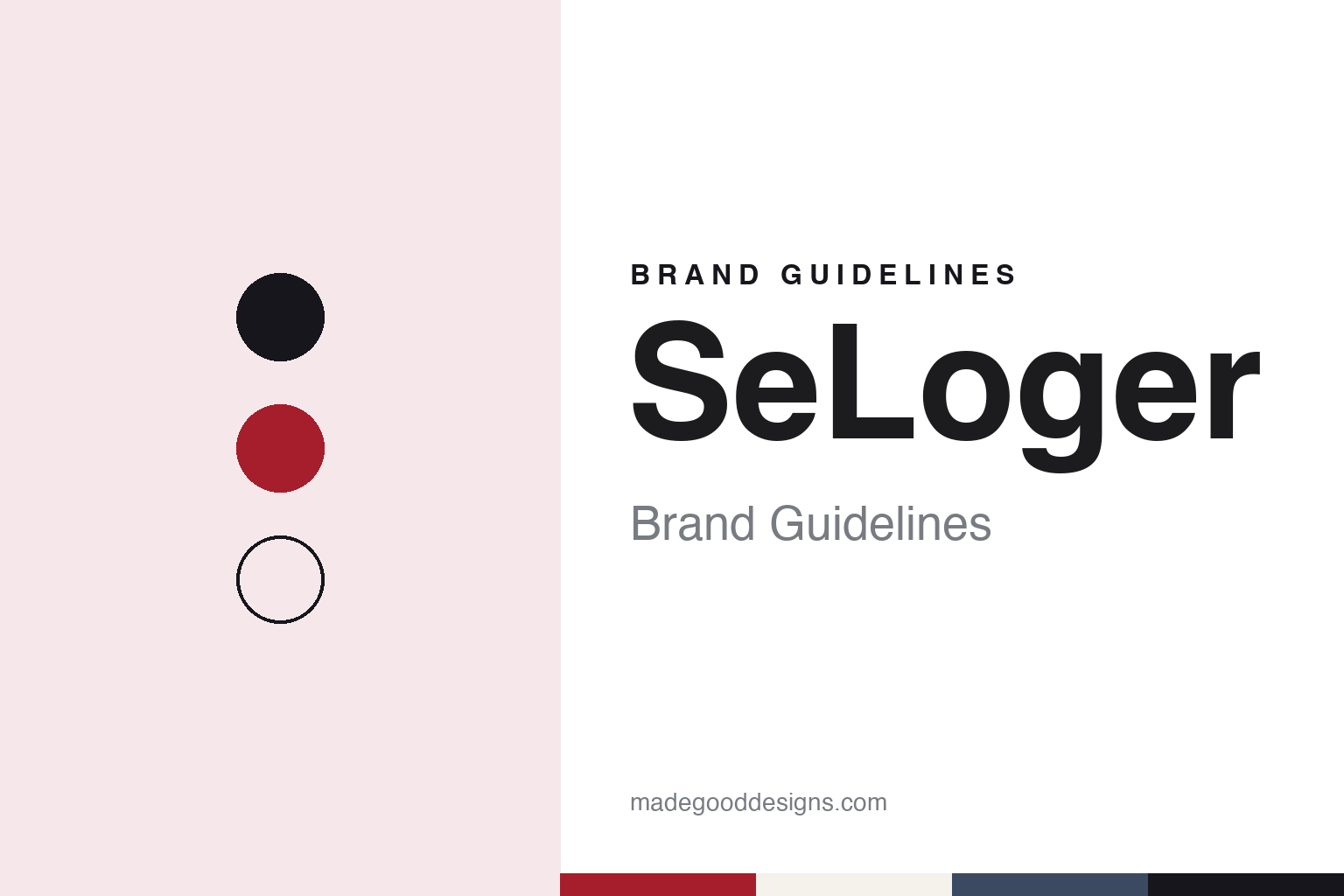
Two constants: a red, ink and warm white palette and a rounded sans register. Abstract homage — not a SeLoger screen or mark; no logo, listing or interface is reproduced.
3615 SeLoger
A Minitel code before a web address.
SeLoger’s story starts before the web. French Wikipedia says the name began as 3615 SeLoger, a Minitel service created in 1989 to compete with the property small ads printed in newspapers, and that users paid by the minute to browse it. When Axel Springer announced its offer for the company in September 2010, it gave a different starting point: Seloger.com SA, it said, was founded in 1992, and it named Amal Amar and Denys Chalumeau as the founders. The two dates describe different things — the Minitel service and the company that grew around it — so both are given here.
French Wikipedia, citing a 2016 interview and a 2012 trade-magazine profile, says Denys Chalumeau had been selling Minitel services to businesses since 1992 through his company France Télématique Diffusion, and that in 1995 he and his partners Vincent Rousset and Amal Amar bought Pressimmo, the publisher of 3615 SeLoger. In 1996 the service moved to the internet, which allowed faster search and photographs, and SeLoger ran the property pages of Wanadoo, Club Internet and Le Monde. In 2000 the parent company took the name Poliris.
Growth came by acquisition. In September 2002 Poliris took control of Immostreet, which Clubic described at the time as the second site in the sector; Poliris said it would keep running both brands. French Wikipedia says that in 2006 SeLoger bought Périclès, software that agencies use to send out their listings, and joined the Euronext list of the Paris stock exchange, and that in 2008 it added the luxury property publisher Belles Demeures and Agorabiz, a marketplace for offices and shops. By 2010, according to Axel Springer, the company ran six property portals, including seloger.com and immostreet.com, from its base in Paris, and it said that 80 percent of property agents in the Paris region and 55 percent elsewhere in France used the company to promote their sales and rentals.
Services spread beyond the listings. French Wikipedia says SeLoger launched Lacoteimmo.com with the Paris-region chamber of notaries in 2004, a free site for estimating a property’s value; released an Android app in 2010; signed a partnership in 2010 that gave it exclusive distribution of listings from the Orpi agency network; bought Webimmo.com, a commercial property site, in 2014; and added geolocation to its search app in 2015.
Colour
Axel Springer, Logic-Immo and one corporate red.
Axel Springer, the Berlin publisher, agreed in September 2010 to buy a 12.4 percent stake from a group of shareholders that included the founders, and announced a public offer for the rest of the shares. On 23 March 2011 it said the offer had been completed and that it held 98.7 percent of the company, with a delisting from the Paris market to follow. French Wikipedia adds the holiday-rental sites a-Gites.com in 2011, Vacances.com in 2012 and Amivac in 2015, and says Poliris, the software arm, left the group in September 2016.
The group then widened. French Wikipedia says Axel Springer bought Logic-Immo, a rival portal with its own printed property magazines, in 2018, making it a sister company of SeLoger. Axel Springer said in October 2019 that it had founded AVIV Group in 2018 as a wholly owned company combining its property, car and general classifieds in Germany, France, Belgium and Israel.
In May 2019, Journal de l’Agence reported, SeLoger and Logic-Immo introduced a corporate and business-to-business brand, Groupe SeLoger, covering eleven brands, among them Belles Demeures, SeLoger Neuf and SeLoger Vacances. The trade title described its new logo as drawing on the graphic worlds of both names — “the red of SeLoger and the blue of Logic-Immo” — around a shared element, property. For the general public, the group said, the individual consumer brands would carry on. The group gave its reach at the time as 2.2 million property listings online and 50 million visits a month. In October 2019 Axel Springer bought MeilleursAgents, an online valuation service, to sit alongside them, French Wikipedia says.
Typography
How property portals present themselves.
Property portals sell a search, and their identities are built around it. Most of them put the same few objects in front of the visitor: a search bar for a town or postcode, a map with markers, and a grid or list of listing cards, each with a photograph, a short address and a few key facts. The brand lives in the details around that frame — the colour of the buttons and markers, the shape of the card, the label that flags a new or exclusive listing — because the photographs themselves belong to the agents and owners who supply them.
The wordmark often has to work very small. A portal’s name appears in an app icon on a phone screen, in a browser tab, on agents’ window cards and on the boards and printed particulars that agencies produce, so many portals rely on a short name or a single letter, a simple house shape or a solid block of colour that can be recognised at that size.
Campaigns tend to be plain. When portals advertise on television, online or on posters, they usually show the moment of moving or searching rather than the interface, and they repeat a short line that the company then carries into its app and website. Some run separate brands for rentals, new homes, luxury property or commercial space, each with its own name but a shared visual system.
Behind the consumer brand there is usually a corporate one. Many portals are owned by publishers, listed groups or investment firms, and their corporate pages explain ownership, the markets they cover and the brands in the family, often with a plainer palette than the consumer site. Read together, the consumer site and the corporate page show how a portal wants to be seen by home-seekers, by agents and by investors.
Aa
A rounded, friendly sans — the register of a consumer search brand. (Specimen set in Manrope, a sans STAND-IN; NOT the SeLoger logo.)
SeLoger
Private sellers, then new owners.
The business model shifted in 2023. Since 1 July that year, Journal de l’Agence reported, SeLoger has let owners post their own sale listings at no charge; until then, selling a home on SeLoger.com went through an estate agency, although LouerVite, a rental site launched in 2016, had already accepted ads from private landlords. The trade title described the change as unwelcome news for many agents.
Ownership changed above the portal in 2025. Axel Springer said that from 29 April 2025 its classifieds businesses, Stepstone and AVIV, became independent joint ventures with the investment firms KKR and CPP Investments as majority owners, while Axel Springer kept ten percent of each. AVIV now describes itself as backed by KKR and CPP Investments, with markets in France, Belgium and Germany and a family of brands that includes SeLoger, immowelt in Germany and Immoweb in Belgium, alongside Meilleurs Agents and the German company Homeday. French Wikipedia places Groupe SeLoger in the 9th arrondissement of Paris.
For a design guide, SeLoger shows how a name built for a Minitel code — a plain French phrase about finding somewhere to live — can carry over to the web and then to a corporate group without changing. Compare Immowelt, the German portal in the same AVIV group, and idealista, a property portal from Madrid. For this guide we use a deep red, ink and warm white with a sans, an unofficial interpretation; no product or logo is reproduced.
Explore & save
Keep SeLoger’s identity on hand — save it to a board in the Made Good inspiration library.
SeLoger identity set
Pin the SeLoger red, ink and warm white palette and the rounded sans register to your own board.