Intermex Brand Guidelines
A 1994 remitter in Miami, with a Western Union deal pending.
Aa
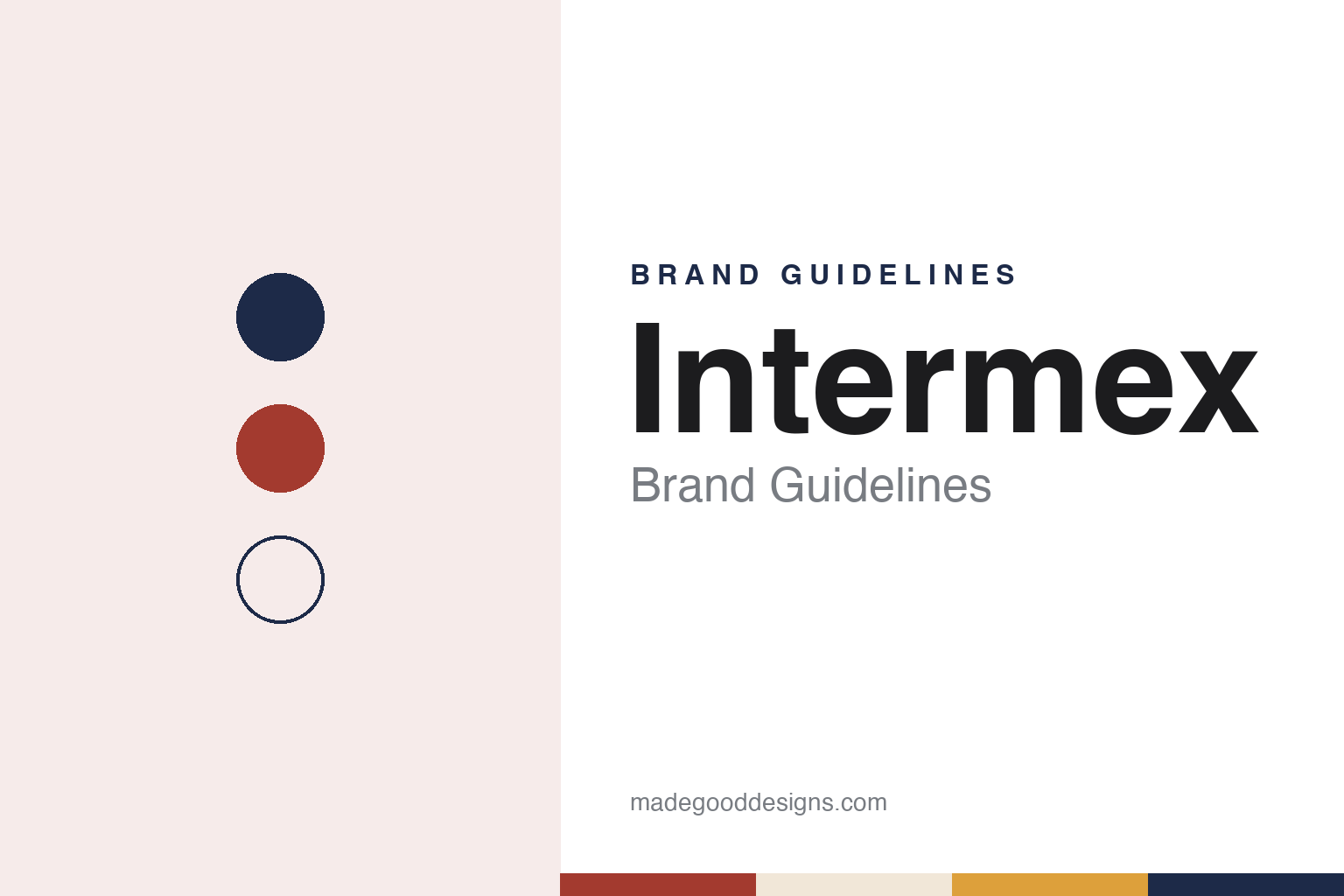
Two constants: a brick red, night blue and marigold palette and a sturdy grotesque register. Abstract homage — not an Intermex asset; no shop sign, app screen, logo or mark is reproduced.
International Money Express
From two north-western states to Miami.
Intermex is the trading name of International Money Express, Inc., a money-transfer company headquartered in Miami, Florida. The company’s own timeline says it began operations in 1994 in the states of Washington and Oregon, and moved its headquarters to Miami in 1996. By 2000, it says, it was licensed in ten states, and its agents had started using computers to communicate with it remotely. Its customer pages also use the longer name Intermex Wire Transfer, and the website footer names the licensed subsidiaries that provide its services.
On the company’s account, growth came largely through purchases and new investors. In 2004 it moved into Texas by buying a money-order firm based in Dallas; in 2006 the New York investment firm Lindsay, Goldberg & Bessemer took a major stake; in 2007 it bought the money-transfer company Servimex and expanded into eight more states; and in 2008 the purchases of Americana de Servicios and Maniflo opened operations in New York and California. In 2009, the timeline says, Robert Lisy became president and chief executive, with plans to expand into Mexico and Central and South America.
The company names two more ownership steps. In 2017, it says, Intermex was acquired by Stella Point from the private equity firm Lindsay Goldberg, and in 2018 it merged with FinTech Acquisition Corp and went public as International Money Express; its shares trade on the Nasdaq under the ticker IMXI. In 2019, the timeline adds, it began sending from Canada and paying out in Africa, and in 2022 it completed the purchase of the US-based assets of La Nacional, a money-transfer business serving the Dominican Republic.
Colour
Shop counters, an app and a Spanish switch.
Intermex’s core trade is sending money from the United States to Latin America. In a joint release with Western Union dated 13 August 2026, the company described itself as enabling consumers to send money from the United States, Canada, Spain, Italy and Germany to more than 60 countries, through agent retailers, Intermex-operated stores, mobile apps and its websites, with transfers paid out through thousands of retail and bank locations. The same release lists international offices in Puebla, Mexico, Guatemala City, London and Madrid. Its own web pages give other counts: the About page claims more than 4.5 million customers and over 100,000 payout locations, while the products page cites more than 180,000 cash pickup points and sending from the app to over 70 countries, among them Mexico, Guatemala, El Salvador and the Dominican Republic.
The website calls its approach omnichannel. A customer can send at a retail agent, or online with a debit card, credit card or bank transfer; the money can arrive in a bank account, on a mobile wallet, at an ATM or as cash at an agent, and the products page adds home delivery in the Dominican Republic. Agent locations also handle phone top-ups, bill payments made in cash or by check, and money orders. For businesses the site lists a payroll card and an employers’ portal, and it recruits shops through a “Become an Agent” page.
Two features of the site shape how the brand speaks. Every page carries a switch to Spanish, and the corporate pages frame the business around financial inclusion: the ESG page says the company creates products for diverse and underrepresented communities, and describes its agents as being as diverse as the communities they serve. The footer is dense with regulatory text, naming each licensed Intermex entity and pointing customers to the NMLS consumer register to check them.
Typography
How money-transfer brands present themselves.
Money-transfer brands work in two places at once: at a shop counter, where a sign has to be read from across the street, and on a phone screen, where the same name has to sit in a small app icon. The guides in this set look at how each brand handles that double job, from strong single-colour wordmarks in yellow, green, orange or purple to the short, easily spoken names that customers repeat to relatives abroad.
The guides also look at the practical pages these brands publish: exchange-rate calculators that show what a recipient will receive, lists of countries and corridors, and finders for agent locations. The networks behind those finders are large by the companies’ own counts: MoneyGram gives more than 480,000 retail locations, and Ria had more than 639,000 locations at the end of 2025, according to English Wikipedia. Partners such as Walmart, post offices and convenience-store chains appear alongside the brands’ own shops.
Language is part of the design. The guides note where pages, apps and customer service are offered in several languages for customers who send money to families in other countries; MoneyGram, for example, says its rebuilt app and website of October 2026 support 40 languages.
The small print matters too. MoneyGram’s website lists its licences as a money transmitter, and the guides note such licence and regulatory disclosures, along with complaint routes and, for listed companies or listed parents, investor pages with reports and filings. Each guide sets out what can be checked about the brand — who founded it, who owns it today, and how its name and network have grown — and marks clearly what rests only on the company’s own word.
Aa
A sturdy grotesque for a counter-and-app brand. (Specimen set in Archivo, a sans STAND-IN; NOT the Intermex logo.)
A pending takeover
Agreed in August 2025, still waiting on California.
In August 2025 Intermex agreed to be acquired by Western Union. Digital Transactions reported on 14 August 2026 that the all-cash deal had been announced on 10 August 2025, approved unanimously by both boards, and expected to close by the middle of 2026. Western Union said at the time that the combination would add scale in Latin America and open its digital services to Intermex’s 6 million users.
The closing has been held up by state regulators. On 13 August 2026 the two companies said they had received approval from the New York State Department of Financial Services, with Western Union making commitments on remittance services and locations in New York, but that the California Department of Financial Protection and Innovation had suspended an approval extension it granted on 31 July 2026, citing a need to review the transaction further. Digital Transactions noted that it was the second time the state had delayed a previously extended approval. On 9 November 2026 the German financial site ad hoc news reported that the companies were still negotiating with the California regulator, and that the merger agreement lets either side end it if the deal is not completed by 10 November 2026. At the time of writing the acquisition is pending: agreed in August 2025 and not completed, with Intermex still a separate company listed on the Nasdaq.
For a design guide, Intermex shows how a remittance brand built on retail agents carries one name across shop counters, an app and a bilingual website. Compare Western Union, the company that agreed to buy it, and MoneyGram, another money-transfer brand. For this guide we use a brick red and a night blue with sand and marigold, set in a sans, an unofficial interpretation; no product or logo is reproduced.
Explore & save
Keep Intermex’s identity on hand — save it to a board in the Made Good inspiration library.
Intermex identity set
Pin the Intermex brick red, night blue and marigold palette and the sturdy grotesque register to your own board.