MoneyGram Brand Guidelines
A Minneapolis money-order firm of 1940 that became a Dallas money-transfer network.
Aa
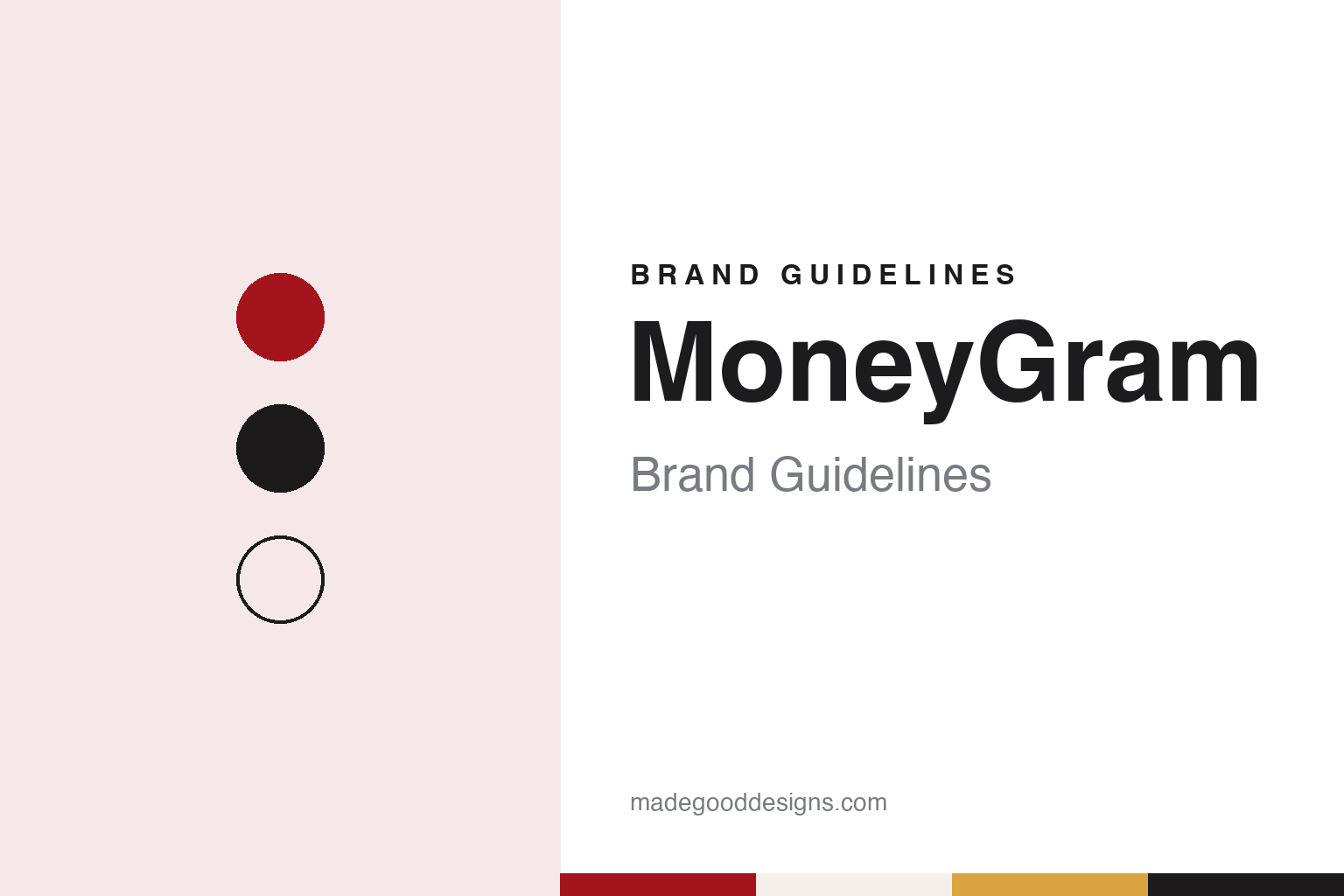
Two constants: a red, charcoal and cream palette and a bold grotesque sans register. Abstract homage — not a MoneyGram product or mark; no logo, receipt or app screen is reproduced.
Travelers Express
A money-order company and a wire service.
MoneyGram has two starting points. The older one is Travelers Express, which the company says was founded as Travelers Express Company in Minneapolis in 1940. English Wikipedia records that the Greyhound Corporation, later Viad, bought it in 1965. In August 1993 the Los Angeles Times described Travelers Express, quoting a company spokeswoman, as the nation’s largest provider of money orders, then a division of the Phoenix-based Dial Corp that cleared money orders, checks and drafts under the Travelers Express and Republic names.
The second starting point is the MoneyGram service itself. The company dates the launch of its wire-transfer service to 1988, by First Data Corporation; English Wikipedia says MoneyGram was formed that year as a subsidiary of Integrated Payment Systems, part of First Data, which was then owned by American Express. When First Data later merged with the owner of Western Union, the Federal Trade Commission required it to sell Integrated Payment Systems, Wikipedia says, and in 1996 that business became a listed company renamed MoneyGram Payment Systems.
The two strands joined in 1998, when Viad bought MoneyGram Payment Systems and folded it into Travelers Express. In January 2004, according to English Wikipedia, Travelers Express took the name MoneyGram International, and that June Viad spun it off; the company’s own timeline gives 2004 as the year it was listed on the New York Stock Exchange, and 2013 as the year its shares began trading on Nasdaq. In 2010 it moved its global headquarters to Dallas, where it remains, with an operations centre in Minnesota.
Colour
From agents to apps and stablecoins.
For most of its history MoneyGram has worked through agents: shops, post offices, banks and chain stores that send and pay out transfers at the counter, alongside money orders and the official checks it supplies to US banks. In June 2025 Payments Dive described a network of about 480,000 retail locations in some 200 countries, “from U.S. drugstores to Latin America bodegas.” The company now gives similar figures on its corporate website, with more than 60 million active customers by its own count.
The digital turn came in stages, by the company’s own timeline: an online transfer and bill-pay platform in 2015, a mobile app in the United States and 14 other countries in 2018, and digital transfers at half of all money-transfer transactions in 2024 and 70 percent in 2025. Its experiments with blockchain began with a partnership with Ripple in 2019, which English Wikipedia says ended in early 2021; later that year it announced a partnership with the Stellar Development Foundation to settle transfers in the USDC stablecoin.
The stablecoin work has since become central to how MoneyGram presents itself. Its newsroom lists a MoneyGram Card, a stablecoin-backed card announced in September 2026, MoneyGram Ramps on the Solana blockchain in August 2026, and a role as a validator on the XDC Network in October 2026. On 19 October 2026 it launched a rebuilt app and website, MoneyGram Online, which it says lets customers send, receive and hold money, pay bills and top up phones, with support in 40 languages.
Brand visibility has also come through sport. In October 2022 MoneyGram announced a title sponsorship of the Haas Formula One team, which raced as MoneyGram Haas F1 Team from 2023 to 2025; in December 2025 The Race reported that Toyota Gazoo Racing would replace MoneyGram as title partner for 2026.
Typography
How money-transfer brands present themselves.
Money-transfer brands work in two places at once: at a shop counter, where a sign has to be read from across the street, and on a phone screen, where the same name has to sit in a small app icon. The guides in this set look at how each brand handles that double job, from strong single-colour wordmarks in yellow, green, orange or purple to the short, easily spoken names that customers repeat to relatives abroad.
The guides also look at the practical pages these brands publish: exchange-rate calculators that show what a recipient will receive, lists of countries and corridors, and finders for agent locations. The networks behind those finders are large by the companies’ own counts: MoneyGram gives more than 480,000 retail locations, and Ria had more than 639,000 locations at the end of 2025, according to English Wikipedia. Partners such as Walmart, post offices and convenience-store chains appear alongside the brands’ own shops.
Language is part of the design. The guides note where pages, apps and customer service are offered in several languages for customers who send money to families in other countries; MoneyGram, for example, says its rebuilt app and website of October 2026 support 40 languages.
The small print matters too. MoneyGram’s website lists its licences as a money transmitter, and the guides note such licence and regulatory disclosures, along with complaint routes and, for listed companies or listed parents, investor pages with reports and filings. Each guide sets out what can be checked about the brand — who founded it, who owns it today, and how its name and network have grown — and marks clearly what rests only on the company’s own word.
Aa
A bold grotesque sans for a counter-and-app brand. (Specimen set in Archivo, a sans STAND-IN; NOT the MoneyGram logo.)
MoneyGram
A listed company, then a private one.
Ownership has shaped the brand’s recent history. In 2017 a planned sale to Ant Financial collapsed after it was rejected by the Committee on Foreign Investment in the United States, English Wikipedia says. In February 2022 MoneyGram agreed to be acquired by the Chicago private equity firm Madison Dearborn Partners, and on 1 June 2023 the two companies announced that the all-cash acquisition had been completed and that MoneyGram’s shares had stopped trading on Nasdaq. In October 2024 MoneyGram named Anthony Soohoo, a former Walmart executive, as chief executive, Payments Dive reported, a few weeks after a cyberattack shut down its international transfer services for about five days and exposed customer data.
Its regulatory record is part of the public story. In November 2012 MoneyGram entered a deferred prosecution agreement with the US Justice Department over failures in its anti-money-laundering programme and over wire fraud carried out by third parties using its service; English Wikipedia says the charges were dismissed in June 2021 after the agreement’s terms were met. In April 2022 the CFPB, the US consumer-finance regulator, and the New York Attorney General sued the company under a 2013 federal rule on remittance transfers. The bureau withdrew from the case in April 2025, and in June 2025 MoneyGram settled with New York without admitting or denying wrongdoing, agreeing to clearer disclosures about how it investigates errors, Reuters reported. The company’s website lists its money-transmitter licences, including one from the New York State Department of Financial Services.
MoneyGram describes its purpose as making “the movement of money across borders seamless, affordable and secure for everyone,” and calls itself “one of the largest global payment networks”; those are the company’s own words.
For a design guide, MoneyGram shows how one name can stretch from a paper money order to a stablecoin app. Compare Western Union, whose owner’s 1990s merger with First Data forced the sale of MoneyGram’s parent, and Ria, another agent network with roots in the 1980s. For this guide we use a deep red, charcoal and a warm cream with a bold sans, an unofficial interpretation; no product or logo is reproduced.
Explore & save
Keep MoneyGram’s identity on hand — save it to a board in the Made Good inspiration library.
MoneyGram identity set
Pin the MoneyGram red, charcoal and cream palette and the bold grotesque sans register to your own board.