Sendwave Brand Guidelines
A 2014 app for sending money to Africa, now one of two Zepz brands.
Aa
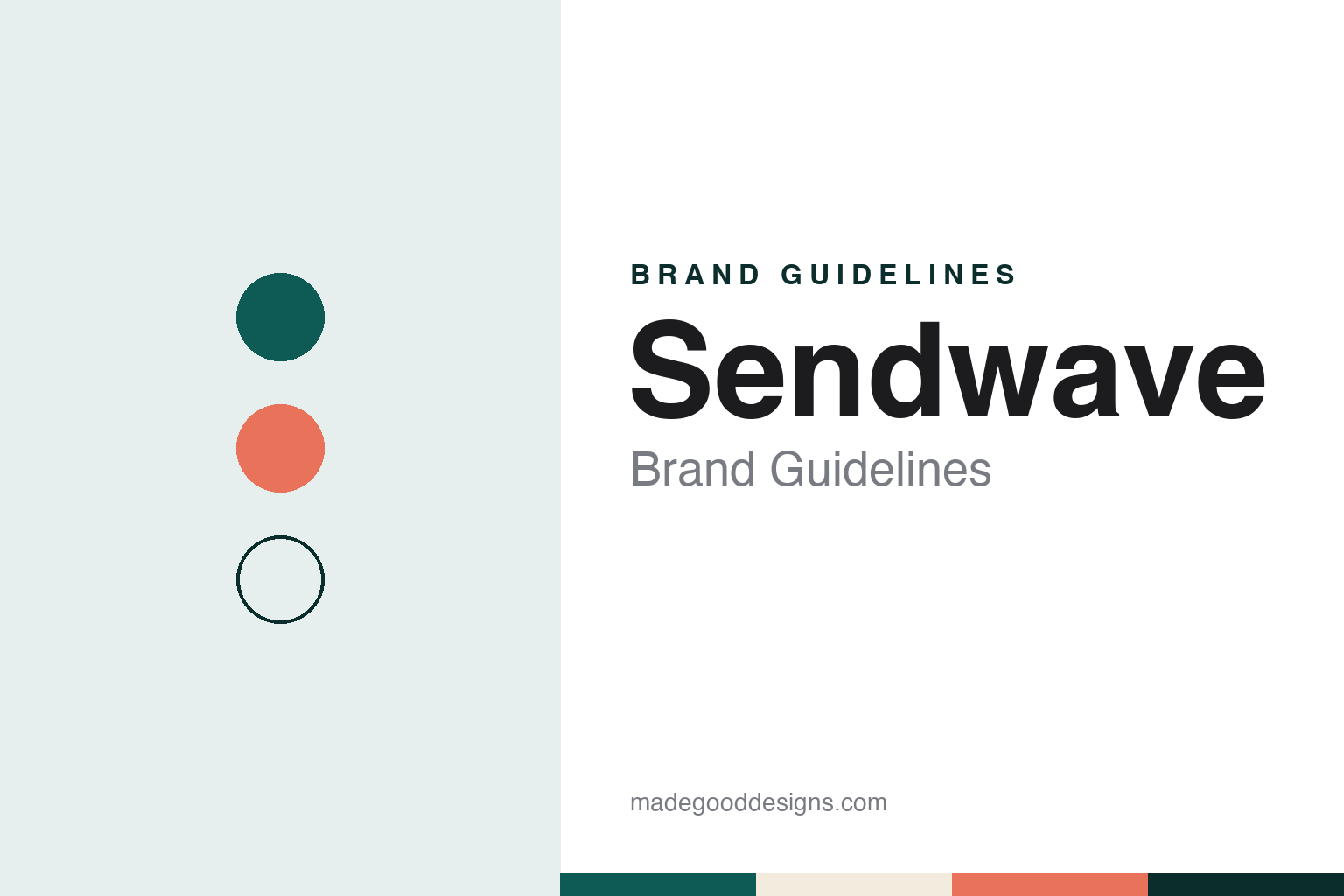
Two constants: a teal, sand and coral palette and a friendly geometric sans register. Abstract homage — not a Sendwave product or mark; no app screen, logo or icon is reproduced.
As Easy as a Text
Two founders, a phone and transfers to Africa.
Sendwave began in 2014. A WorldRemit press release of August 2020, carried by Business Wire and the Financial Post, names its founders as Drew Durbin and Lincoln Quirk and describes their mission as making cross-border transfers “as easy as sending a text.” In a December 2022 piece in The Arab American News, which carried a Sendwave press contact, the company traced the idea to Durbin’s time running a non-profit organisation based in Tanzania, where he saw the need for an alternative to traditional transfer counters.
The service was built around the phone from the start. English Wikipedia says Sendwave was set up to carry remittances to African countries, beginning with Kenya and Ghana, and that it put the emphasis on transfers straight into mobile-money wallets, reflecting the growing use of mobile financial services in Africa. Zepz, the group that owns Sendwave today, describes the original product on its own site as a stripped-back, mobile-first app focused on getting money into a wallet or bank account, with clear fees shown up front, starting in Africa before it moved into Asia.
That move into Asia came in 2020. The WorldRemit release of 25 August 2020 says Sendwave had added Bangladesh that summer as its first receiving market in Asia, while it sent money from North America and Europe to Ghana, Nigeria, Senegal and East Africa. English Wikipedia adds Sri Lanka to the first South Asian launches of that year. The company’s own story page still opens with the same idea that sat in the founders’ mission line: since 2014, it says, Sendwave has made sending money “as easy as texting.”
Colour
A cash-and-stock deal, then a group of two brands.
The ownership story turns on one deal. On 25 August 2020 WorldRemit, the London digital remittance company founded in 2010, announced that it had agreed to acquire Sendwave in a cash-and-stock transaction. The release said the deal was expected to close in the fourth quarter of 2020, subject to licensing and regulatory approvals, and that Sendwave would keep its mobile apps, brand, management, staff and key partners and continue to operate independently. Sendwave’s chief executive at the time was Will Fogel. American Banker reported the agreement the next day on the same terms, noting that the price was not disclosed by the companies.
English Wikipedia dates the completion of the acquisition to February 2021. On its own site, Zepz describes 2021 as the year the two companies came together and Zepz was formed to bring both brands under one roof, each keeping its own identity and customers while sharing infrastructure. The same release had said that, once the deal was done, Sendwave’s founders would continue working on separate projects bringing financial services to Africa, on an independent basis.
Under Zepz, Sendwave widened its map. A December 2022 article in The Arab American News described its launch of transfers to Lebanon, with cash collected at agencies of the local partner Whish Money. English Wikipedia records a launch for Mexico in June 2023 and an entry into Morocco in November 2023 through a partnership with Chaabi Cash, part of the Banque Centrale Populaire group. On 27 June 2023, in a release datelined Boston and issued by Zepz Group, Sendwave announced Sendwave Pay, a US bank account and debit card for selected Sendwave customers in the United States, which the release called the first neobank offering within Zepz.
Typography
How the category looks.
Money-transfer brands work in two places at once: at a shop counter, where a sign has to be read from across the street, and on a phone screen, where the same name has to sit in a small app icon. The guides in this set look at how each brand handles that double job, from strong single-colour wordmarks in yellow, green, orange or purple to the short, easily spoken names that customers repeat to relatives abroad.
The guides also look at the practical pages these brands publish: exchange-rate calculators that show what a recipient will receive, lists of countries and corridors, and finders for agent locations. The networks behind those finders are large by the companies’ own counts: MoneyGram gives more than 480,000 retail locations, and Ria had more than 639,000 locations at the end of 2025, according to English Wikipedia. Partners such as Walmart, post offices and convenience-store chains appear alongside the brands’ own shops.
Language is part of the design. The guides note where pages, apps and customer service are offered in several languages for customers who send money to families in other countries; MoneyGram, for example, says its rebuilt app and website of October 2026 support 40 languages.
The small print matters too. MoneyGram’s website lists its licences as a money transmitter, and the guides note such licence and regulatory disclosures, along with complaint routes and, for listed companies or listed parents, investor pages with reports and filings. Each guide sets out what can be checked about the brand — who founded it, who owns it today, and how its name and network have grown — and marks clearly what rests only on the company’s own word.
Aa
A friendly geometric sans for an app that speaks like a text message. (Specimen set in DM Sans, a sans STAND-IN; NOT the Sendwave logo.)
Sendwave
From transfers to a wallet.
The newest chapter is a wallet. On 24 October 2025 Zepz announced the Sendwave Wallet, a peer-to-peer balance held in a US-dollar stablecoin, built on infrastructure from Circle, Solana and Portal and offered, the release said, across Africa and more than 100 countries. PYMNTS reported on 2 December 2025 that Zepz had added a Visa card for wallet customers through Bridge, the stablecoin infrastructure company owned by Stripe, so that wallet balances could be spent with merchants. Sendwave’s story page now describes the wallet as offering cashback or improved rates and USDC transfers. In January 2026 The Paypers reported that Zepz had acquired Pomelo International, a San Francisco credit-card company with a footprint in the Philippines, buying its product and team; the publication said Zepz presented the deal as building on the Sendwave Wallet.
Sendwave’s US service runs through a WorldRemit company. The footer of its site says that WorldRemit Corp., doing business as Sendwave, is licensed as a money transmitter by the New York State Department of Financial Services and lists further licences in Puerto Rico, Massachusetts and Rhode Island. Zepz describes itself as the payments group behind both WorldRemit and Sendwave, with customers sending from more than 50 countries to recipients in more than 130 countries and territories, according to its own site in 2026.
The brand’s voice has stayed close to the founders’ line. The site greets visitors with “Send money with love” and keeps the comparison with a text message at the centre of its pitch, alongside a short walkthrough: download the app, link a debit card, verify your identity and send. The visual identity is not documented in any public brand book, so nothing here should be read as an official specification.
For a design guide, Sendwave shows how a remittance brand can be built around one plain promise and the habits of a messaging app: short sentences, warm greetings and the phone as the whole shopfront. Compare its sister brand at WorldRemit, which shares the Zepz group, and the app-first Remitly. For this guide we use lagoon teal, night ink, warm sand and a coral note with a friendly geometric sans, an unofficial interpretation; no product or logo is reproduced.
Explore & save
Keep Sendwave’s identity on hand — save it to a board in the Made Good inspiration library.
Sendwave identity set
Pin the Sendwave teal, sand and coral palette and the friendly geometric sans register to your own board.