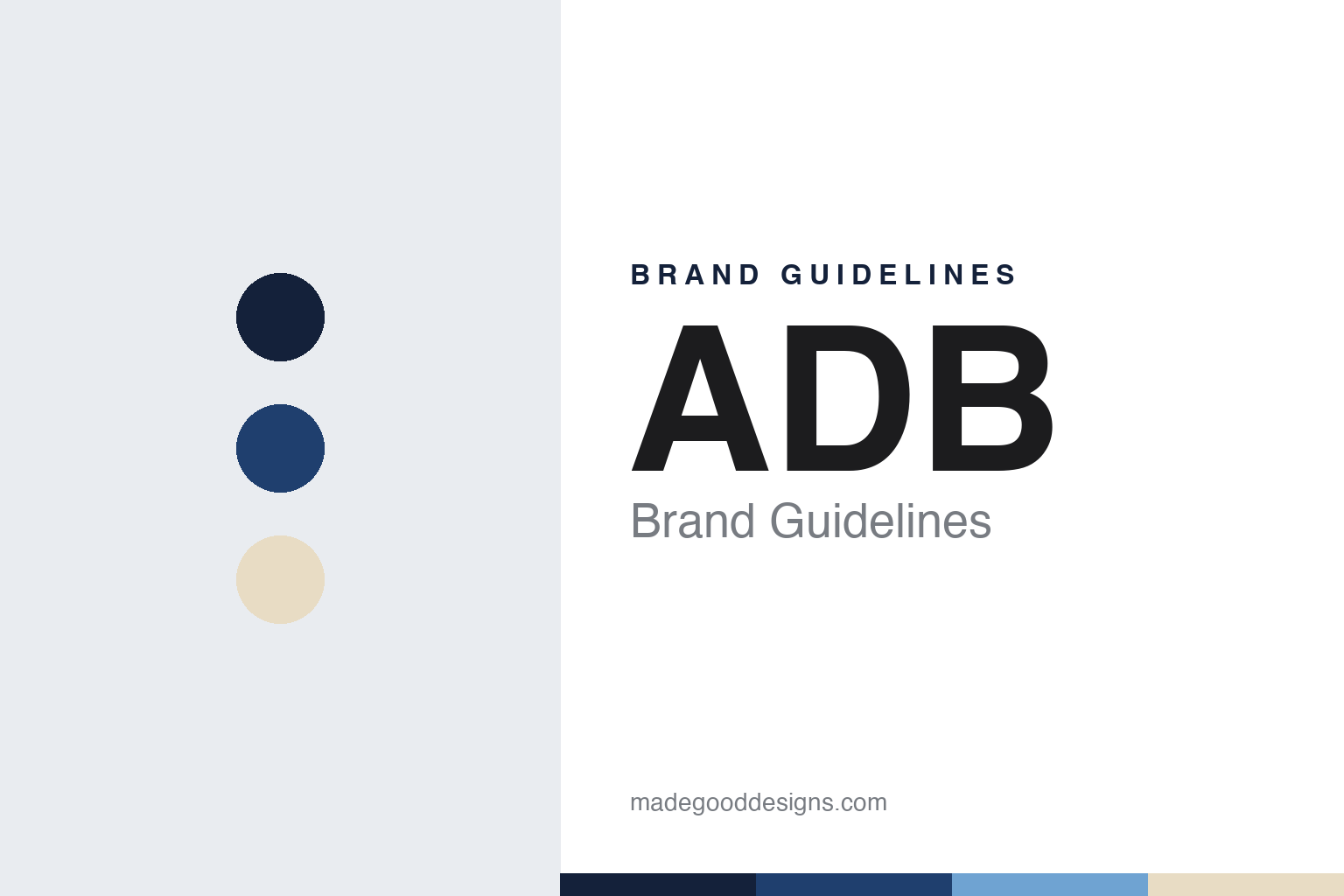
ADB Brand Guidelines
The Manila development bank opened in 1966 and now owned by 69 members.
Aa
Two constants: an ADB harbour blue, sky blue and sand palette and an institutional sans register. Abstract homage — not an ADB asset or mark; no logo or emblem is reproduced.
A bank for Asia
An ECAFE resolution, a close vote and a Manila opening.
The Asian Development Bank (ADB) opened in Manila on 19 December 1966 with 31 members, the bank says. Its own history traces the idea to a resolution passed in 1963 at the first Ministerial Conference on Asian Economic Cooperation, held by the United Nations Economic Commission for Asia and the Far East (ECAFE), and describes the aim as a financial institution that would be “Asian in character” and foster growth and cooperation in what was then a largely agricultural region.
The choice of city was close. English Wikipedia, citing ADB’s 1977 history Towards a New Asia, says nine cities were interested and that the 18 prospective regional members voted three times at a ministerial conference in Manila in late 1965; in the final round Manila beat Tokyo by nine votes to eight, with one abstention. Takeshi Watanabe of Japan was elected the first president at the inaugural meeting on 24 November 1966 and served until 1972, according to the bank’s list of past presidents.
The bank has moved twice within Metro Manila. English Wikipedia says its headquarters in Pasay City was inaugurated on 18 November 1972, and that on 31 May 1991 ADB moved to the Ortigas Center in Mandaluyong, where it remains.
Colour
Funds, field offices and a widening mandate.
ADB’s own timeline sets out how its work broadened. In the 1960s it concentrated on food production and rural development; in 1970 it made its first bond issue in Asia, in Japan; and in 1974 it set up the Asian Development Fund to provide low-interest loans to its poorest members. In 1982 it opened its first field office, in Bangladesh, and later in that decade it began working with nongovernment organisations, the bank says.
In the 1990s membership grew with several Central Asian countries. When a financial crisis hit the region in mid-1997, the bank says, it responded with projects to strengthen financial sectors and social safety nets, and approved its largest single loan, an emergency loan to the Republic of Korea. In 1999 ADB adopted poverty reduction as its overarching goal, according to its history. From January 2017 the lending operations of the Asian Development Fund were combined with the bank’s ordinary capital resources, a change announced in May 2014. In April 2014 the bank had opened offices in Nay Pyi Taw and Yangon after resuming operations in Myanmar. English Wikipedia notes that, besides “hard” loans on commercial terms to middle-income countries and lower-interest loans to poorer ones, its private-sector arm can offer guarantees, equity and mezzanine finance.
The bank’s governance follows the World Bank model closely, English Wikipedia says, with votes weighted by members’ capital subscriptions. A Board of Governors with one representative from each member elects twelve directors, eight for regional members and four for nonregional ones, and elects the president for a five-year term. Wikipedia notes that every president so far has been Japanese, and that as of 31 December 2020 Japan and the United States each held 15.571% of the shares, the largest stakes. The bank’s list of past presidents runs to ten names, from Watanabe to Masatsugu Asakawa, who served from January 2020 to 23 February 2025; Masato Kanda succeeded him that month. ADB also holds observer status at the United Nations, English Wikipedia says.
Typography
How development banks present themselves.
Development banks are owned by their member countries and economies rather than by private shareholders, and their websites put that ownership up front. The Asian Development Bank lists its 69 members with the year each one joined; the Asian Infrastructure Investment Bank publishes a register of regional, non-regional and prospective members with their subscriptions and voting power. For these institutions the shareholder list is part of the brand, set out as openly as a logo.
Names travel in several languages. ADB’s website runs in English, Japanese and Chinese, with some country pages in other languages, and most of these lenders are known by short sets of initials that have to read the same on a loan document in one country and a project sign in another. The palettes in this group of guides lean on deep blues, greens and teals, chosen here as our own unofficial interpretations rather than official colours.
Their websites are organised around what they finance and where. ADB’s menus divide its work by region and subregional programme and separate public- from private-sector financing, which can take the form of loans, guarantees or equity; the AIIB sorts its project list by status, from proposed to approved, on hold or cancelled, and by sovereign-backed and nonsovereign-backed financing. These project databases are where a reader can follow a single road, power line or water scheme from proposal onward.
Accountability is presented as part of the same identity. ADB lists an Accountability Mechanism and Independent Evaluation among its pages; the AIIB has its Project-affected People’s Mechanism, approved in 2018. Alongside annual reports and financial statements, these evaluation pages and complaint routes are where the banks set out, in their own words, how their projects are reviewed.
Aa
An institutional sans for a set of three initials. (Specimen set in Public Sans, a sans STAND-IN; NOT the ADB logo.)
ADB
Sixty years of members, regions and reports.
Today ADB describes itself as “a leading multilateral development bank supporting sustainable, inclusive, and resilient growth across Asia and the Pacific.” It says it is owned by 69 members, 50 of them from Asia and the Pacific and 19 from outside the region. Its members page lists each one with the year it joined: Japan, India, Indonesia, the Philippines and the United States among the members of 1966, the People’s Republic of China in 1986, Ireland in 2006 and Niue, the most recent listed, in 2019.
The website runs in English, Japanese and Chinese, and in 2026 carries the line “Solving Complex Challenges Together for 60 Years” for the bank’s anniversary. Its menus divide the bank’s work by region — Central and West Asia, East Asia, South Asia, Southeast Asia and the Pacific — and by subregional programmes such as the Greater Mekong Subregion and CAREC, the Central Asia Regional Economic Cooperation programme. Separate sections cover public- and private-sector financing, projects and tenders, a data library, annual reports, and accountability pages that include an Accountability Mechanism and Independent Evaluation. Some country pages link to versions in other languages, among them Chinese for the People’s Republic of China, Bahasa Indonesia for Indonesia and Vietnamese for Viet Nam.
In October 2026 ADB hosted the heads of the multilateral development banks at its Manila headquarters as the group’s 2026 chair, the first time the MDB Heads Group had met in the Philippines, Devdiscourse reported.
For a design guide, ADB shows how a regional lender carries one short set of initials across many languages, regions and country pages; compare the World Bank, whose model it followed, and the Beijing-based AIIB, which signed a cooperation memorandum with ADB in May 2016. For this guide we use a deep harbour blue, a clear sky blue and a warm sand with a sans, an unofficial interpretation; no product or logo is reproduced.
Explore & save
Keep ADB’s identity on hand — save it to a board in the Made Good inspiration library.
ADB identity set
Pin the ADB harbour blue, sky blue and sand palette and the institutional sans register to your own board.