WorldRemit Brand Guidelines
A London sender built without agent counters.
Aa
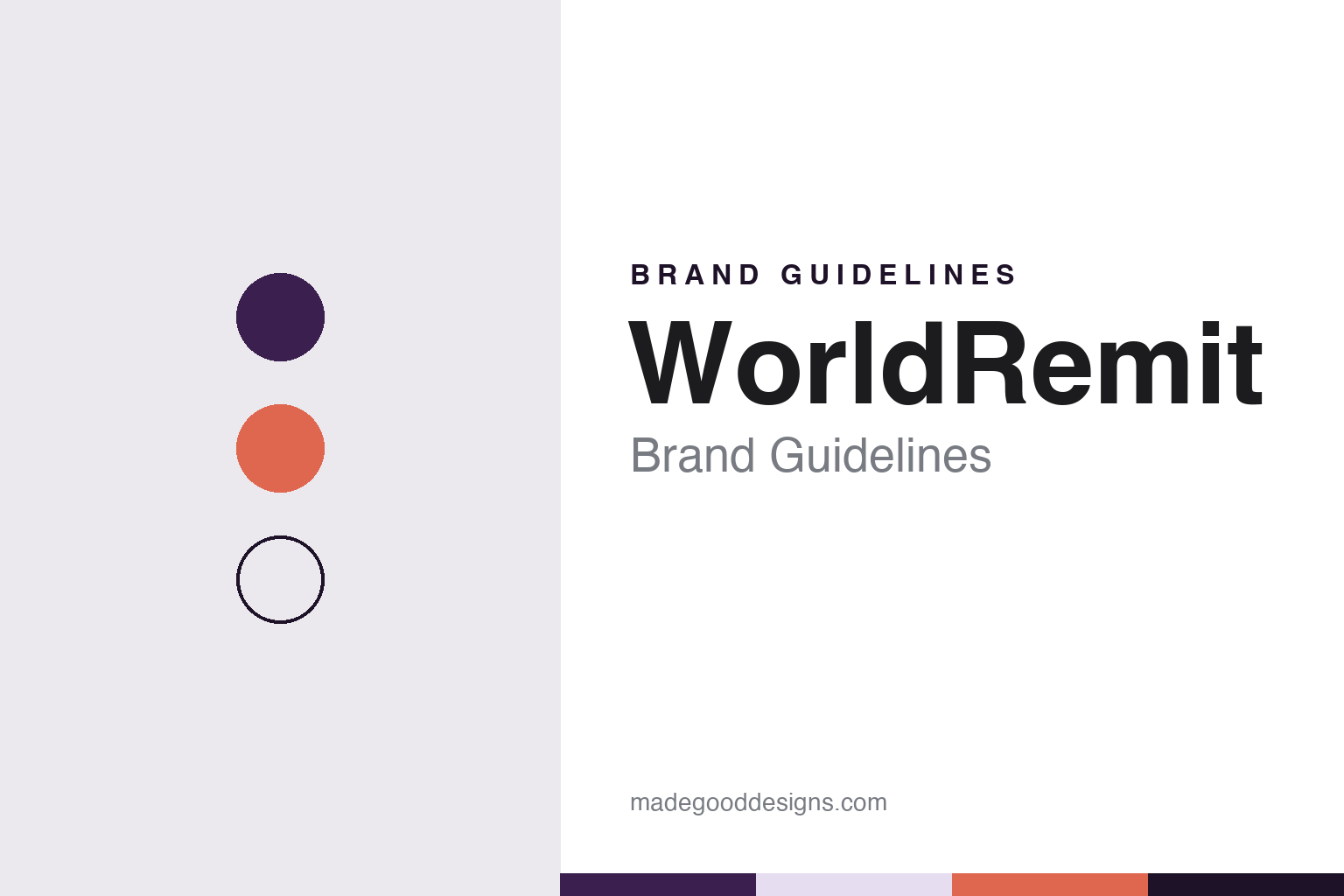
Two constants: a plum, coral and lilac palette and a Geometric sans register. Abstract homage — not a WorldRemit product or mark; no app screen or logo is reproduced.
From London, 2010
A remittance specialist starts his own service.
WorldRemit was founded in London. Its founder, Ismail Ahmed, was born and raised in Somaliland and was educated in the UK, where he studied remittances and the money-transfer industry for a PhD at Imperial College, the BBC reported in December 2014. He went on to advise smaller money-transfer firms on meeting stricter compliance rules and, from 2004, worked with the United Nations Development Programme on the same problem. After an MBA at London Business School, where he pitched the idea to investors who bought a stake, he launched WorldRemit in 2010, the BBC said.
The company names Catherine Wines and Richard Igoe as co-founders, and English Wikipedia gives the same three names. Its own telling begins earlier: as a student in London in the 1980s, the company says, Ahmed had to make a long journey to an agent each time he sent money to his family in East Africa. Companies House records show that WorldRemit Ltd was incorporated in December 2009, shortly before the service launched.
Colour
Bank, mobile money, airtime and cash.
From the start WorldRemit was digital on the sending side. In 2014 the BBC described a service that took money only through its website and app, with no agents to hand cash to, and said cash pickups made up about a third of its transactions; the rest went to bank accounts or, increasingly, to mobile phones, through agreements with networks and payment systems such as Ecocash in Zimbabwe. That year the BBC put its staff at 110 and its volume at 200,000 transfers a month. TechCrunch reported in March 2014 that the London start-up had taken its first venture investment, from Accel, and could send to some 100 countries. Ahmed told the site the money would help extend that reach and add more ways to pay out, including payments for specific needs such as utility bills or school fees, and that he expected the share of remittances sent online to grow sharply. The BBC placed the headquarters in west London.
The payout menu is still the core of the brand’s message. English Wikipedia lists bank deposit, mobile money, airtime top-up, cash pickup and cash delivery, and names mobile-money links including M-Pesa in Kenya, bKash in Bangladesh, MTN and Zaad. The company’s about page says it has served 5.7 million customers in 70 currencies across 130 countries, with regional hubs in the Philippines, the United States, Nigeria, Poland and Cameroon besides its London headquarters.
Its campaigns put the senders at the centre. In June 2023 WorldRemit launched I*mMigrant, which profiled 15 UK-based migrants — among them the Nigerian-born British video director Daps — in the first phase of a series of stories, and announced a grant programme, MyGrant, planned for 2024, the company said. The stories were published on the WorldRemit website and, the company said, in national and regional media across the UK that summer.
Inside the group, the two brands now share more than ownership. In June 2023 Zepz said a reorganisation had centralised areas of expertise across Sendwave and WorldRemit, and that it was building a single technology platform beneath both brands. Its company description at the time called Zepz a remote-first employer of more than 1,400 people, with WorldRemit’s regional offices spread from the United States and Poland to Kenya, Uganda, Somaliland and the Philippines.
Typography
Remittance brands.
Money-transfer brands work in two places at once: at a shop counter, where a sign has to be read from across the street, and on a phone screen, where the same name has to sit in a small app icon. The guides in this set look at how each brand handles that double job, from strong single-colour wordmarks in yellow, green, orange or purple to the short, easily spoken names that customers repeat to relatives abroad.
The guides also look at the practical pages these brands publish: exchange-rate calculators that show what a recipient will receive, lists of countries and corridors, and finders for agent locations. The networks behind those finders are large by the companies’ own counts: MoneyGram gives more than 480,000 retail locations, and Ria had more than 639,000 locations at the end of 2025, according to English Wikipedia. Partners such as Walmart, post offices and convenience-store chains appear alongside the brands’ own shops.
Language is part of the design. The guides note where pages, apps and customer service are offered in several languages for customers who send money to families in other countries; MoneyGram, for example, says its rebuilt app and website of October 2026 support 40 languages.
The small print matters too. MoneyGram’s website lists its licences as a money transmitter, and the guides note such licence and regulatory disclosures, along with complaint routes and, for listed companies or listed parents, investor pages with reports and filings. Each guide sets out what can be checked about the brand — who founded it, who owns it today, and how its name and network have grown — and marks clearly what rests only on the company’s own word.
Aa
A geometric sans for a digital sender. (Specimen set in Manrope, a sans STAND-IN; NOT the WorldRemit logo.)
Zepz
One group, two brands.
Ownership changed shape in 2020 and 2021. WorldRemit bought Sendwave, an Africa-focused remittance app: PYMNTS dated the purchase to August 2020, while the group’s own announcement of August 2021 said Sendwave was acquired in 2021. On 23 August 2021 the holding company, until then WorldRemit Group, announced that it had renamed itself Zepz and would keep both the WorldRemit and Sendwave brands. Zepz said its brands sent from 50 countries to 130 and covered more than 5,000 money-transfer corridors. In October 2018, Wikipedia says, the company had brought in Breon Corcoran as chief executive; he led the renamed group until August 2022, when Mark Lenhard, formerly of Bill.com, took over as group chief executive, and the WorldRemit website names him as chief executive today.
Regulators have examined the business. In November 2025 ABC News reported that AUSTRAC, Australia’s financial intelligence agency, had run a spot check of 15 online payment platforms to see whether they flagged and reported suspicious transactions, as the law requires. AUSTRAC said WorldRemit had the most concerning monitoring and reporting practices of the businesses checked, and ordered it to appoint an external auditor. A company spokesperson told the ABC that it strives to keep a positive and productive relationship with its regulator in Australia.
For a design guide, WorldRemit shows how a digital sender can make its payout options — bank, mobile money, airtime and cash — the centre of its message, and give the people who send money a face in its campaigns. Compare Sendwave, its sister brand within Zepz, and Remitly, another app-first sender. For this guide we use a deep plum, a warm coral and a pale lilac with a geometric sans, an unofficial interpretation; no product or logo is reproduced.
Explore & save
Keep WorldRemit’s identity on hand — save it to a board in the Made Good inspiration library.
WorldRemit identity set
Pin the WorldRemit plum, coral and lilac palette and the Geometric sans register to your own board.