Istituto Europeo di Design Brand Guidelines
One Milan square, one acronym, campuses in three countries.
Aa
Two constants: an ink, stone and terracotta palette and a high-contrast serif register. Abstract homage — not an Istituto Europeo di Design asset; no logo or wordmark is reproduced.
Milan, 1966
A school for the new creative professions.
The Istituto Europeo di Design (IED) was founded in Milan in 1966 by Francesco Morelli. It began in Piazza Santa Maria del Suffragio, according to both Italian Wikipedia and the institute. Interviewed by Artribune in June 2016, the year of the school’s fiftieth anniversary, IED Italia’s director Emanuele Soldini said Morelli was 24 at the time and, without a specific background in the field, had picked out the new creative professions then emerging in a fast-growing Italy, with close attention to the market and to marketing.
Teaching began with design, Soldini said, followed soon after by photography and fashion, and then by graphics and marketing courses. The institute dates the founding of a research centre, the CRSN, to 1976; it was later renamed CRIED. Fashion gained its own departments in the 1980s: the institute places a fashion department in Rome, in Piazza Colonna, in 1983, and one in Milan, by then based on Via Sciesa, in 1986. In 2002 it established a separate fashion school in Milan, on Via Pompeo Leoni, and English Wikipedia describes two Milan sites, IED Moda and IED Design.
Expansion within Italy came first. Rome opened in 1973, on Via dei Fori Imperiali, followed by Cagliari in 1984 and Turin in 1989; Artribune, Italian Wikipedia and the institute agree on those dates. The sources differ by a year on some later openings: the institute and Italian Wikipedia give Madrid as 1994, Venice as 2007 and Rio de Janeiro as 2014, while Soldini’s 2016 interview gave 1993, 2006 and 2013. They agree on Barcelona in 2002 and Florence in 2009, and the institute and Italian Wikipedia date the São Paulo campus, where the group opened in Brazil, to 2005.
Colour
Islands, palaces and a casino.
Several IED campuses occupy buildings with long histories of their own. The institute says its Venice school opened on the island of La Certosa in 2007, its Madrid school moved into the Palacio de Altamira in 2006, and its Rio de Janeiro campus opened in 2014 in the redeveloped Cassino da Urca. In Rome, where the school moved to Via Alcamo in 1996, it opened a further campus in Testaccio in 2000 for its fashion and communication courses, the institute says.
Courses kept widening. The institute dates a transportation design course in Turin to 1994 and a sound design course in Milan to 2006. Speaking to Artribune in 2016, Soldini said IED had introduced courses taught in English in the 1990s, that its design master’s programmes were then taught only in English, and that fashion and interior design drew the most international students. He also described a visual arts course shared between the Venice and Rome schools, so students could spend periods in each city.
The group has also grown by taking over other schools. In 2009 it acquired the Accademia di Belle Arti Aldo Galli in Como, a step recorded by both the institute and Italian Wikipedia, and in 2020 it joined with the Centro Superior de Diseño Kunsthal to open Kunsthal – IED Bilbao. The institute also says it was among the founders, in 1990, of Cumulus, an international association of universities and colleges of art, design and media.
IED is organised into four areas — design, fashion, visual communication and management — according to English Wikipedia. Italian Wikipedia says that in Italy its three-year and two-year courses lead to first- and second-level academic diplomas recognised under a ministerial decree of 10 December 2010; in Spain the Barcelona, Bilbao and Madrid schools award the Grado en Diseño, and in Brazil the São Paulo and Rio de Janeiro schools run three-year bachelor’s courses in fashion, design and visual arts. Courses are taught in Italian, English, Spanish and Portuguese.
Ownership has stayed private. Since 2017 the IED group has belonged to the Fondazione Francesco Morelli, a private non-profit organisation, the institute says, and in 2022 the operating company, IED S.p.A., became a società benefit, the Italian benefit-corporation form. In 2016 Soldini told Artribune the school then had eleven sites in three countries.
Typography
How fashion schools present themselves.
Fashion schools often introduce themselves through their names. Many name a city or a country outright, or describe what they teach in plain words, as the Fashion Institute of Technology in New York and the Fashion Institute of Design & Merchandising in Los Angeles did. Long names tend to shrink into acronyms in everyday use — FIT, FIDM, LCF, IED, IFM, NABA — and the short form often becomes the name people know, set as a wordmark on signage, websites and graduate-show material.
Buildings carry much of the identity. Some schools began in borrowed space: FIT, its own history says, opened in 1944 on the top two floors of a New York trade high school before moving into its first building on Seventh Avenue in 1959. New buildings are presented as statements of their own, such as the Joyce F. Brown Academic Building that SHoP Architects designed for FIT, which opened in October 2025 with exhibition cases showing student work to the street.
Parent bodies shape how a school is named and described. FIT is a college of the State University of New York; London College of Fashion belongs to University of the Arts London; other schools sit within private education groups. Names also change hands. FIT dropped the word “Design” from its original title early on, and in 2023 Arizona State University renamed its fashion programme ASU FIDM, a name that continued after the independent Los Angeles college closed in March 2025.
Graduate shows are a recurring public face. FIT holds fashion shows of work by graduating Bachelor of Fine Arts students each year, and graduate collections elsewhere are typically shown under the school’s own name. This guide looks at how each school documents its founding, owners, buildings and shows, and treats colours and type as our own interpretation.
Aa
A high-contrast serif with a Milanese accent. (Specimen set in Bodoni Moda, a serif STAND-IN; NOT the Istituto Europeo di Design logo.)
Istituto Europeo di Design
Three letters in front of a city name.
The school is known everywhere by its initials. The three letters IED stand in front of each city in its campus names, from IED Roma and IED Torino to Kunsthal – IED Bilbao, where the name of the Spanish school it joined is kept beside its own. The research centre took the name too: the CRSN, founded in 1976 as a research centre for natural structures, was renamed CRIED, the Istituto Europeo di Design Research Centre, the institute says. English Wikipedia lists among IED’s alumni the fashion designer Maria Grazia Chiuri.
The institute’s story is also a story of addresses: a Milan square in 1966, an avenue beside the Roman Forum in 1973, a Venetian island, a Madrid palace and a former casino in Rio de Janeiro. Each new site took the same three-letter prefix, so one short name links schools in very different buildings and cities.
For a design guide, the Istituto Europeo di Design shows how a private school founded in one Milan square can carry a single acronym across campuses in Italy, Spain and Brazil, letting a three-letter prefix and a city name do the work of identity. Compare NABA and Domus Academy, two other Milan schools of design and fashion. For this guide we use ink, Milan stone, terracotta and plaster with a high-contrast serif, an unofficial interpretation; no product or logo is reproduced.
Explore & save
Keep Istituto Europeo di Design’s identity on hand — save it to a board in the Made Good inspiration library.
Istituto Europeo di Design identity set
Pin the ink, stone and terracotta palette and the high-contrast serif register to your own board.
Source & notes
Frequently Asked Questions
What font can I use to match the Istituto Europeo di Design look?
This guide describes Istituto Europeo di Design’s type as “A high-contrast serif with a Milanese accent”. Its type specimen is set in Bodoni Moda from Google Fonts as a stand-in; Bodoni Moda is not Istituto Europeo di Design’s own lettering.
What colours are in the Istituto Europeo di Design palette?
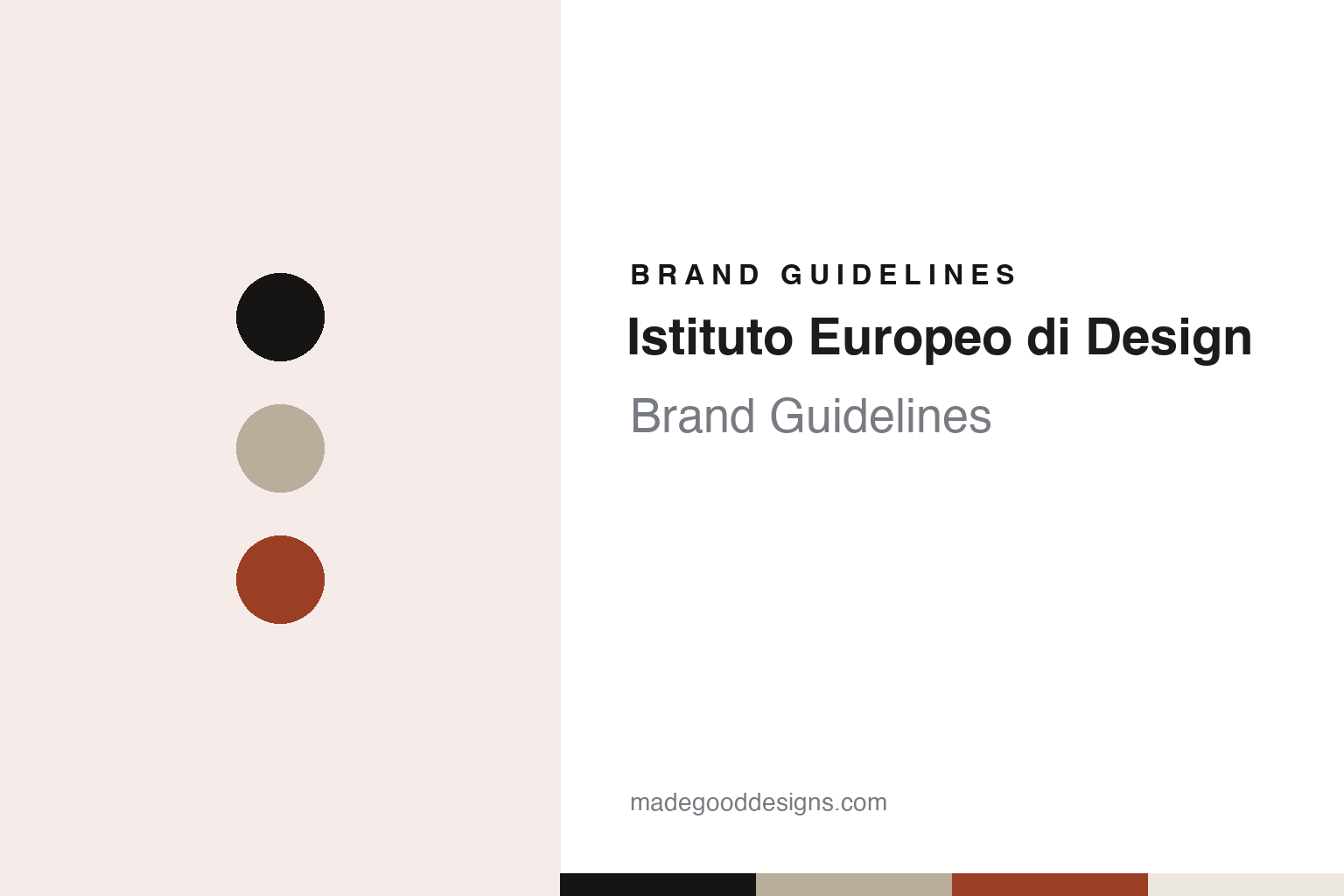
This guide’s Istituto Europeo di Design palette is Ink #161514, Milan stone #B9AE9C, Terracotta #9A3F24, Plaster #EDE8DF and Paper #F8F6F2. The tones are the guide’s own unofficial interpretation, not official Istituto Europeo di Design hex codes.
When was Istituto Europeo di Design founded?
Istituto Europeo di Design was founded in 1966, in Milan, Italy.
Who founded Istituto Europeo di Design?
Istituto Europeo di Design was founded by Francesco Morelli in 1966.
Who owns Istituto Europeo di Design?
Istituto Europeo di Design is owned by Fondazione Francesco Morelli (since 2017).