Jacques Le Moyne is remembered for two bodies of work that look nothing alike. One is a set of engravings of Florida, published after his death, in which Native communities, ships and a French fort are arranged like stage sets. The other is a group of small, quiet sheets in which a single rose, a kingfisher or a handful of garden flowers floats on blank paper. For a designer the second group is the more useful: each sheet is a lesson in isolating a subject, drawing it clearly and letting colour do the work. This guide covers both, and it keeps to what museum records and named scholars support.
The two images below are public domain watercolours held by the Metropolitan Museum of Art. For more reusable images, browse the MGD museum inspiration collection.
Who was Jacques Le Moyne de Morgues?
The Met records him as French, born in Dieppe about 1533 and died in London in 1588. Dieppe was a port with a tradition of chart-making and illumination, and accounts of his career commonly suggest that he trained there, although the early years are poorly documented and no surviving work is securely dated before he left for America.
In 1564 he sailed to Florida with the expedition led by René de Laudonnière, which founded Fort Caroline near the St. Johns River, close to present-day Jacksonville. Accounts of the venture say he was there as an artist and mapmaker. The colony did not last. In 1565 a Spanish force under Pedro Menéndez de Avilés attacked the fort, and Le Moyne was among a small group of survivors who got away.
He later settled in England, where historians place him among the flower painters working in Elizabethan London, and where Sir Walter Raleigh is reported as a patron. He died in London in 1588. The Met’s watercolours are dated only “16th century”, and this guide does not give them a more precise year.
Key works and how we know them
The Florida engravings (published 1591). Le Moyne’s account of the expedition appeared in Latin as Brevis narratio eorum quae in Florida Americae provincia Gallis acciderunt, issued in Frankfurt by the Flemish engraver and publisher Theodor de Bry, with about forty engraved illustrations and maps. It appeared after Le Moyne’s death. All but one of his original American drawings is reported lost, so the images people know are de Bry’s engraved versions.
That raises a question that scholars still argue about. The archaeologist Jerald Milanich has questioned how closely the engravings of the Timucua people reflect anything Le Moyne actually saw, and the ethnohistorian Christian Feest has argued that the one watercolour attributed to Le Moyne, owned by the New York Public Library, may be a copy of an engraving rather than the source for it. For designers the point is practical: when you work from a reproduction, you are working from an interpreter’s hand.
The Victoria and Albert Museum plant album. According to the standard account, a small bound volume of fifty-nine plant watercolours bought by the V&A in 1856 for its sixteenth-century binding was recognised as Le Moyne’s work in 1922 by Spencer Savage, librarian of the Linnean Society. Other groups of sheets, including some now in the British Museum, were attributed to him after that, and Paul Hulton’s two-volume catalogue of 1977 is the reference most often cited for the whole group.
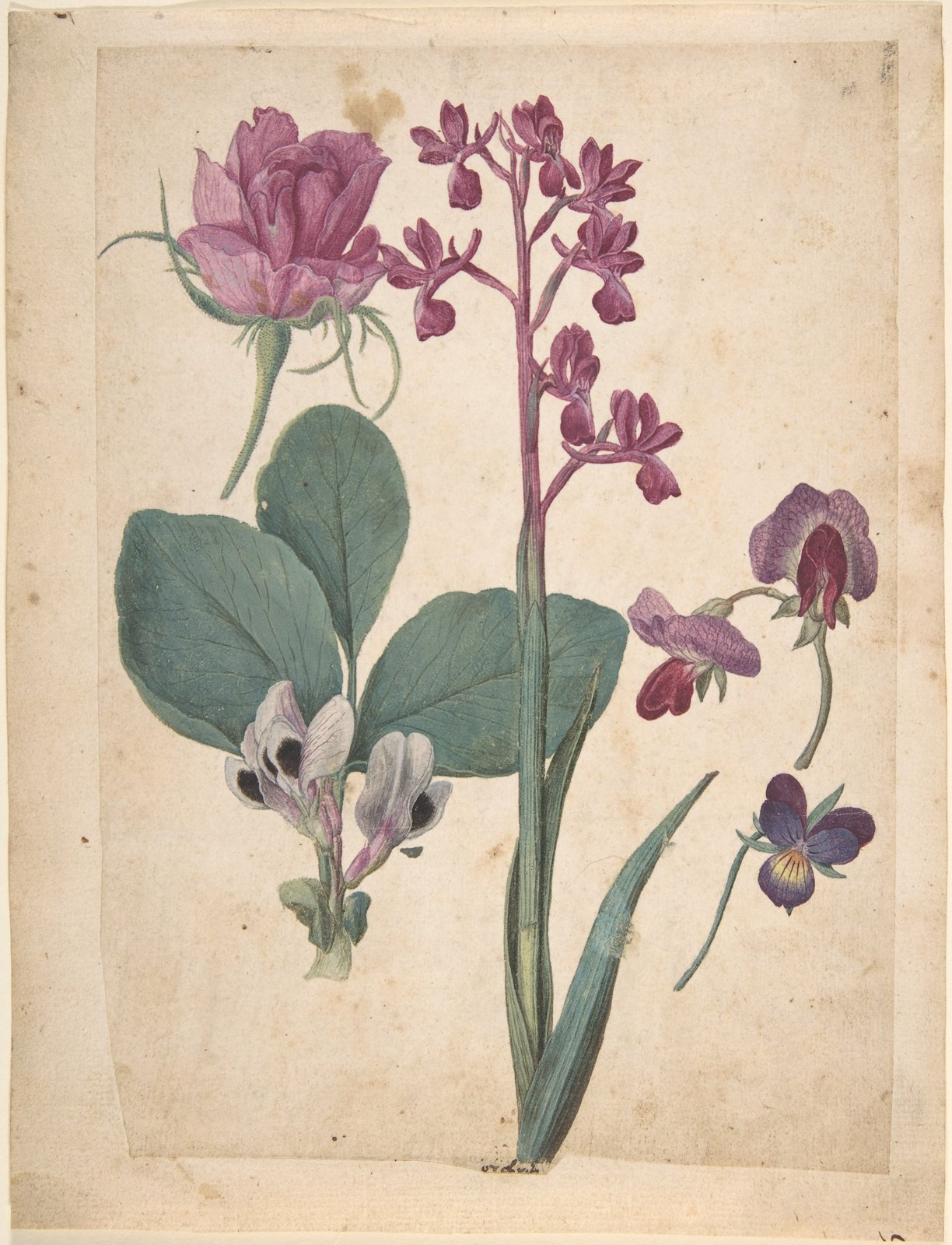
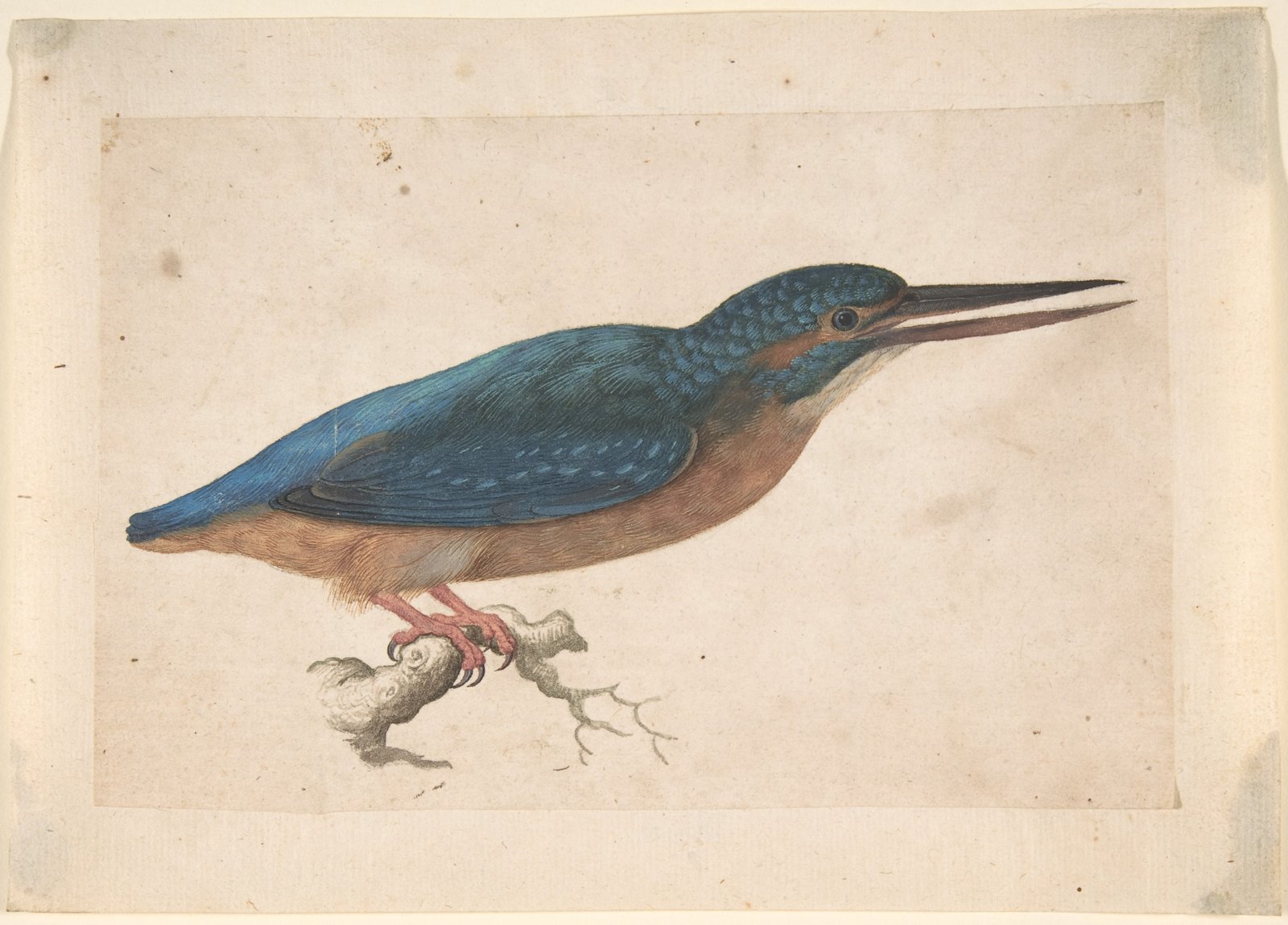
The Met sheets. The Metropolitan Museum owns two Le Moyne watercolours, both purchased in 2004 through the David T. Schiff Gift. A Sheet of Studies of Flowers shows a rose, a heartsease, a sweet pea, a garden pea and a lax-flowered orchid, in watercolour and gouache over black chalk, on a sheet of about 21.1 by 15 centimetres. A Kingfisher on a Branch is in the same media on a sheet of about 11.5 by 18 centimetres.
What to look at in a Le Moyne sheet
- Isolation. Nothing overlaps the page edge and nothing sits on a surface. Each plant or bird is cut loose from its setting and placed on bare paper, which makes every contour readable.
- Composition. On the flower sheet, the tall orchid spike acts as a spine. The rose bends toward it from the left, the pea leaves fill the lower left, and three small flowers drift down the right. The eye zigzags through the sheet without a border or a frame.
- Line and edge. Under the colour you can read the black chalk drawing, and the edges stay crisp. Veins on the pea leaves are drawn, not just implied by shading.
- Colour. Measured from the museum’s scan of the flower sheet, the pinks of the rose sit around #9f6677, the leaves around #6d7b73, and the paper ground near #d0c2af. On the kingfisher sheet the ground measures near #e6d5c0, with the plumage a cool blue-grey against a warm orange breast. These are measurements of the scan, not claims about original pigments.
Technique: chalk, wash and gouache
The Met describes both sheets as watercolour and gouache over black chalk. In practice that means a drawing first, then thin transparent colour for the underlying forms, then opaque gouache for the details that need to stand out. In the kingfisher, the blue back carries a pattern of tiny scale-like marks on the head and wing, and the open beak and pinkish feet are crisp against the soft breast. The branch is handled in a restrained grey, so the colour is reserved for the bird.
This approach descends from manuscript illumination, a tradition that was strong in France, and from the habit of sixteenth-century naturalists of recording plants and animals one at a time. Writers on Le Moyne’s flower paintings place them between those two traditions and the garden culture of Elizabethan England, which is a useful way to look at them: part record, part pleasure.
The same visual logic was later developed in printed plates. If you want to see how botanical drawing hardened into a standard layout, read our guide to botanical illustration and browse the botanical theme in the museum collection. For the engraver who carried Le Moyne’s Florida pictures into print, see our profile of Theodor de Bry.
How designers can borrow Jacques Le Moyne’s ideas
- Cut the subject loose. Product shots, icons and editorial illustrations read clearly on an empty ground. Give the subject a clean outline and let the whitespace carry the layout.
- Use one hot colour against cool neutrals. The kingfisher’s orange chest against a grey branch and cream paper is a simple palette recipe: one saturated accent, one cool counterpoint, one warm neutral ground.
- Build a sheet, not a pile. The flower sheet is a layout system: a vertical axis, a heavy mass at one corner, small elements trailing away. Use it for infographics, seed packets, plant-care cards and packaging.
- Draw under the colour. A visible underdrawing keeps a colourful illustration disciplined. In digital work, keep a line layer and colour beneath or above it.
- Mark your sources. Le Moyne’s Florida images reach us through de Bry. Credit each hand in a chain: original, copyist, publisher. Our colour palette generator can pull a swatch set from a museum scan, but always say the colours come from the scan.
Reading the Florida images critically
If you use the Florida engravings in a project, remember how they were made. The pictures are European engravings published in Frankfurt decades after the events, and scholars question how far they can stand as evidence of Native life. They are better used as examples of sixteenth-century printed narrative: a high viewpoint, small figures in groups, and captions that explain each scene. A designer can borrow that structure, a wide view with numbered or lettered episodes, for process diagrams and timelines.
Do not describe Le Moyne’s work as a documentary record without qualification. Name the engraver and say the images date from 1591.
Frequently asked questions
Who was Jacques Le Moyne de Morgues?
A French artist, born in Dieppe about 1533 and died in London in 1588, according to the Met. He travelled to Florida in 1564 with Laudonnière’s expedition and later worked in England.
Where can I see Jacques Le Moyne’s watercolours?
The Metropolitan Museum of Art in New York holds two, a sheet of flower studies and a kingfisher on a branch. The Victoria and Albert Museum in London holds a bound album of plant watercolours, and the British Museum also holds drawings attributed to him.
Did Jacques Le Moyne make the Florida engravings?
The engravings were published by Theodor de Bry in 1591 in Brevis narratio, and they are based on Le Moyne’s account and drawings. All but one of the original drawings is reported lost, and scholars including Jerald Milanich and Christian Feest have questioned how closely the engraved scenes follow what he saw.
Are Jacques Le Moyne’s images in the public domain?
The Met flags its two Le Moyne watercolours as public domain in its open-access data, so they can be reused. Check each museum’s own rights statement before reusing any other image of his work.