Wilhelm Lehmbruck made figures that seem to lean away from the viewer: long necks, lowered eyes, limbs stretched past natural proportion, surfaces smoothed until little remains except contour. The Metropolitan Museum of Art lists him as German, born in Duisburg in 1881 and dead in Berlin in 1919, and holds both a bronze head and a group of his drypoints. Few of his full-length works are available as free images, so this guide works from what museums do flag as public domain: a head in bronze and a head in drypoint, with the standing and kneeling figures described in words. More public-domain sculpture and prints are in the MGD museum inspiration collection.
Who was Wilhelm Lehmbruck?
Britannica and the Deutsches Historisches Museum’s biography site LeMO both give his birth in Meiderich, then a separate town and now part of Duisburg, on 4 January 1881. He trained in Düsseldorf: a CV published by the Ludorff gallery lists a period at the applied arts school and then the academy under Karl Janssen between 1901 and 1906, while Britannica describes his early output as academic and conservative. Accounts of the period note the large 1904 international exhibition in Düsseldorf, where sculptures by Auguste Rodin were shown, as an early influence.
The decisive change came in Paris. According to biographies including the one on the Lehmbruck Museum’s website, he moved there in April 1910 and lived in Montparnasse, where he met other sculptors working there, among them Constantin Brâncuși, Alexander Archipenko and Amedeo Modigliani. The Tate’s artist biography notes his special admiration for Rodin and for Aristide Maillol. Maillol’s calm, rounded classicism is usually linked to the quieter forms of his Standing Woman of 1910.
The First World War ended his time in Paris. One biography has him reaching Berlin via Cologne at the end of 1914, another has him settling there in 1915; the Lehmbruck Museum says he was not sent to the front but worked for a time in a military hospital in Berlin-Friedenau. In 1916 he moved to Zurich, and in early 1919 he returned to Berlin, where LeMO records his appointment to the Prussian Academy of Arts on 24 January. He died in Berlin on 25 March 1919, aged 38.
Key works by Wilhelm Lehmbruck
- Standing Woman, 1910, and Large Standing Figure, 1910–12 (dated variously), where his own proportions begin to appear.
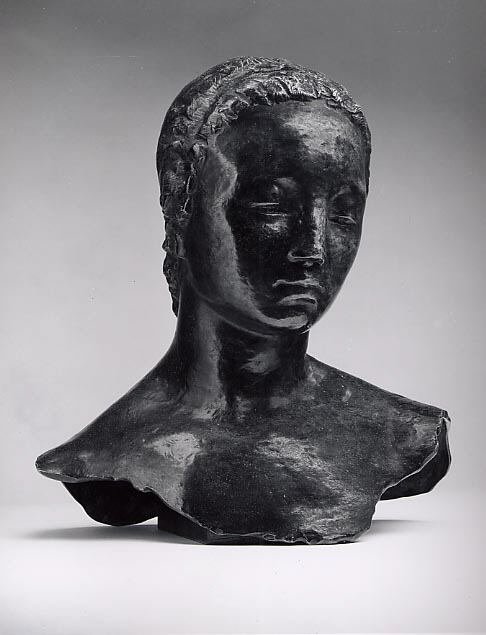
- Head of a Woman, ca. 1910, cast ca. 1930, bronze, Metropolitan Museum of Art.
- Kneeling Woman, 1911, a figure with markedly lengthened limbs; Britannica and Encyclopedia.com both use it as the example of his elongation.
- Head of a Woman (Kopf Groß), 1912, drypoint, Metropolitan Museum of Art.
- Three Women, 1912, drypoint, Cleveland Museum of Art.
- Standing Youth, 1913.
- Fallen Man, 1915/16, and Seated Youth, dated 1916/17 by the Lehmbruck Museum and 1918 by Britannica.
- Macbeth drypoints, 1918, in the Met’s collection.
What to look at: the lowered head
The Met’s bronze Head of a Woman is the clearest introduction to his language. The museum gives its size as 43.8 by 36.8 by 21.6 centimetres and notes that it was cast about 1930, after Lehmbruck’s death, from a model of about 1910. Look at the head from the front. The face is a long oval with a straight nose, closed or half-closed eyes and a small, level mouth. The braids lie flat against the skull. The neck is long and the shoulders end in a sharp, cut-off line, so the form reads as a tall vertical rather than a classical bust.
The effect is stillness. Nothing is turned, raised or shouted. In design terms, the face is drawn with very few decisions: one oval, two soft arcs for the lids, one line for the mouth. The viewer fills in the feeling. Brand illustrators who want a calm, thoughtful character can borrow this directly, since a lowered gaze and a long neck do more than detail.
The photograph itself is black and white, so the only colours available are tones. Measured from the Met’s scan, they run from near-black #28272b through #5f5f62 and #79787b to light greys #b2b0b3, #d1ced3 and #ece9ee. These are values from a museum photograph, not the colour of the bronze.

Line: the drypoint heads
MoMA says that Lehmbruck made 183 drypoints and 17 lithographs between 1910 and 1919, and that all of them depict figures. The Met’s Head of a Woman (Kopf Groß) of 1912 is a drypoint, a technique in which the artist scratches directly into a metal plate with a needle, raising a burr of metal that holds ink and gives lines a soft, slightly furry edge. The Met records the plate at 29 by 26 centimetres and the impression came to the museum through the Harris Brisbane Dick Fund in 1923.
The line is thin and hesitant on purpose. The contour of the neck and shoulder is a single stroke; the hair is a loose scribble; the eyes have just enough hatching to look heavy. Large areas of the sheet remain blank. In the margin below the plate, the impression carries a pencil title and a signature, a convention of the period that gives every print a built-in caption. Measured from the museum’s scan, the paper ground is a warm cream: #c2b093 at the shadowed edge and #e2ceac, #efdab5 and #f7e5c2 across the sheet. They are scan values, not the paper’s true tone.
For designers, the drypoint is a model of how to use empty space. If the subject is clear, the line can be minimal, and the paper does half the work. The same logic suits packaging, editorial spot illustrations and letterhead. Expressive art of this period is covered in the museum’s expressionism theme and in our guide to expressionism in art.
Technique: modelling, casting and reproducing
Lehmbruck’s sculpture was modelled and then cast, and the casting often happened after his death. The Met’s bronze head is an example, with a cast date of about 1930. That matters if you are looking at a catalogue: a bronze dated to a lifetime model but cast later is a posthumous cast, and museum records usually say so.
His prints followed a similar path. The Berlin publisher Paul Cassirer is named by MoMA as the publisher of a posthumous edition of Potiphar’s Wife, dated 1920. Both sculpture and print were therefore designed to be reproduced, a useful reminder for anyone making work meant to exist in multiples.
For other sculptors from the Paris scene of these years, see our guide to Jacques Lipchitz, and for the earlier sculptor whose work was shown in Düsseldorf in 1904, see Auguste Rodin.
Copyright and the works shown here
The museum APIs flag the Met’s bronze head and drypoint as public domain, and they are shown here on that basis. Lehmbruck died in 1919, so many of his works are in the public domain in the United States, but status can differ by country and by individual work or edition. Check the museum’s record before reusing any image.
How designers can borrow from Wilhelm Lehmbruck
Stretch the proportions
Lengthen one thing, such as the neck, the stem or the letter ascender, and keep everything else simple. The slight distortion becomes the signature.
Let a lowered gaze carry the mood
Quiet characters are often drawn with eyes down and mouth level. They read as thoughtful, which suits cultural, educational and wellness brands.
Draw less, leave the paper
Use one continuous contour and let the ground show. The image colour picker can pull the warm paper tones from a museum scan to use as a background.
Plan for the edition
If you make a motif for print, merchandise or packaging, design it to hold up when reproduced. Check the rules for reuse in our guide to public-domain art.
Frequently asked questions
Who was Wilhelm Lehmbruck?
He was a German sculptor and printmaker, born in Meiderich, now part of Duisburg, in 1881, and died in Berlin in 1919. He is known for slender, lowered-head figures made after he moved to Paris in 1910.
What is Wilhelm Lehmbruck known for?
Reference sources such as Britannica name Kneeling Woman (1911), Standing Youth (1913), Fallen Man and Seated Youth as key works, with elongated proportions as a defining trait. He also made well over a hundred drypoints, according to MoMA.
Where can I see Lehmbruck’s work?
The Lehmbruck Museum in Duisburg holds a large collection of his sculptures, prints and drawings. The Metropolitan Museum of Art and the Cleveland Museum of Art hold prints and other works, and the Met also has a bronze head.
Are Lehmbruck’s works public domain?
The museum APIs flag the two works shown here as public domain. He died in 1919, so many works are public domain in the United States, but check each museum record, since posthumous casts and editions can be treated differently.