Jargar Brand Guidelines
Jarl Hansen’s Danish steel-core strings, since 1956.
Aa
Two constants: a Jargar ink, steel and Danish red palette and a Classic serif register. Abstract homage — not a Jargar product or mark; no string, packaging or logo is reproduced.
Jarl Hansen
An orchestral cellist who wanted more than gut.
Jargar Strings is a Danish maker of strings for bowed instruments, founded in 1956 by the cellist Jarl Hansen. The company’s history page says Hansen, a member of the Royal Danish Orchestra — named on an earlier version of the page as the Royal Danish Opera Orchestra — came to a realisation in about 1950: the gut strings on his cello “did what they had always done,” but he wanted more from his instrument.
He experimented in his spare time for years, the company says, “until 1956, when he was ready to start his own company, Jargar Strings.” Its current history page puts the experiments at six years. Thomastik-Infeld, the Vienna string maker whose group Jargar has since joined, also gives the founding as “in Denmark in 1956.”
What Hansen developed, the company says, was a string with a steel core wound with thin threads of pure or alloyed metal. Compared with gut, it says, the new strings held their pitch better and were stronger and longer-lasting; they responded quickly and had a warm, brilliant and powerful tone. “Bring on Wagner,” the current history page says, “and Jargar Strings will respond accordingly.” Those qualities, the company says, quickly made Jargar strings popular throughout the world of classical music.
Colour
A family firm in and around Copenhagen.
For most of its history Jargar was a small Danish company. An archived 2006 version of its website described “a family-owned company” in Copenhagen that “upholds a tradition for world-class handmade strings for violin, viola, cello and bass.” In 2016 the company, Jargar Strings ApS, gave an address in Østerbro, in Copenhagen; by 2021 it had moved to Søborg, in Gladsaxe just north-west of the city, where its website footer still placed it in January 2026.
The range has grown beyond the steel-core original, and the company says it now also makes strings from synthetic materials. Its current catalogue lists the Superior, Classic, Evoke, Young Talent and Eccentric lines for violin; the Superior and Classic for viola; and for cello the Superior, Special, Young Talent, Classic, Evoke and Eccentric. It describes the Superior violin set as giving “a warm and clean sound that is both focused and direct,” the Classic as a good match for piezo pick-ups because of its minimal bow noise, and the Eccentric as “fast, edgy, with a full tonal core.”
The company’s advice to players is practical rather than promotional. Its FAQ says the best set “can only be found via a personal journey of trying,” ideally with the guidance of an experienced colleague or luthier; that silver-wound strings usually sound warmer and more colourful, with a slightly slower response, than aluminium- or nickel-wound ones; that strings keep best at room temperature and 40 to 60 per cent relative humidity; and that, for an ideal result, the whole set should be changed at once, string by string. It also publishes a table comparing its products’ main characteristics, while admitting that describing sound in words “is quite a challenge.”
The website also works as a small publication. Its Sound Lab, Sound Book, Sound Talks and Sound Sessions sections offer articles, conversations and master classes, and its artist pages quote players including the Rolston Quartet, the violinist Niklas Walentin and the cellist Soo-Kyung Hong. Outside the company’s own pages, Strings magazine reported in 2019 that Cynthia Phelps, principal violist of the New York Philharmonic, uses a mix of Pirastro and Jargar strings, as Wikipedia notes.
Typography
The orchestral accessory trade.
The seven brands here make the small things string players handle daily, in four trades. Two make shoulder rests. Kun was started in Ottawa by Joseph Kun, who, the company says, left Czechoslovakia for Canada in 1968 and had the design patent for its first rest published in 1972; it says its products are made in Canada. Bon Musica is the trade name of Bonmusica OHG of Vettweiß, in western Germany, whose own product notes describe the bendable, plastic-coated aluminium rest it manufactures.
Two work on the bow. CodaBow began in Winona, Minnesota, in 1993 as a partnership between the materials scientist Stan Prosen and the engineer Jeff Van Fossen, its early website said, and describes its carbon-fibre bows as made in the USA. Hidersine, the British rosin maker, says on its website that it was founded in London in 1890, though the same site has also given 1876; it says the music company Barnes & Mullins bought it in 1987 and moved production to Oswestry, in Shropshire.
Two make strings. Jargar was founded in Denmark by Jarl Hansen, a cellist in the Royal Danish Orchestra, after experimenting from 1950; its website now calls it part of the Thomastik-Infeld family. Warchal, a Slovak company, was established in 2003 by the violinist Bohdan Warchal Jr., concertmaster of the Slovak Chamber Orchestra, which his father founded in 1960.
The seventh, Wittner, makes metronomes and fittings. It says Gustav Wittner founded it in 1895; it is based in Isny im Allgäu, labels almost all its products Made in Germany, and since 2024 has belonged to GEWA music of Adorf, in Saxony.
This guide sets out what can be checked about each brand — who founded it, who owns it, and what it says about where its products are made — and marks clearly what rests only on the company’s own word.
Aa
A classic serif for a mid-century Copenhagen string house. (Specimen set in Libre Caslon Text, a serif STAND-IN; NOT the Jargar logo.)
Jargar
Part of the Thomastik-Infeld family.
Jargar’s ownership has changed recently. By 2023 its webshop was operated by THOMASTIK-INFELD d.o.o., the Croatian subsidiary of the Viennese string maker, while the website still named Jargar Strings ApS in Søborg as the company behind it. By March 2026 Thomastik-Infeld had posted “Welcome, Jargar Strings” on its own website, calling Jargar “a valued part of the Thomastik-Infeld family” and saying that the brand “is now available in our portfolio.” The Jargar website now gives Thomastik-Infeld GmbH in Vienna as its address and describes the brand as “part of the Thomastik-Infeld family,” while still carrying the Jargar Strings ApS name.
Where the strings are made is less clear than it once was. In 2006 the company presented its strings as handmade in Copenhagen, and its 2016 history page still called them “handmade.” The current page says that its production “is state-of-the-art, but we still uphold the handcrafted quality steps,” which it calls “old-fashioned in the modern way,” without saying where that production now takes place. We therefore make no claim about the current factory.
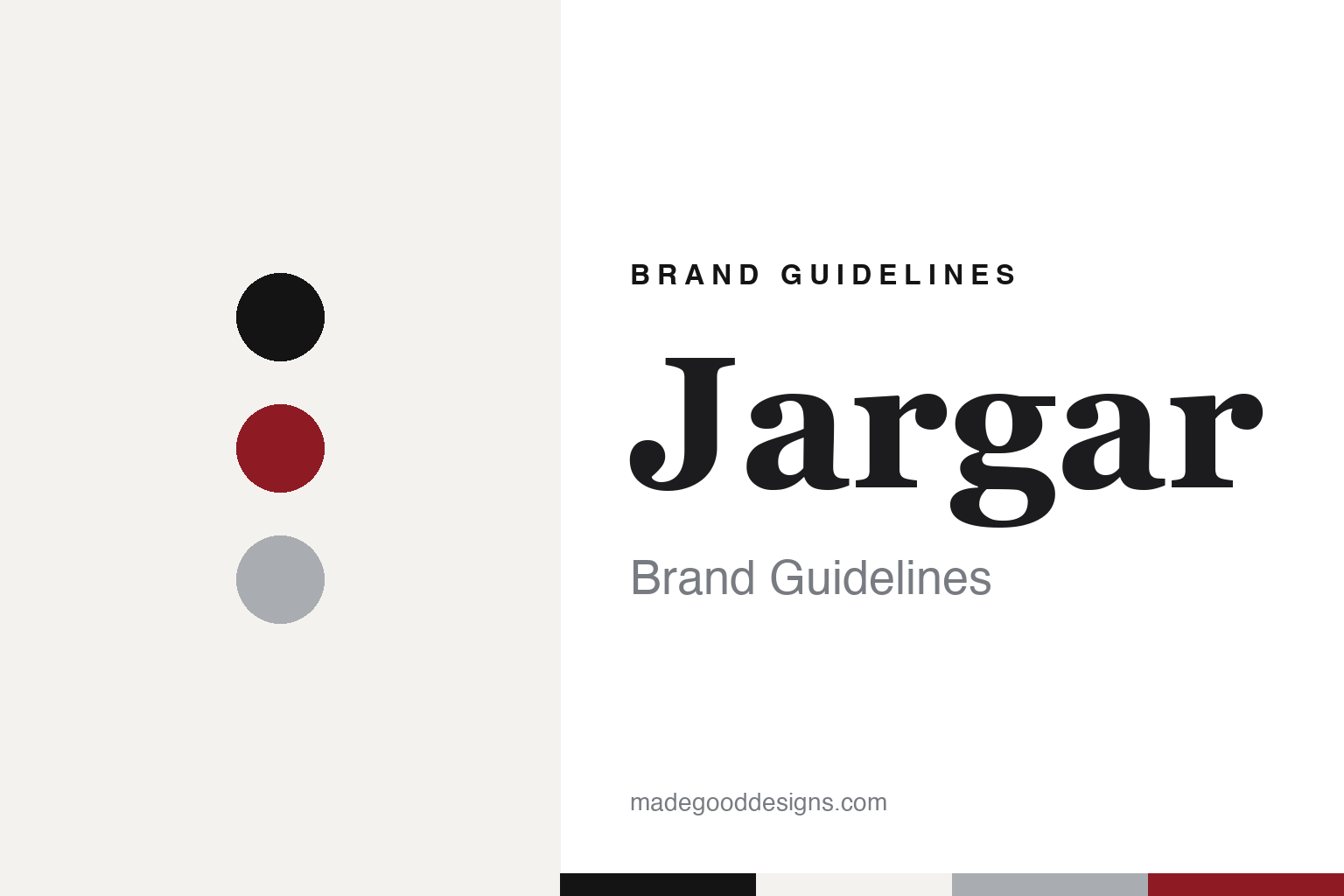
No colour or typeface standard is published, so the palette below is our own reading of the product: steel strings, dark ink and a red borrowed from the Danish flag.
For a design guide, Jargar shows how a specialist can keep a founder’s story — one orchestral cellist, years of spare-time experiments — at the centre of its identity, even inside a larger group. Compare Thomastik-Infeld, the Vienna string maker whose family Jargar has joined, and Larsen Strings, another Danish string maker. For this guide we use ink, string steel and a Danish red with a serif, an unofficial interpretation; no product or logo is reproduced.
Explore & save
Keep Jargar’s identity on hand — save it to a board in the Made Good inspiration library.
Jargar identity set
Pin the Jargar ink, steel and Danish red palette and the Classic serif register to your own board.