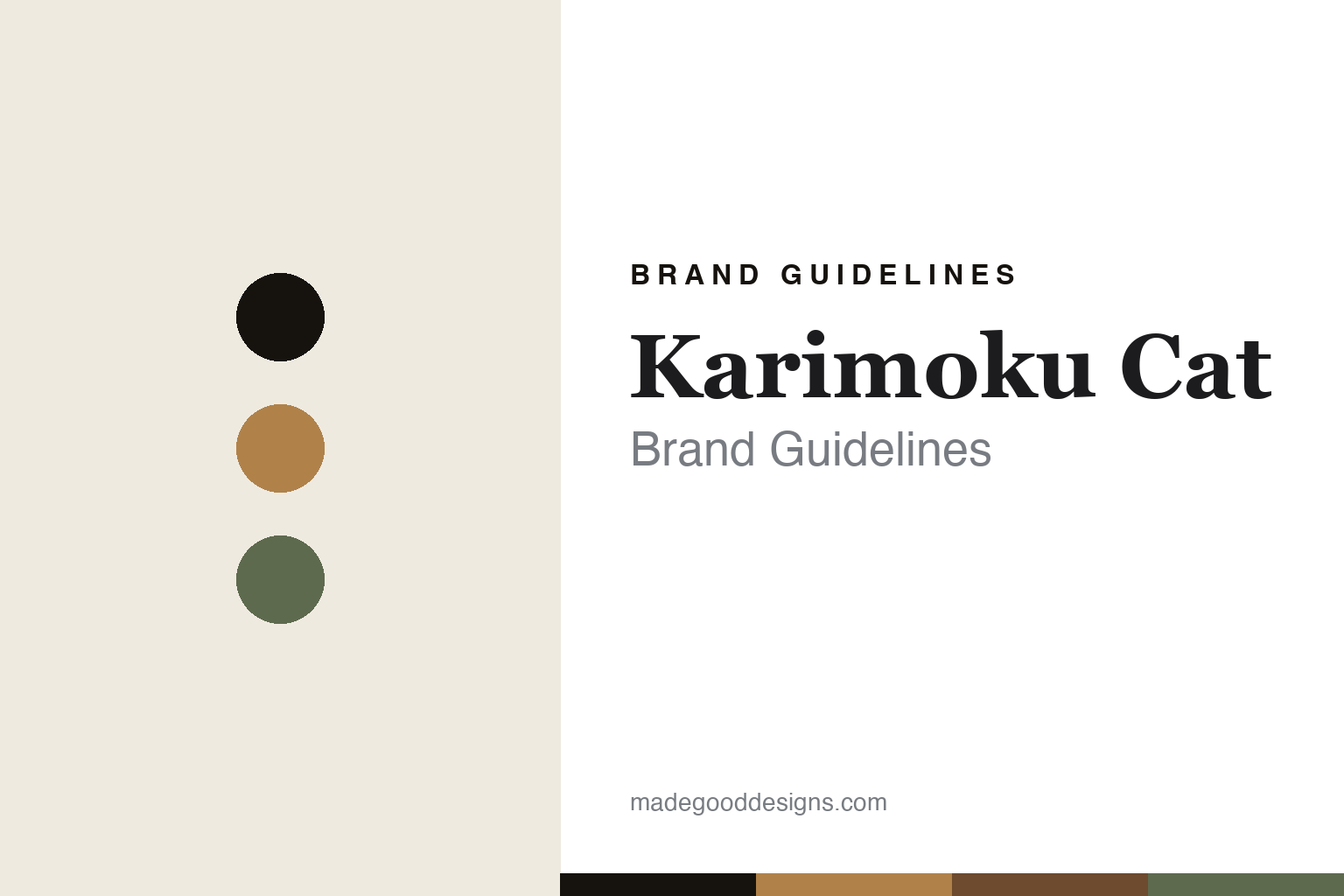
Karimoku Cat Brand Guidelines
The cat tower.
Aa
Two constants: a honey-wood palette and a craft serif register. Abstract homage — not the Karimoku Cat tower or wordmark.
The cat tower
Karimoku makes a cat tree that is real furniture.
Karimoku Cat is a lesson in furniture craftsmanship as the identity. A design cat-furniture line from Karimoku, the Japanese wood-furniture maker, it launched around 2019 and made its name with a wooden cat tower built to furniture grade.
Its identity is the cat tower. Karimoku Cat’s wooden cat tree is the object it is known for — solid wood, furniture-grade joinery — designed to blend into a modern interior rather than look like typical carpeted cat gear. A cat tree that is real furniture. Pet gear made by a furniture house.
(Honest notes: Karimoku Cat is a design cat-furniture line by Karimoku (Karimoku Furniture Inc.), a Japanese wood-furniture maker founded in 1940 in Aichi and now third-generation family-run; the cat line launched around 2019 (its cat tree won an iF Design Award in 2020, so we date it to ~2019 and flag the exact date), developed with the design studio RINN. Its signature is the wooden cat tree/tower (designed by Yoh Komiyama), built with Karimoku’s furniture-grade woodworking under a “Cat First” philosophy, with craft details like anti-slip textured steps. It is genuinely made in Japan. One clarification: “Karimoku Cat” is distinct from Karimoku’s other lines (Karimoku60, Karimoku Case Study and others), and RINN is a design partner, not the owner. There’s no official brand hex, and we reproduce no cat tree or logo — these tones are an unofficial interpretation. This is design commentary and does not promote any product.)
Colour
Karimoku Cat lives in a honey-wood palette. Click a swatch to copy the hex.
Karimoku Cat’s identity is warm, wooden and crafted — a honey oak, an ink, a walnut, a moss, and a cream. The palette leans honey wood — the register of solid-wood furniture in a warm interior. It signals craft and calm rather than novelty. The honest caveat: with no published brand hex, these tones are an original, unofficial interpretation, not first-party values.
The lesson is a honey-wood palette signals furniture-grade pet design. Karimoku Cat’s world is a warm, crafted, wooden object. For designers, it is a reminder that a furniture maker’s craftsmanship can transform a pet product — turning a carpeted cat tree into real furniture — and that a warm wood palette signals that quality. Because a honey oak can fail as small text, keep type dark and let the colour live in the accents, palette and band. The takeaways: apply real craft; use solid wood; make it furniture; and treat any single hex as unofficial.
Typography
The register is a craft serif — warm, refined, considered.
Karimoku Cat’s identity carries a warm, refined, considered spirit — a crafted, wooden object. A quiet text serif captures the mood: it is elegant and grounded, the register of a furniture house. Set in a honey-wood palette, the craft serif feels warm and refined — exactly the personality Karimoku Cat carries. It is considered rather than showy, mirroring furniture-grade joinery. (Karimoku Cat’s real cat tree and wordmark are works we describe but do not reproduce, and the exact typeface is not ours to use.) Because it is not ours to use, the honest description is “a craft serif spirit,” shown here in a stand-in. The type behaves like the brand: warm, refined and considered.
Aa
A craft serif spirit — warm and refined. (Specimen set in Spectral, a quiet text serif STAND-IN; NOT the Karimoku Cat wordmark.)
Furniture craftsmanship as identity
Karimoku Cat stands for the cat tower.
Karimoku Cat is a lesson in making furniture craftsmanship the identity. A honey-wood palette, a craft serif and a solid-wood cat tree make furniture-grade craft the whole brand — warm, wooden, considered. The craft is the differentiator. The differentiator is a furniture house’s woodworking applied to a category usually made of carpet and cardboard.
Put to work, the identity is craft transferred. A designer building in this spirit would bring genuine furniture-making — solid wood, real joinery — to a pet product, so a cat tree becomes an object worthy of a living room. The lesson Karimoku Cat teaches is that provenance can elevate a category: when a respected furniture maker builds cat furniture to its own standard, the result is real furniture, and a warm, crafted design language makes that quality legible.
For designers and brand-builders, Karimoku Cat offers a clear takeaway: bring real craft to a neglected category. The lessons: apply real craft; use solid wood; make it furniture; and be honest about the story. It is also a reminder to stay accurate: it is a line by Karimoku (founded 1940 in Aichi), it launched around 2019, and it was developed with RINN as a design partner — the palette here is an unofficial interpretation. And it is a reminder that made-where honesty can also be a point of pride: Karimoku Cat is genuinely made in Japan, and saying so plainly is both accurate and part of the appeal — a contrast with pet brands whose manufacture is offshore or undisclosed. It is a reminder, too, that lines need distinguishing: Karimoku Cat is separate from Karimoku60 and Karimoku Case Study, and keeping them distinct respects each. Karimoku Cat made the cat tower the brand — proof that furniture craftsmanship can be the difference.
Explore & save
Keep Karimoku Cat’s identity on hand — save it to a board in the Made Good inspiration library.
Karimoku Cat identity set
Pin the honey-wood palette and the craft-serif register to your own board.


