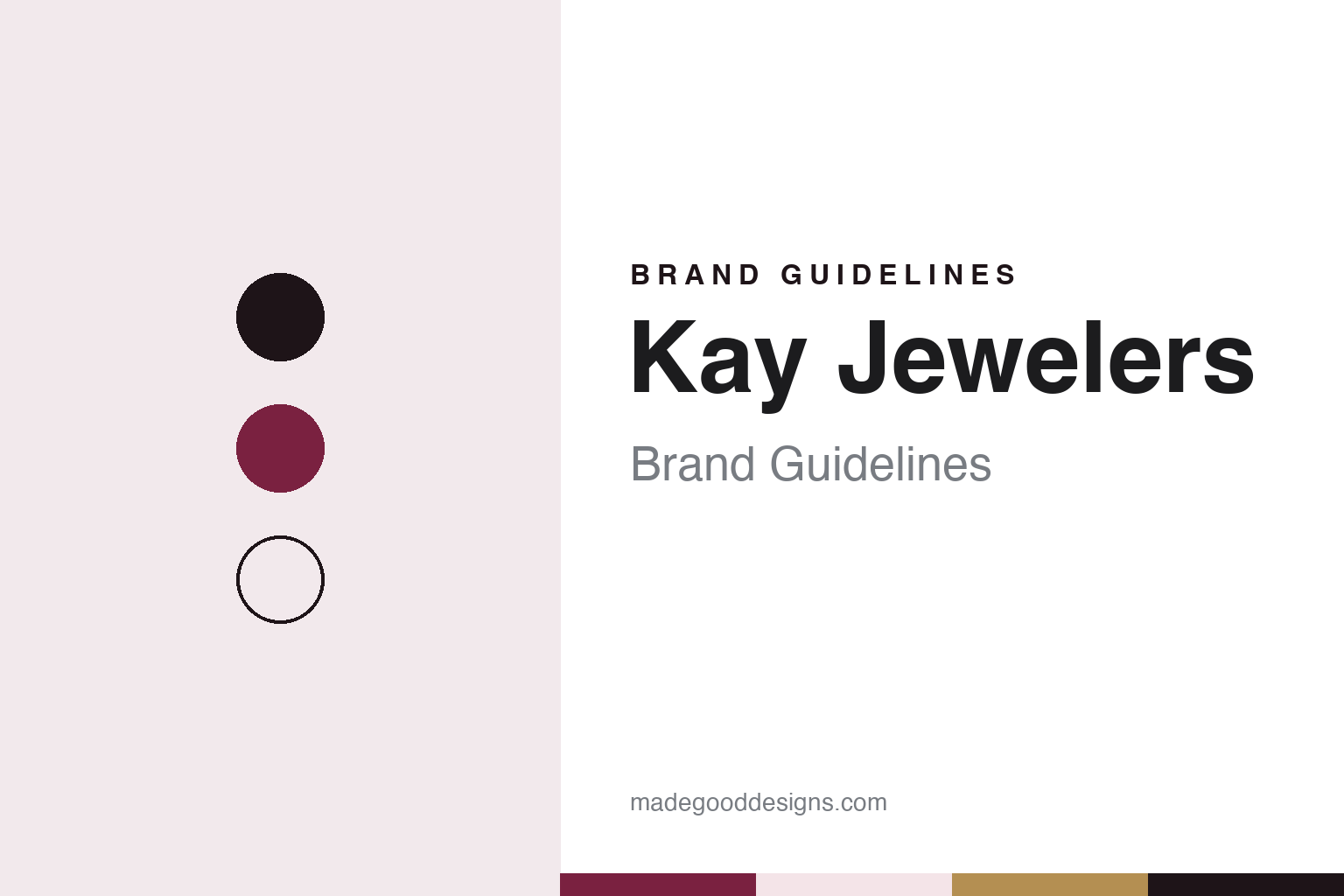
Kay Jewelers Brand Guidelines
The Reading store of 1916 that became Signet’s mall chain.
Aa
Two constants: a Kay berry red, blush and gold palette and a Romantic serif register. Abstract homage — not a Kay product or mark; no ring, logo or store sign is reproduced.
Reading, 1916
Two brothers and a general store of gifts.
Kay Jewelers dates itself to 1916. The company says its first storefront opened that year in Reading, Pennsylvania, and that customers there could buy eyeglasses, music boxes, silverware and appliances as well as jewellery. An article published by the Israeli Diamond Industry portal in October 2016 names the founders as two brothers from Pennsylvania, Sol and Edmund Kaufmann, and says the early store sold musical jewellery boxes, electric razors and even radios before it narrowed its focus to jewellery for a broad public.
Kay grew into a chain of shopping-mall stores along the East Coast. By 1990, according to the International Directory of Company Histories, Kay Jewelers Inc. ran nearly 500 stores: 426 Kay stores, located mainly on the East Coast, 82 stores in the regional JB Robinson chain and 48 jewellery boutiques in Marcus department stores.
That year it changed hands. The British jeweller Ratners, which had entered the American market in 1987 by buying Sterling and Westhall, both based in Ohio, agreed in 1990 to acquire Kay Jewelers, the same history says. After the deal Ratners’ American store count neared 1,000, which made the United States its largest market for the first time. Ratners had expanded quickly in the late 1980s and entered the 1990s heavily in debt; in the early 1990s the group dropped the Ratners name and became Signet, the name it still uses.
Colour
The mall flagship.
Inside Signet, Kay became the core of the American business. The International Directory of Company Histories, in an entry that runs to early 2004, described the mall-based Kay chain as the group’s United States flagship, run through its Ohio subsidiary Sterling, while the larger, free-standing Jared stores, first opened in 1993, were the fastest-growing part of the group. When Signet bought the 137-store Marks & Morgan chain in 2000, it converted a little more than half of those stores to the Kay name, the same entry says.
Sterling Jewelers, the subsidiary that operates Kay, is based in Akron, Ohio, in the Fairlawn suburb, and has belonged to Signet since 1987, English Wikipedia says. In October 2016, a century after the first store opened, the Israeli Diamond Industry portal reported that Kay ran 1,094 stores in all 50 US states, in regional malls, outlet malls and power centres, the open-air retail parks built around large stores. Kay’s own website now speaks of locations in about 1,000 communities across the country.
The group grew again in 2014. Signet agreed to buy the Zale Corporation in February 2014 and completed the purchase that year, according to the Handbook of Texas Online, which brought Zales and, in Canada, Peoples Jewellers into the same group as Kay. In 2016 Kay, Zales and Jared introduced Ever Us, a collection of two-stone diamond rings, earrings and pendants, the Handbook says.
Kay’s operator has also faced two federal cases. In May 2017 Sterling settled a sex-discrimination case brought by the US Equal Employment Opportunity Commission in 2008 over the pay and promotion of female retail sales staff; under the consent decree it agreed to have its policies reviewed by an outside expert and to appoint a compliance officer, and the company said the decree carried no monetary award and no admission of wrongdoing, JCK reported. A separate class arbitration was continuing at the time. In January 2019 the Consumer Financial Protection Bureau and the State of New York settled claims that Sterling had opened store credit-card accounts and enrolled customers in payment-protection insurance without their consent; Sterling paid civil penalties and agreed to injunctive relief, according to the Bureau.
Typography
How jewellery chains present themselves.
Jewellery chains in North America and Asia sell much of the same thing — engagement rings, wedding bands, gold chains and gifts — but they present it through the places they trade. In the United States and Canada the typical store sits in a shopping mall, often beside rival banners owned by the same group; in Hong Kong, mainland China and India, the chains’ own store pages often show gold jewellery at long counters and bridal sets as a category of their own.
Advertising carries much of the identity. American chains have long built their brands on television campaigns and on credit offers for buyers paying in instalments, and in recent years their campaigns have widened from engagement and anniversaries to everyday wear and self-purchase, as the trade press reports. Asian chains publish campaigns tied to weddings and festivals, and some name their collections after the occasion, the material or the craft rather than after a designer.
Ownership is often more complicated than the shop sign suggests. Several North American names that began as family businesses now belong to listed groups or to holding companies, and some have changed hands more than once, through mergers, takeovers and restructurings. Several Asian chains are listed on a stock exchange, and their corporate pages name the founders and the controlling shareholders alongside the listing.
This guide sets out what can be checked about each brand: who founded it, where and when, who owns it now, how it has presented itself in its stores and campaigns, and what rests only on the company’s own word. Store counts are given with the date of the source that reports them.
Aa
A romantic serif — KAY in capitals. (Specimen set in Fraunces, a serif STAND-IN; NOT the Kay logo.)
KAY
Love All In.
Kay’s identity is carried mainly by its advertising. In October 2024 National Jeweler reported that Kay was being rebranded to appeal to the next generation of jewellery shoppers, with a campaign about everyday, “authentic” love, a refreshed product assortment and plans for redesigned stores. The next stage came in September 2026. The “Love All In” campaign launched on 8 September 2026 with a 60-second film set to “Everything is Romantic” by Charli XCX, featuring Caroline Polachek, shown on television, streaming, digital and social channels, National Jeweler reported. The trade paper said the jeweller was cutting its assortment by a fifth in selected categories and giving more room to custom-made and men’s jewellery, alongside a redesigned website and stores with new displays and product information.
The launch was staged during New York Fashion Week, with a pop-up shop in SoHo and a jacket made with the fashion label Public School NY and set with 550 lab-grown and natural diamonds, according to the same report. On Kay’s current website the name is written in capitals, as KAY. National Jeweler placed the relaunch within Signet’s work to set its American banners — Kay, Zales, Jared and Banter — apart from one another, and noted that Zales had launched its own campaign, “You Are The Occasion,” a few weeks earlier.
For a design guide, Kay shows how a mall chain can rest its identity on one emotional theme and restate it as its audience changes. Compare Jared, its sister chain in the Signet group, and Zales, which joined the group in 2014. For this guide we use a berry red, a blush pink and a warm gold with a serif, an unofficial interpretation; no product or logo is reproduced.
Explore & save
Keep Kay Jewelers’s identity on hand — save it to a board in the Made Good inspiration library.
Kay identity set
Pin the Kay berry red, blush and gold palette and the Romantic serif register to your own board.