Zales Brand Guidelines
The Wichita Falls credit jeweller of 1924, now part of Signet.
Aa
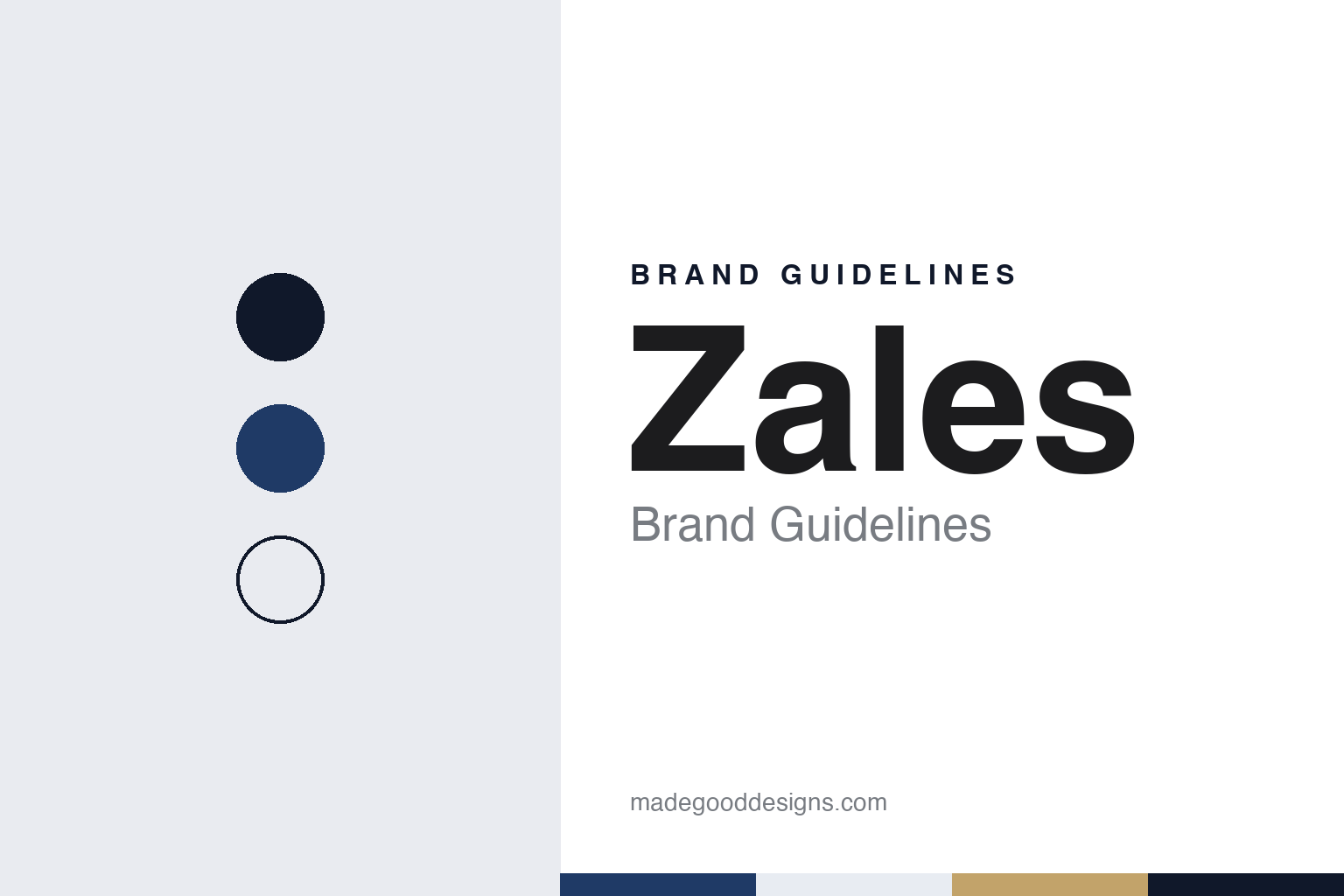
Two constants: a Zales deep blue, silver and gold palette and a Clean retail sans register. Abstract homage — not a Zales product or mark; no ring, logo or store sign is reproduced.
Wichita Falls, 1924
Jewellery on weekly credit.
Zales began as a single shop in Wichita Falls, Texas. The Zale Jewelry Company was organised on 17 March 1924, according to the Handbook of Texas Online, published by the Texas State Historical Association. Morris B. Zale, a Russian Jewish immigrant, founded it and was its first president; his brother William Zale was vice president, and his brother-in-law Ben Lipshy was a third partner. The store sold cameras, small appliances and cookware as well as jewellery.
Its model was selling to working people. The Handbook says the company set out to sell the greatest amount of jewellery to the largest number of people at low prices, offered interest-free credit with small down payments and low weekly instalments at a time when jewellers mostly traded for cash, and advertised heavily. English Wikipedia gives the credit offer as “a penny down and a dollar a week.” Stores followed in Tulsa and Oklahoma City in the late 1920s; the Depression slowed growth in the 1930s, but by 1939 the company ran twelve stores in three states.
After the Second World War it expanded fast. It moved its headquarters to Dallas in 1946 and bought established jewellers that kept their own names, beginning with Corrigan’s of Houston in 1944, which became the base of its Guild Division. By 1956 it had 63 stores in ten states. In 1957 it sold shares to the public and opened its first store in a shopping centre, a shift away from downtown streets, and in 1958 it began buying diamonds directly from De Beers and cutting, polishing and mounting them itself, the Handbook says.
Colour
From conglomerate to Chapter 11.
In the mid-1960s the Zale Corporation spread into other trades, acquiring the Skillern drugstore chain, the Butler Shoe Company and furniture, department and sporting-goods stores, among others. By 1984 it had sold all of them except the O. G. Wilson catalogue stores and returned to jewellery, with some 1,550 retail jewellery units in nine divisions, according to the Handbook. That year it unveiled the 890-carat “Incomparable” diamond, and in 1985 it moved its head office from Dallas to Irving. Outside the United States, the Handbook says, the corporation also had holdings in countries including France, Germany, India, the United Kingdom, Switzerland, Japan and Israel.
Its ownership then turned over. In 1986 the Canadian chain Peoples Jewellers, with the help of Swarovski International of Austria, took over Zale after three earlier attempts, JCK reported in 1999; in 1989 the new owners bought Gordon’s Jewelers of Houston, a chain of 469 stores, the Handbook says. The takeover left heavy debt, and in January 1992, pressed by its creditors, Zale filed for protection under Chapter 11 of the US Bankruptcy Code. It filed a reorganisation plan in July 1992, replaced its top management and closed many duplicate mall stores. According to JCK, the restructuring lasted 18 months; in 1993 Peoples itself went bankrupt and lost control of Zale, which emerged as an independent company.
The roles were later reversed. In 1999 Zale agreed to buy Peoples Jewellers, then a 175-store chain, in its first step into Canada, JCK reported, noting that both chains were mall-based, with stores of similar size, and sold to middle- and upper-middle-income customers; the Handbook records that Zale acquired Peoples Jewellers and Piercing Pagoda at the end of the decade. At that time Zale ran about 1,140 stores under the Zales Jewelers, Zale’s Outlet, Gordon’s Jewelers and Bailey Banks & Biddle names, and it had begun selling online at zales.com in 1998. It sold the Bailey Banks & Biddle brand to Finlay Enterprises in 2007, English Wikipedia says.
Typography
How jewellery chains present themselves.
Jewellery chains in North America and Asia sell much of the same thing — engagement rings, wedding bands, gold chains and gifts — but they present it through the places they trade. In the United States and Canada the typical store sits in a shopping mall, often beside rival banners owned by the same group; in Hong Kong, mainland China and India, the chains’ own store pages often show gold jewellery at long counters and bridal sets as a category of their own.
Advertising carries much of the identity. American chains have long built their brands on television campaigns and on credit offers for buyers paying in instalments, and in recent years their campaigns have widened from engagement and anniversaries to everyday wear and self-purchase, as the trade press reports. Asian chains publish campaigns tied to weddings and festivals, and some name their collections after the occasion, the material or the craft rather than after a designer.
Ownership is often more complicated than the shop sign suggests. Several North American names that began as family businesses now belong to listed groups or to holding companies, and some have changed hands more than once, through mergers, takeovers and restructurings. Several Asian chains are listed on a stock exchange, and their corporate pages name the founders and the controlling shareholders alongside the listing.
This guide sets out what can be checked about each brand: who founded it, where and when, who owns it now, how it has presented itself in its stores and campaigns, and what rests only on the company’s own word. Store counts are given with the date of the source that reports them.
Aa
A clean retail sans — the Zales name. (Specimen set in Inter Tight, a sans STAND-IN; NOT the Zales logo.)
Zales
Part of Signet since 2014.
Zales became part of Signet Jewelers, the owner of Kay and Jared, in 2014, the year of its 90th anniversary. Signet agreed to buy the Zale Corporation in February 2014, English Wikipedia says, and the Handbook of Texas Online records the acquisition that year. English Wikipedia also says the company moved its offices to a new building in Coppell, Texas, in 2018. Before the takeover, in 2012, Zales had worked with the designer Vera Wang on the Vera Wang Love Collection of diamond bridal jewellery; in 2016 Zales, Kay and Jared introduced the Ever Us two-stone collection, according to the Handbook, which put the company at more than 1,700 locations as of 2019.
Its recent advertising has moved away from milestones. In August 2026 National Jeweler reported on Zales’ campaign “You Are The Occasion,” which encourages shoppers to wear fine jewellery every day rather than saving it for special occasions, and whose images also show men wearing watches and gold chains; the trade paper noted that Zales’ “Own It” campaign of the previous year carried a similar message. In September 2026 the same paper placed the work within Signet’s effort to set its American banners — Kay, Zales, Jared and Banter — apart from one another, part of what it called Signet’s “Grow Brand Love” turnaround strategy.
For a design guide, Zales shows how a credit-led Texas shop of the 1920s became a national mall chain and then one banner in a larger group, while keeping its founders’ name. Compare Kay Jewelers, its sister chain since 2014, and Peoples Jewellers, its one-time owner and later subsidiary. For this guide we use a deep blue, a pale silver grey and a soft gold with a sans, an unofficial interpretation; no product or logo is reproduced.
Explore & save
Keep Zales’s identity on hand — save it to a board in the Made Good inspiration library.
Zales identity set
Pin the Zales deep blue, silver and gold palette and the Clean retail sans register to your own board.