Kramer Brand Guidelines
The Neptune guitar maker of the aluminium neck and the Baretta.
Aa
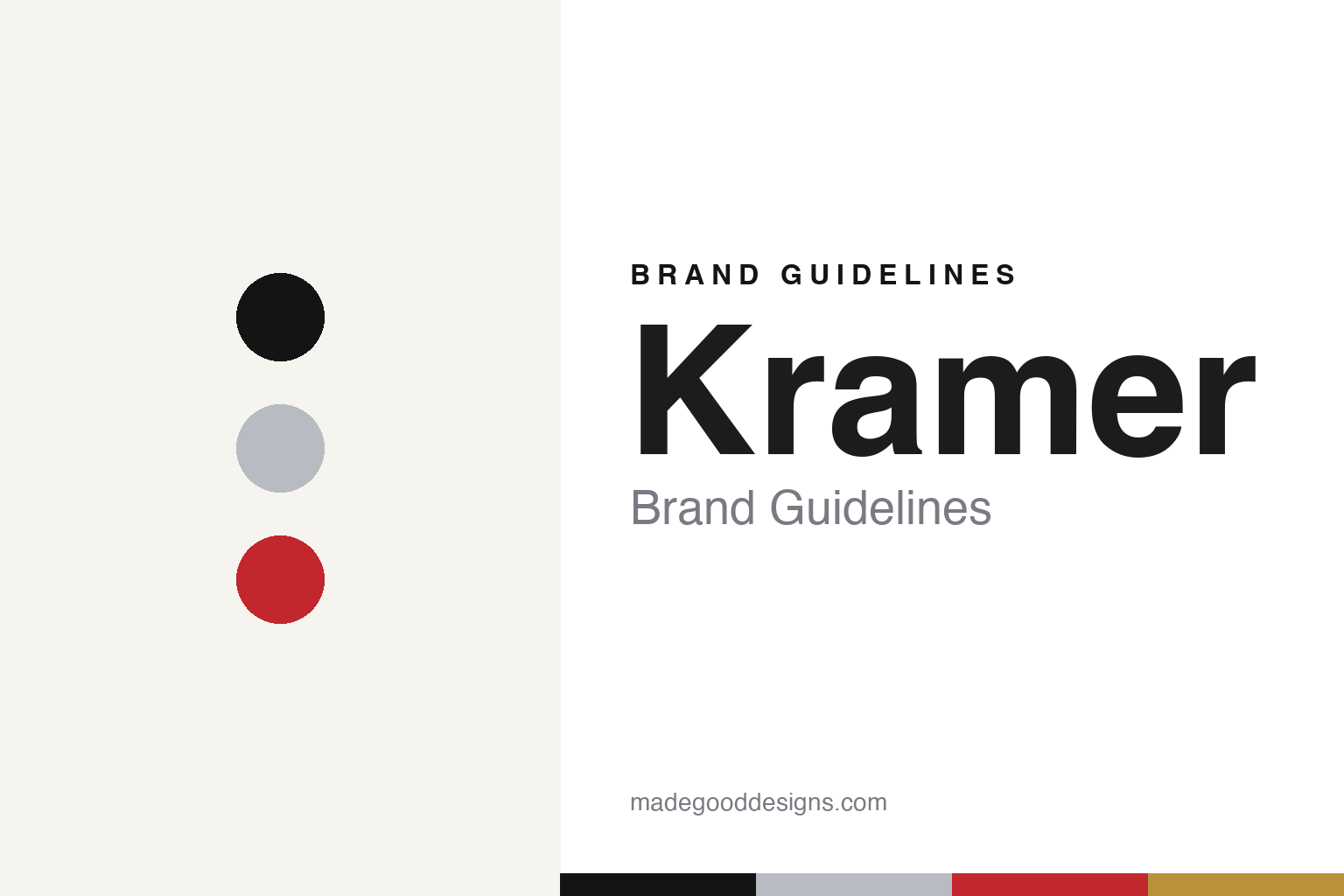
Two constants: a Kramer black, silver, red and gold palette and a Condensed sans register. Abstract homage — not a Kramer product or mark; no instrument, logo or headstock is reproduced.
Neptune
An aluminium neck with wood set into it.
Kramer began with an aluminium neck. In 1974 Gary Kramer joined Travis Bean and Marc McElwee in starting Travis Bean Guitars in California, which made instruments with machined aluminium necks, according to Guitar.com and to English Wikipedia, which cites Vintage Guitar. Kramer and Bean parted — in 1975, Wikipedia says; in 1976, Guitar.com says — and Kramer set up on his own with Dennis Berardi, from New York. Wikipedia, citing a 2014 Vintage Guitar article, says the pair formed a company called BK International and hired the luthier Phil Petillo to make prototypes.
Gibson, which owns the brand today, tells the rest in its own Kramer history. Gary Kramer, Berardi, Peter LaPlaca — a former vice-president at Norlin, then Gibson’s parent company — and the investor Henry Vaccaro opened a plant in Neptune, New Jersey. Gibson’s page says the company was founded “in the late 1970s” and that its first guitars were introduced in 1976; its 2026 product pages say “Kramer is turning 50.” The page also says Gary Kramer soon moved to Los Angeles and his connection with the company became “in name only.” The NAMM Oral History programme, which interviewed him in 2009, says he left the industry at the peak of Kramer’s success and returned in the early 2000s with a company under his own name, Gary Kramer Guitars, which is separate from Gibson’s Kramer.
The first Kramers changed Bean’s idea rather than copying it. Gibson says the necks were aluminium with wooden inserts — usually walnut or maple, set in epoxy — under a fretboard of Ebonol, a material like that used in bowling balls, with a “pitchfork” headstock, because an all-metal neck was heavy and cold to the touch. Wikipedia adds that the inserts also avoided infringing Bean’s neck patent. Bodies were walnut, maple or koa, hardware came from Schaller, and pickups from Schaller and DiMarzio. Gibson says basses outnumbered guitars about four to one, and that the aluminium-neck line lasted until about 1982.
Colour
Van Halen, the Floyd Rose and the Baretta.
Kramer moved to wooden necks in late 1981. Its first versions copied Fender’s Stratocaster headstock; Guitar.com says Fender sent a cease-and-desist order in May 1981, while Gibson’s history says only that it “isn’t clear whether a lawsuit from Fender ever materialized.” After about a thousand guitars Kramer switched to a “beak” headstock. The wooden era also took production overseas: Gibson says necks and tremolos were made in Japan and finished in New Jersey, and Wikipedia names ESP as the Japanese neck maker.
The company’s rise is tied to Eddie Van Halen. Gibson says Berardi met Van Halen’s manager on a flight, that Van Halen wanted a tremolo that stayed in tune, and that at a later meeting he “reportedly” promised to help make Kramer “the #1 guitar company in the world.” By 1983 Kramer had switched to the Floyd Rose locking tremolo and, Gibson says, was the only company fitting the original Floyd Rose as standard on production guitars. The Baretta of 1983, a single-pickup guitar styled after Van Halen’s own, became the flagship, though English Wikipedia notes that he never played it on stage.
Headstocks changed again — to what Gibson calls the “banana” and others the “hockey stick” in late 1983, and to a drooping “pointy” shape in 1986 — and Seymour Duncan pickups arrived in late 1985. Gibson says Kramer was the best-selling guitar brand of 1985 and 1986, outselling Fender and Gibson; Guitar.com repeats the claim, but we found no independent sales figures. The slogan of the period, Gibson says, was “A Step Ahead.” Kramer’s late-1980s artists included Mötley Crüe’s Mick Mars and Vivian Campbell, Wikipedia says.
By 1987, according to Gibson, the “American Series” was built from Japanese necks and bodies assembled in Neptune, while the Striker and Aerostar lines were made entirely in Korea.
Typography
American guitar makers and their owners.
The seven brands in this guide are American electric-guitar names outside the Fender and Gibson pair, though several trace back to one or the other. Music Man began in 1971, formed by the former Fender men Forrest White and Tom Walker with Leo Fender as a silent partner, English Wikipedia says; Ernie Ball bought it in 1984, and the company says it has made instruments in San Luis Obispo, California, ever since. G&L was the company Leo Fender set up with George Fullerton in Fullerton, California; Guitar World reported in November 2025 that its closure had been confirmed.
Heritage was founded in Kalamazoo, Michigan, in 1985 by former Gibson employees who stayed when Gibson moved to Nashville, and remains there. Kramer, founded in Neptune, New Jersey, in 1976, has belonged to Gibson since 1997, Wikipedia says.
Dean, started by Dean Zelinsky in Chicago, has been owned since 1997 by Armadillo Enterprises of Tampa, Florida, which filed for Chapter 11 bankruptcy protection in June 2026, Guitar.com reported. Reverend, founded by Joe Naylor in the Detroit area in 1997, now gives an address in Toledo, Ohio. B.C. Rich grew from Bernardo Chavez Rico’s family shop in Los Angeles and now lists an address in Orlando, Florida; its owner since 2019 is not named in the sources we checked.
Where guitars are made varies even within one brand: B.C. Rich’s own product pages list the United States, Korea and Indonesia.
This guide sets out what can be checked about each brand — who founded it, who owns it, and what it says about where its products are made — and marks clearly what rests only on the company’s own word.
Aa
A condensed sans — the loud register of 1980s guitar advertising. (Specimen set in Oswald, a sans STAND-IN; NOT the Kramer logo.)
Kramer
Out of bankruptcy and into Gibson.
The decline came quickly. Gibson’s history says a labour strike in Korea in 1987 left Kramer behind on orders, and that the company was overextended by endorsement deals, advertising and royalties owed to Floyd Rose; in 1989 Berardi started an artist-management company, Berardi/Thomas Entertainment. The original company “effectively came to an end” in 1991, Gibson’s text says — its own timeline puts this under 1990, and English Wikipedia gives January 1991 — followed by a fire sale of surplus parts. By 1995 Vaccaro owned the brand and made a few hundred guitars from leftover parts in Neptune. In 1997, Gibson says, it bought Kramer out of bankruptcy.
Under Gibson, Kramer was first sold mostly direct through the MusicYo website, with reissues such as the 1984 and the Jersey Star; Wikipedia says MusicYo closed in January 2009 and Kramers moved to music shops. Gibson’s timeline describes reissues “assembled in the USA as well as … guitars made overseas.” Guitar.com reported in 2023 that current Kramers are made only in Gibson’s Asian factories; the Gibson pages we checked do not name a country. In 2023 Halestorm’s Lzzy Hale became the first woman with a Kramer signature model, a Voyager, Consequence reported. The old domain, kramerguitars.com, now redirects to a Kramer section of gibson.com, where Kramer sits beside Gibson, Epiphone, Mesa/Boogie and KRK; in 2026 Gibson released Anniversary Gold editions of the Baretta, Pacer, NightSwan and others for Kramer’s 50th year. Original Kramers, which Guitar.com says were once dismissed as “firewood,” are now collected. Kramer Electronics, a maker of audio-visual equipment, is a different company.
For a design guide, Kramer shows how a brand’s look can be built from hardware and headstock shapes as much as from a logo. Compare Gibson, its owner since 1997, and ESP, which made Kramer necks in the 1980s. For this guide we use black, aluminium silver, red and an anniversary gold with a condensed sans, an unofficial interpretation; no product or logo is reproduced.
Explore & save
Keep Kramer’s identity on hand — save it to a board in the Made Good inspiration library.
Kramer identity set
Pin the Kramer black, silver, red and gold palette and the Condensed sans register to your own board.