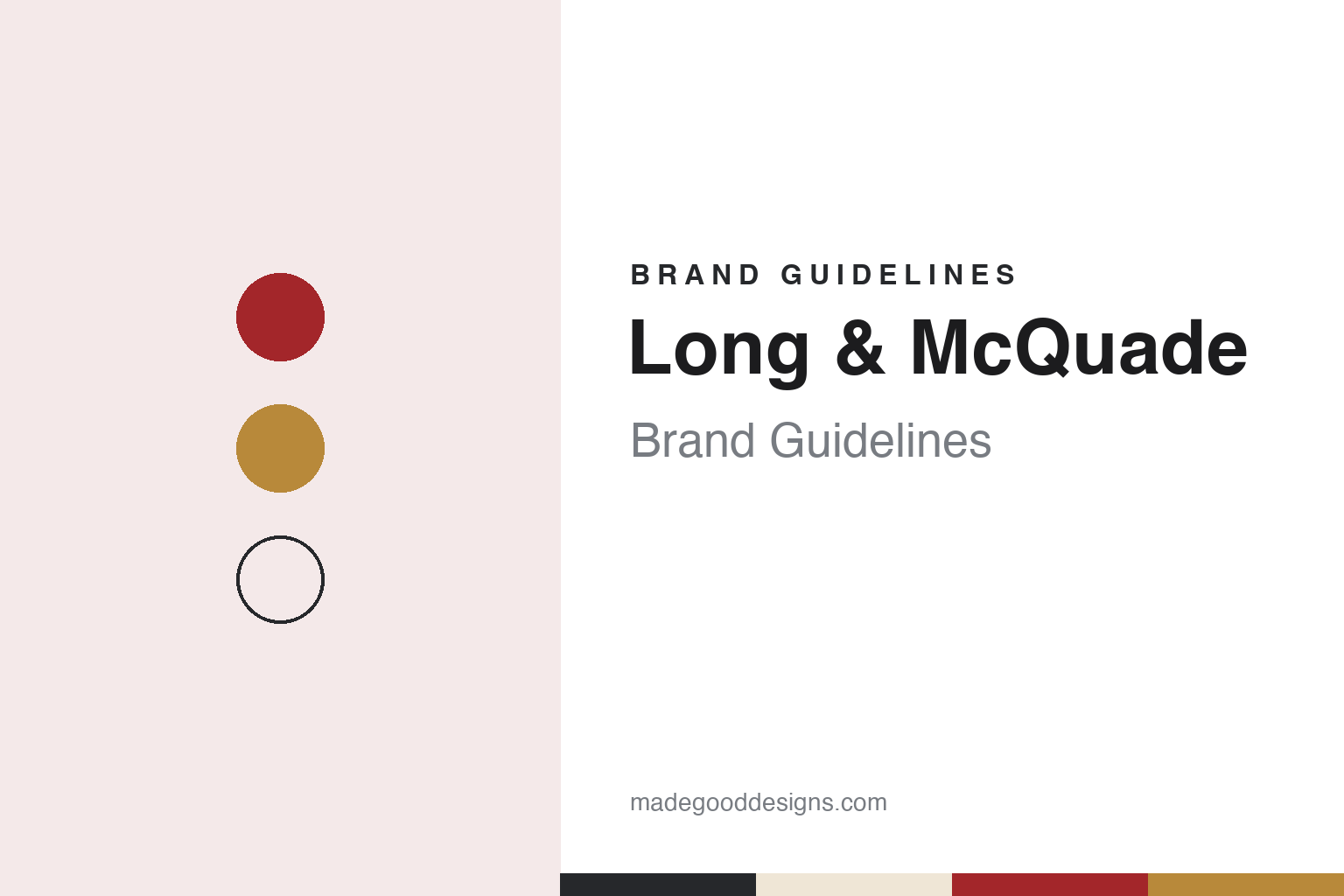
Long & McQuade Brand Guidelines
The Toronto music shop that grew into a Canada-wide chain.
Aa
Two constants: a Long & McQuade red, brass and charcoal palette and a music-shop serif register. Abstract homage — not a Long & McQuade product or mark; no instrument, logo or shop sign is reproduced.
Two rooms on Carlton Street
A trumpet player and a drummer.
Long & McQuade is a Canadian chain of musical instrument stores headquartered in Toronto. Its story begins in 1956, when Jack Long, a professional trumpet player who had graduated in music from the University of Toronto in 1952, opened a shop selling instruments in two rooms on the second floor of a house on Carlton Street, CBC Music reported in September 2024. The company’s own history says he thought he could sell instruments to friends in the city’s music community, that the earliest line he carried was King Band Instruments, and that part of the floor was divided into studios so that he could teach trumpet on the side.
Within a year he had rented a room to a drummer, Jack McQuade, who used it for drum lessons. In 1957 the two became business partners and opened a store on Yonge Street under the name Long & McQuade Musical Instruments, according to both CBC Music and the company. The partnership lasted until 1965, when McQuade sold his share of the business to Long; the company says he left to concentrate on drumming.
The shop kept both founders’ names after 1965. Expansion began in 1968, the company says, and by that year, CBC Music reported, the business had added music lessons, rentals, repairs and layaways to instrument sales.
Long described the shop’s aim in a 2015 Toronto Biographies profile quoted by CBC Music: “We always tried to not be a rock ’n’ roll store, not be a jazz store, not be a symphonic store.” The company’s website makes a similar point in its own words, saying its range runs from a flugelhorn to a special-edition electric guitar.
Colour
A shop that grew a manufacturer.
The back room of the Yonge Street store also produced a manufacturer. English Wikipedia says Yorkville Sound began there in 1963, when the shop’s repairman, Peter Traynor, built a sturdier bass amplifier, the Dynabass, and rented it out to customers. Traynor took the idea of a separate company to Long, and the two went into business together, Long holding two-thirds and Traynor one-third. The amplifiers carried the Traynor name, with rear nameplates reading “mfg. by Yorkville Sound.”
Yorkville Sound was incorporated in 1965 with Long as president and Traynor as vice-president, English Wikipedia says. Traynor sold his shares and left in 1976, and Long’s son Steve joined Yorkville full-time in 1981 and later became its president. The company, now based in Pickering, Ontario, makes amplifiers and live-sound loudspeakers and distributes other makers’ products in North America, and English Wikipedia says it remains owned by the Long family.
In its stores, Long & McQuade presents itself as a service business as much as a shop. Its website describes music lesson centres at many locations, rentals by the day, week or month, rental and rent-to-own programmes for schools, service departments for repairs, in-store financing, trade-ins of used instruments and a one-year performance warranty on most products. It also says its salespeople are not paid on commission. It runs print music divisions in Vancouver and Toronto, the company says.
In 2014 Jack Long was appointed a member of the Order of Canada. English Wikipedia says the honour recognised his contribution to the Canadian music industry, and in particular his founding of both Long & McQuade and Yorkville Sound. CBC Music reported that he had also received an Arbor Award from the University of Toronto in 2008 for his work as a volunteer.
Typography
How music retailers present themselves.
Musical-instrument retailers often present themselves through places as much as products. Guitar Center’s Sunset Boulevard store in Los Angeles hosts Hollywood’s RockWalk, a hall of fame begun in 1985 in which musicians’ handprints are set in cement, and Sweetwater has built a campus in Fort Wayne, Indiana, with a retail store, recording studios and a performance theatre, according to English Wikipedia. Guitar Center’s website groups its stock by department: guitars, amplifiers and effects, keyboards, drums and recording gear.
Names in the trade tend to be plain. Guitar Center took its name in the late 1960s after starting as The Organ Center and then The Vox Center, and its group includes Musician’s Friend, Music & Arts and Woodwind & Brasswind, names that state the trade directly. Retailers also commission their own lines: in January 2025 Guitar World reported a set of three pedals made by Keeley Electronics as Sweetwater exclusives, and in 2026 the magazine reported Guitar Center’s plan for an in-house guitar brand developed with customer input.
Corporate histories in this trade usually begin with one person: a musician recording bands from a Volkswagen bus in 1979, as CNN Business reported of Sweetwater’s Chuck Surack, or an organ seller in Hollywood in 1959, as English Wikipedia says of Guitar Center’s Wayne Mitchell. Later chapters often involve investors, with private equity firms investing in both companies, and in Guitar Center’s case a Chapter 11 reorganisation in 2020.
The trade has also contracted. In August 2025 Guitar World reported, in an article on the pressure that online selling puts on physical shops, that Sam Ash had closed all of its stores the previous year. This guide sets out what can be checked about each retailer — founders, owners, stores and own-brand lines — and attributes each claim to the source that makes it.
Aa
A music-shop serif for a family firm that kept its founders’ names. (Specimen set in Libre Baskerville, a serif STAND-IN; NOT the Long & McQuade logo.)
Long & McQuade
Still a family business.
Long & McQuade has grown partly by taking over independent shops. Global News reported on 8 February 2018 that Axe Music, an Edmonton retailer that had opened in 1980, had sold its store there to Long & McQuade. The Review, the newspaper of Vankleek Hill in eastern Ontario, reported on 13 June 2023 that Bobby Lalonde Music in Hawkesbury had become part of Long & McQuade with effect from 6 June that year, that the chain had offered jobs to all of the shop’s employees, and described the buyer as “Canada’s largest chain of music stores,” headquartered in Toronto.
The Review gave 90 stores in June 2023; CBC Music wrote of more than 100 branches in September 2024; and the company’s website now says there are over 100 stores across Canada, from British Columbia to Newfoundland, plus an online store that opened in 2008. The company says it employs more than 1,800 musicians and contracts about 1,000 music teachers. Its location list runs from Calgary and Vancouver through Ontario and Quebec to Halifax and St. John’s.
Ownership has stayed in the family. The company says it is still entirely owned by the Long family and that Jack Long’s sons, Steve and Jeff, run its day-to-day operations; CBC Music reported that he handed the day-to-day running of the business to his sons in 2008. The Review said the family ownership was one reason the Hawkesbury shop’s owners chose to sell to the chain.
For a design guide, Long & McQuade shows how a shop name built from two founders’ surnames can carry a national chain long after the partnership itself ended. Compare Guitar Center, the American music-store chain, and Yamaha, the Japanese maker of band, orchestral and keyboard instruments. For this guide we use a deep red, a brass gold and charcoal with a serif, an unofficial interpretation; no product or logo is reproduced.
Explore & save
Keep Long & McQuade’s identity on hand — save it to a board in the Made Good inspiration library.
Long & McQuade identity set
Pin the Long & McQuade red, brass and charcoal palette and the music-shop serif register to your own board.