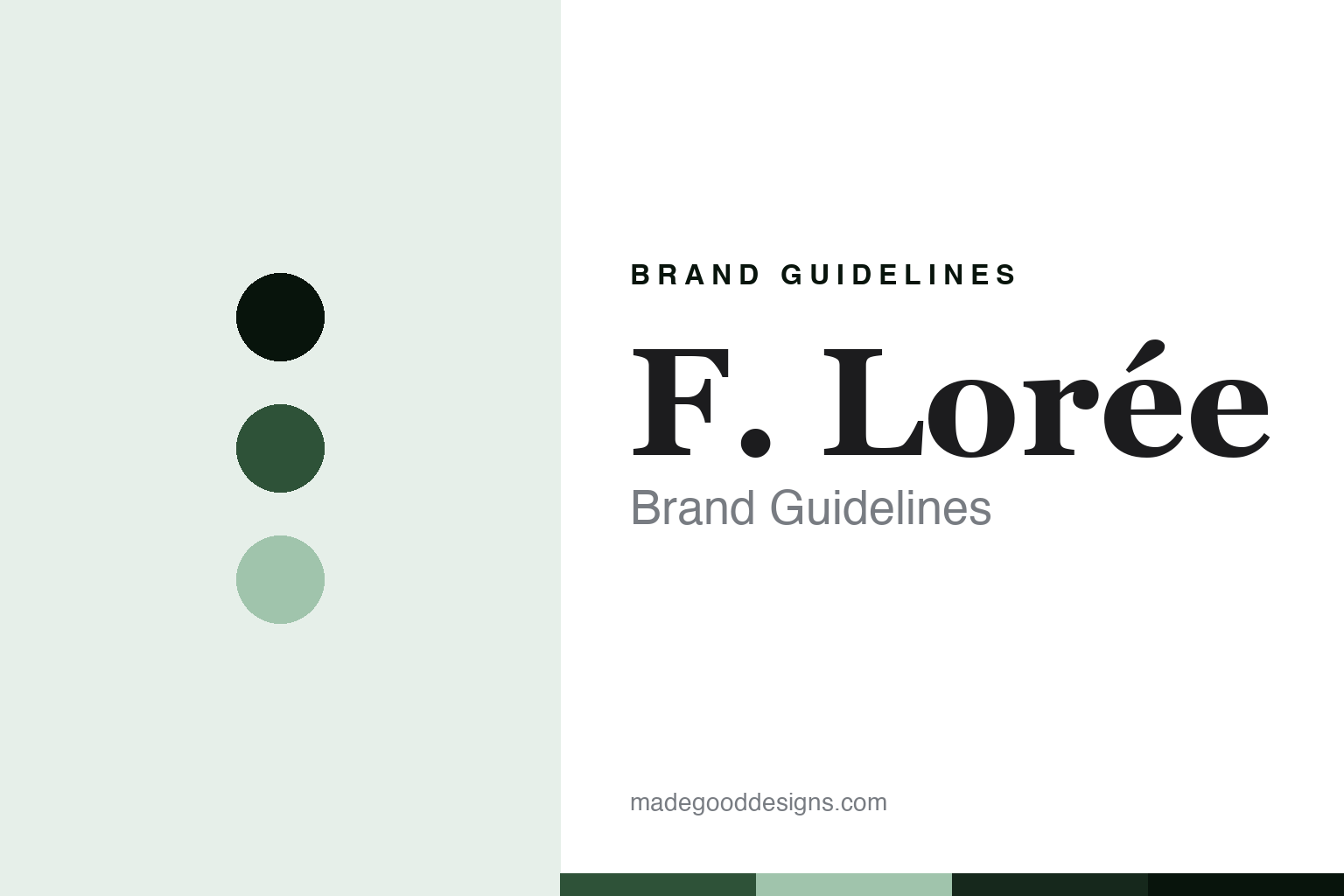
F. Lorée Brand Guidelines
The Paris oboe house.
Aa
Two constants: a grenadilla-green palette and a Paris-serif register. Abstract homage — not an F. Lorée oboe, keywork or mark.
The Paris oboe house
F. Lorée is the French oboe maker founded in Paris in 1881, still family-owned by the de Gourdon family, hand-making its oboes in Paris as a Living Heritage Enterprise.
F. Lorée is the round’s oboe house, and it has stayed exactly where it started. From Paris, in the streets around the Conservatoire, Lorée has made professional oboes since 1881 — and calls itself the oldest house that specialises in the oboe. Its answer to how a house becomes a name is focus and place: make one difficult instrument, in one city, to a benchmark standard, generation after generation. A French oboe, hand-made in Paris.
Its identity is the Paris oboe house. F. Lorée’s oboes, its four-generation family ownership and its made-in-Paris craft are the work it is known for. An oboe, from Paris. A house that never left the Conservatoire district.
(Honest notes, so the story stays precise. F. Lorée was founded in 1881 by François Lorée in Paris; its live official presence is at loree-paris.com, and its workshop is on the rue de Rome, in the Paris music district. On what it makes, it is professional double-reed woodwinds — oboe, oboe d’amore, cor anglais (English horn), bass oboe and piccolo oboe; its student line is branded Cabart, which we note as reported. On where it is made — a theme of this round — Lorée states it is “100% made in France,” in Paris, and carries the French state “Entreprise du Patrimoine Vivant” (Living Heritage Enterprise) label. On ownership, it is still family-owned and independent, run by the de Gourdon family into its fourth generation; the family name passed by marriage from François Lorée through Lucien Lorée to the de Gourdons, which is why its oboes are described as made by the de Gourdon family, and we do not name a single current 2026 head we could not pin down. Its “Royal” bore model is shown on its own site; its widely-discussed “AK” bore and its grenadilla (African blackwood) material we present as reported/standard rather than quote directly, and we name no living oboists. Its name and marks are IP, described but never reproduced, and there is no official brand hex; these tones are an unofficial interpretation. This is design commentary and does not promote any product.)
Colour
F. Lorée lives in a grenadilla-green palette. Click a swatch to copy the hex.
F. Lorée’s identity is refined, French and focused — a grenadilla green, an ink, a sage, a deep grenadilla, and a paper. The palette leans grenadilla green and sage: the register of dark grenadilla wood, the near-black African blackwood an oboe is turned from. It signals focus and heritage. The honest caveat: with no published brand hex, these values are an original, unofficial interpretation, not first-party colours.
The lesson is a grenadilla-green palette signals a focused, made-in-Paris identity. F. Lorée’s world is a refined, wooden, French object. For designers, it is a reminder that a dark grenadilla green and a soft sage can carry a house built on one instrument — the near-black of the wood and the pale of a reed. Because these tones can fail as small text, keep type dark and let the colour live in the accents, palette and band. The takeaways: specialise deeply; stay in one city; keep the family; and treat any single hex as unofficial.
Typography
The register is a Paris serif — refined, classical, focused.
F. Lorée’s identity carries a refined, classical, focused spirit — a specialist oboe house, not a fashion label. A Paris serif captures the mood: elegant, storied and precise, the register of a maker beside the Conservatoire. Set in a grenadilla-green palette, the Paris serif feels refined and classical — exactly the personality F. Lorée carries. It is a specialism and a lineage rather than a logo, mirroring a hand-made oboe. (F. Lorée’s real logo, its model wordmarks and any keywork are things we describe but do not reproduce, and the exact typeface is not ours to use.) Because it is not ours to use, the honest description is “a Paris-serif spirit,” shown here in a stand-in. The type behaves like the house: refined, classical and focused.
Aa
A Paris-serif spirit — refined and focused. (Specimen set in Playfair Display, a Paris-serif STAND-IN; NOT the F. Lorée logo or keywork.)
The heritage houses
F. Lorée stands for the oboe house that stayed in Paris.
F. Lorée is a lesson in how deep specialism can be an identity. A grenadilla-green palette, a Paris serif and a hand-made oboe make one thing — the Paris oboe house — the whole identity: refined, French and focused. The single-instrument focus is the differentiator, and the four-generation family in one city is the meaning. The point is a house that has made only oboes, only in Paris, since 1881 — and became the benchmark by never doing anything else.
Put to work, the identity is focus, honestly told, as design. A house in this spirit would specialise deeply, stay in one place, and keep the family — professional oboes, made in Paris, a Living Heritage label, four generations of one family. A brand learning from it would see that deep specialism is a durable identity — that a house making only oboes, only in Paris, holds a place a generalist cannot — and that being precise, founded 1881 by François Lorée, made in France, run by the de Gourdon family, keeps the story honest. Lorée holds the round’s still-family, made-at-home pole: against the heritage names in this round that changed hands or moved their making, it is the house that simply stayed — same instrument, same city, same family by descent. There is discipline in the restraint: presenting the AK bore and the grenadilla wood as reported rather than quoted, and naming no living oboists, keeps a benchmark reputation honest. The lesson F. Lorée teaches is that focus can hold an identity: the single instrument gives it substance, and the four-generation continuity keeps it credible. The specialism is the personality, and the Paris-made oboe is the proof.
For designers and brand-builders, F. Lorée holds the France pole in the heritage houses: specialise deeply, and stay put. The lessons: master one instrument; keep it in one city; hold the family; attribute reputation not endorsement; and never reproduce a logo or keywork. It is also a reminder to stay precise: F. Lorée is the French oboe maker founded in Paris in 1881, still family-owned by the de Gourdon family, hand-making its oboes in Paris as a Living Heritage Enterprise — with the palette here an unofficial interpretation. F. Lorée made deep focus the identity — proof that a house that stayed in Paris, honestly told, can be the difference.
Explore & save
Keep F. Lorée’s identity on hand — save it to a board in the Made Good inspiration library.
F. Lorée identity set
Pin the grenadilla-green palette and the Paris-serif register to your own board.