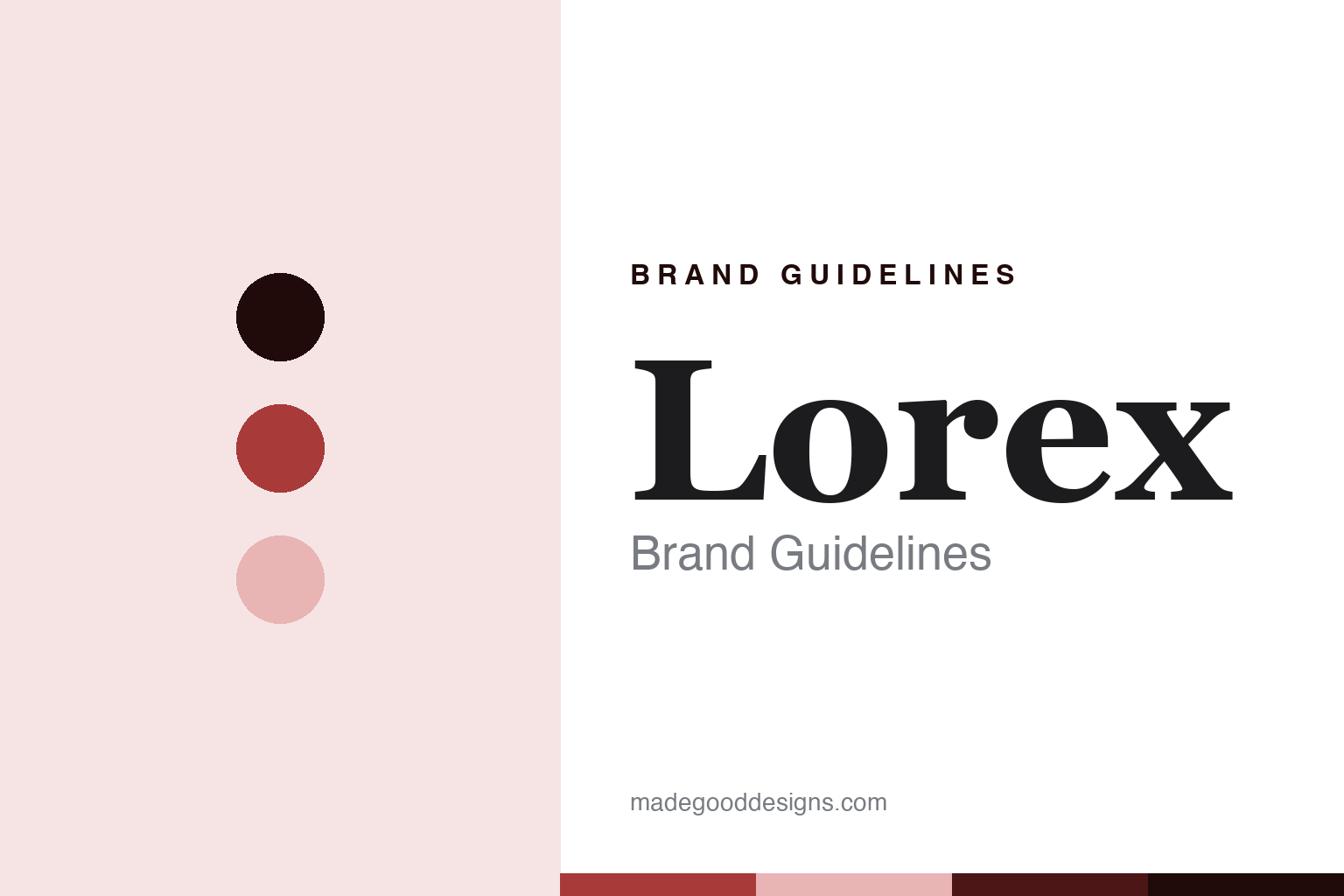
Lorex Brand Guidelines
The changed-hands DIY system.
Aa
Two constants: a signal-red palette and a heritage-serif register. Abstract homage — not a Lorex product or mark; no camera, DVR or logo is reproduced.
The changed-hands DIY system
Lorex is the Canadian DIY surveillance brand whose ownership ran FLIR to Dahua to Taiwan’s Skywatch, its current owner.
Lorex brings the round its ownership-saga node — a Canadian DIY surveillance brand whose owner changed three times in a decade, ending, after US security pressure, with a Taiwanese company. Its answer to a round about who owns the camera and where it is made is a chain: Canadian in origin, made in Asia, and today owned by Skywatch of Taiwan.
Its identity is the changed-hands DIY system. The Canadian DIY heritage, the FLIR-to-Dahua-to-Skywatch ownership chain and the local-storage, no-subscription systems are the story here. A system that changed hands. The changed-hands DIY system.
(Honest notes, so the ownership chain and the security context are framed accurately, with the company’s own claims attributed. Lorex sells DIY surveillance as its heroes — wired DVR and NVR kits and PoE systems, plus Wi-Fi, 4K and a doorbell — with local storage and no mandatory subscription; we report its language as the brand’s own. On origin: Lorex is historically Canadian, based in Markham, Ontario, with hardware made in Asia. On the ownership chain, dated and verified: FLIR Systems acquired Lorex in December 2012 for around sixty million dollars; FLIR sold Lorex to Dahua Technology of China in 2018 for around twenty-nine million dollars; and then, under US pressure tied to NDAA Section 889 and the FCC Covered List that restrict Dahua, Dahua agreed at the end of 2022 to sell Lorex to the Taiwan-based Skywatch, a sale completed in February 2023 for around seventy-two million dollars — so the chain is FLIR, then Dahua, then Skywatch, and the current owner is Skywatch of Taiwan. On the security context, kept accurate: Lorex hardware in the Dahua era from 2018 to 2023 shared Dahua’s technology lineage, and Dahua and Hikvision are restricted under NDAA Section 889 from 2019 and were placed on the FCC Covered List in late 2022; the transfer to Skywatch was explicitly to distance Lorex from those restrictions. On the company’s claim, attributed rather than asserted: Lorex says its current products are fully free of Dahua technology and firmware, which we report as the company’s statement, not as verified fact; and we note for readers that these NDAA restrictions target government and federal procurement, not a blanket consumer ban. Its designs and the Lorex name are IP we describe but do not reproduce; there is no official brand hex; these tones are an unofficial interpretation.)
Colour
Lorex lives in a signal red. Click a swatch to copy the hex.
Lorex’s identity is established, DIY and much-changed — a signal red, an ink, a pale rose, a deep maroon, and a paper. The palette leans signal red and pale rose: a serious, alert register that nods to a wired security system rather than a loud logo colour. It signals the changed-hands DIY system — established, DIY and much-changed. The honest caveat: with no official brand hex, these values are an original, unofficial interpretation, not first-party colours.
The lesson is a signal red signals an established, DIY identity. Lorex’s world is a multi-camera kit wired to a recorder, whose badge has outlasted three owners. For designers, it is a reminder that a serious red and a soft rose can carry a security brand — an alert tone held as an accent, not a product shot. Because a mid hue can fail as small text, keep type dark and let the colour live in the accents, palette and band. The takeaways: keep Lorex Canadian in origin; lay out the FLIR-to-Dahua-to-Skywatch chain with dates; place the current owner as Skywatch of Taiwan; attribute the Dahua-free claim to Lorex; and note NDAA targets procurement, not consumers.
Typography
The register is a heritage serif — established, DIY, much-changed.
Lorex’s identity carries an established, DIY, much-changed spirit — a heritage security badge with a complicated ownership past, not a fresh startup. A heritage serif captures the mood: solid, serious and a little institutional, the register of a long-running security brand. Set in a signal-red palette, the heritage serif feels established and DIY — exactly the personality Lorex carries. It behaves like a made, engineered thing rather than a loud logo, mirroring a lens aperture and a signal wave. (Lorex’s real products and the name are things we describe but do not reproduce, and the exact typeface is not ours to use.) Because it is not ours to use, the honest description is “a heritage-serif brand,” shown here in a stand-in. The type behaves like the brand: established, DIY and much-changed.
Aa
A heritage-serif brand — established and DIY. (Specimen set in Playfair Display, a heritage-serif STAND-IN; NOT the Lorex logo or products.)
The security camera
Lorex stands for the changed-hands DIY system.
Lorex brings the round its ownership-saga node. A signal-red palette, a heritage serif and a three-step ownership chain make one thing — the changed-hands DIY system — the whole identity: established, DIY and much-changed. The Canadian DIY heritage is the frame, and the FLIR-to-Dahua-to-Skywatch chain is the story. The point is a badge that outlasted three owners, in a round about who owns the camera and where it is made.
Put to work, the identity is the brand told straight, the chain dated and the company’s claim attributed. A brand in this spirit would keep Lorex Canadian in origin, lay out the FLIR-to-Dahua-to-Skywatch chain with dates, and place the current owner as Skywatch of Taiwan. A reader in this spirit would keep the facts right: Lorex sells DIY DVR and NVR and PoE systems as heroes; it is historically Canadian, made in Asia; FLIR bought it in 2012, sold it to Dahua in 2018, and Dahua sold it to Taiwan’s Skywatch, completed in February 2023, under US restriction pressure; its claim to be fully Dahua-free is the company’s own; and NDAA restrictions target procurement, not consumers. Lorex sits sixth in the round, after Tapo. The honest editorial moves are to keep it Canadian, to date the chain, to name Skywatch as the current owner, to attribute the Dahua-free claim, and to bound the NDAA scope.
For designers and brand-builders, Lorex continues the security camera: carry a heritage badge through changing owners — and lay out the chain, and its claims, with dates and attribution. The lessons: a brand can outlast several owners while keeping its badge; an ownership chain is told with dates and prices where documented, here FLIR then Dahua then Skywatch; a security-driven divestiture is explained plainly, including why it happened; a company’s claim to have removed a former owner’s technology is attributed to the company, not verified as fact; and the scope of a restriction, government procurement rather than a consumer ban, is spelled out. It is also a reminder to stay precise: Lorex is the Canadian DIY surveillance brand whose ownership ran FLIR to Dahua to Taiwan’s Skywatch, its current owner — with the palette here an unofficial interpretation. The hook is that saga: Lorex’s badge passed from an American thermal-imaging firm to a Chinese giant to a Taiwanese buyer, the last move made expressly to escape US restrictions on the previous owner — a rare case where the ownership history is the brand story. Read that way, Lorex is less a single product than the changed-hands DIY system: established, DIY, much-changed. The lesson for a brand is that a heritage badge and a dated, attributed ownership account reinforce each other, and attributing the Dahua-free claim keeps the story earned. Lorex made the-changed-hands-DIY-system the identity — proof that an ownership chain can carry a round.
Explore & save
Keep Lorex’s identity on hand — save it to a board in the Made Good inspiration library.
Lorex identity set
Pin the signal-red palette and the heritage-serif register to your own board.


