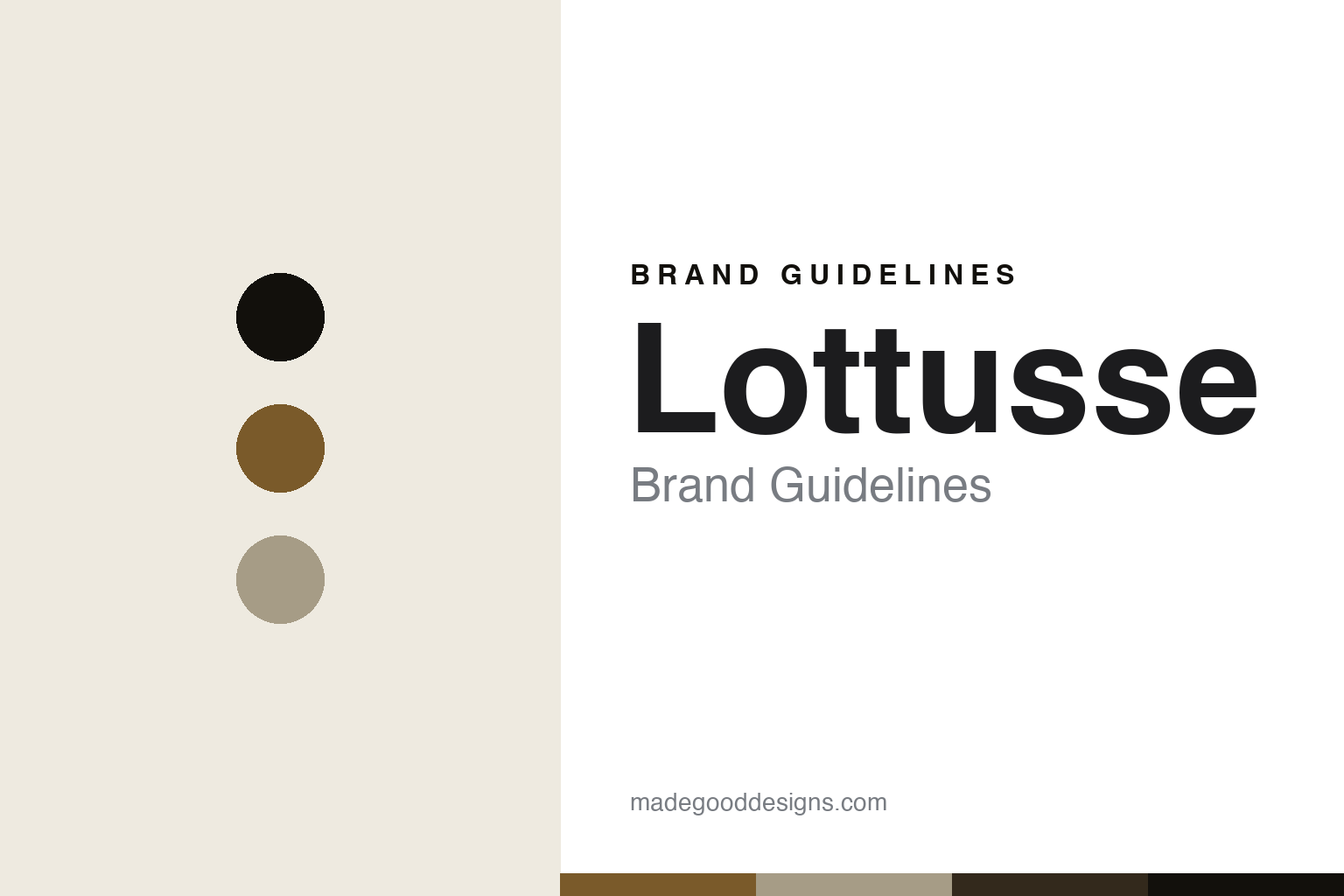
Lottusse Brand Guidelines
The Mallorcan Fluxà house.
Aa
Two constants: a Mallorca-tan palette and an island-sans register. Abstract homage — not a Lottusse shoe, last or wordmark.
The Mallorcan Fluxà house
Lottusse is a Fluxà-family Mallorcan house whose Goodyear-welted shoes are made in Inca, on a shoemaking lineage traced to 1877.
Lottusse is a lesson in how a house lasts down a family line. From Inca — the Mallorcan shoemaking town — it makes Goodyear-welted shoes on a craft lineage that reaches back to 1877, the welt stitched so the shoe is resoleable and long-lived. Its answer to how a house endures is generational: keep the leather craft in the family, on the island, across four generations. A welted shoe carried by a family name.
Its identity is the Mallorcan welted shoe, in the Fluxà line. Lottusse’s Goodyear welting, its Inca making and its long family lineage are the work it is known for. A craft, kept in a family. A house that lasted by staying in the bloodline.
(Honest notes, so the story stays precise, because the history is easy to muddle. The Fluxà family’s Mallorcan shoemaking lineage traces to 1877, when Antonio Fluxà set up an artisan workshop in Inca — so we credit the 1877 lineage while noting the Lottusse brand name itself is younger than that date, rather than implying the label existed in 1877. It is a family-owned house, run across four generations, and its Goodyear-welted dress shoes are genuinely made in Inca, Mallorca (we scope that to its core welted range, since it also makes non-welted styles). One important clarification: the same 1877 Antonio Fluxà Inca origin also gave rise to Camper, but Lottusse and Camper are separate companies run by different branches of the Fluxà family — Lottusse is not part of Camper, and we do not assert any parent-group name. It shares the Inca shoemaking tradition with island houses like Carmina, covered elsewhere, but is a distinct, older firm. Its designs and marks are its IP, described but never reproduced, and there is no official brand hex — these tones are an unofficial interpretation. This is design commentary and does not promote any product.)
Colour
Lottusse lives in a Mallorca-tan palette. Click a swatch to copy the hex.
Lottusse’s identity is Spanish, warm and lineage-proud — a Mallorca tan, an ink, a calf sand, an umber, and a chalk. The palette leans Mallorca tan and sand: the register of warm Mediterranean leather and an Inca bench. It signals craft carried through a family over show. The honest caveat: with no published brand hex, these values are an original, unofficial interpretation, not first-party colours.
The lesson is a Mallorca-tan palette signals a welted, family-lineage identity. Lottusse’s world is a resoleable, island-made, family-carried object. For designers, it is a reminder that a warm tan and a soft sand can carry a brand built on lineage — the amber of Mediterranean leather and the sand of the last. Because these tones can fail as small text, keep type dark and let the colour live in the accents, palette and band. The takeaways: keep the craft in the family; date the lineage honestly; distinguish yourself from your cousins; and treat any single hex as unofficial.
Typography
The register is an island sans — warm, even, unhurried.
Lottusse’s identity carries a warm, even, unhurried spirit — a family house at Mediterranean pace, not a fashion sprint. An island sans captures the mood: relaxed, legible and warm, the register of an Inca workshop. Set in a Mallorca-tan palette, the island sans feels warm and even — exactly the personality Lottusse carries. It is unhurried rather than flashy, mirroring a Goodyear-welted shoe. (Lottusse’s real designs and marks are things we describe but do not reproduce, and the exact typeface is not ours to use.) Because it is not ours to use, the honest description is “an island-sans spirit,” shown here in a stand-in. The type behaves like the house: warm, even and unhurried.
Aa
An island-sans spirit — warm and even. (Specimen set in Manrope, an island-sans STAND-IN; NOT the Lottusse wordmark or any shoe design.)
The houses that lasted
Lottusse stands for lasting down a family line.
Lottusse is a lesson in how a house lasts by staying in a family. A Mallorca-tan palette, an island sans and a Goodyear-welted shoe make one thing — a welted shoe carried on a 1877 family lineage — the whole house: Spanish, warm and lineage-proud. The welt is the constant, and the family line is the survival. The point is a genuinely welted object, made in Inca, by a family that kept a leather craft alive across four generations on one island.
Put to work, the identity is lineage as design. A house in this spirit would keep the craft in the family and the place, date its history precisely rather than rounding a lineage into a brand age, and distinguish itself clearly from relatives who took a different path. It would treat a shared ancestor as context, not confusion. A brand learning from it would see that a genuine family lineage is a durable identity — that “kept in the family since 1877” means something a bought-in heritage cannot claim — and that being precise, the lineage dates to 1877 though the brand name is younger, and Camper shares the ancestor but is a separate company, is more credible than a tidy myth. A brand learning from it would also let the island itself, Inca, be part of the identity. The lesson Lottusse teaches is that a welted craft carried down a family can hold an identity: the method gives it substance, and the lineage gives it meaning. The craft is the personality, and the welted shoe is the proof.
For designers and brand-builders, Lottusse holds the family-lineage pole in this round about the houses that lasted: keep the craft in the family, and date the lineage honestly. The lessons: stay in the bloodline; keep it on the island; distinguish yourself from relatives; and never reproduce a protected design. It is also a reminder to stay precise: Lottusse is a Fluxà-family Mallorcan house whose Goodyear-welted shoes are made in Inca on a lineage traced to 1877, separate from Camper — with the palette here an unofficial interpretation. Lottusse lasted down a family line — proof that lineage can be the difference.
Explore & save
Keep Lottusse’s identity on hand — save it to a board in the Made Good inspiration library.
Lottusse identity set
Pin the Mallorca-tan palette and the island-sans register to your own board.