Lukfook Brand Guidelines
A 1991 Hong Kong shop that grew into a network of thousands.
Aa
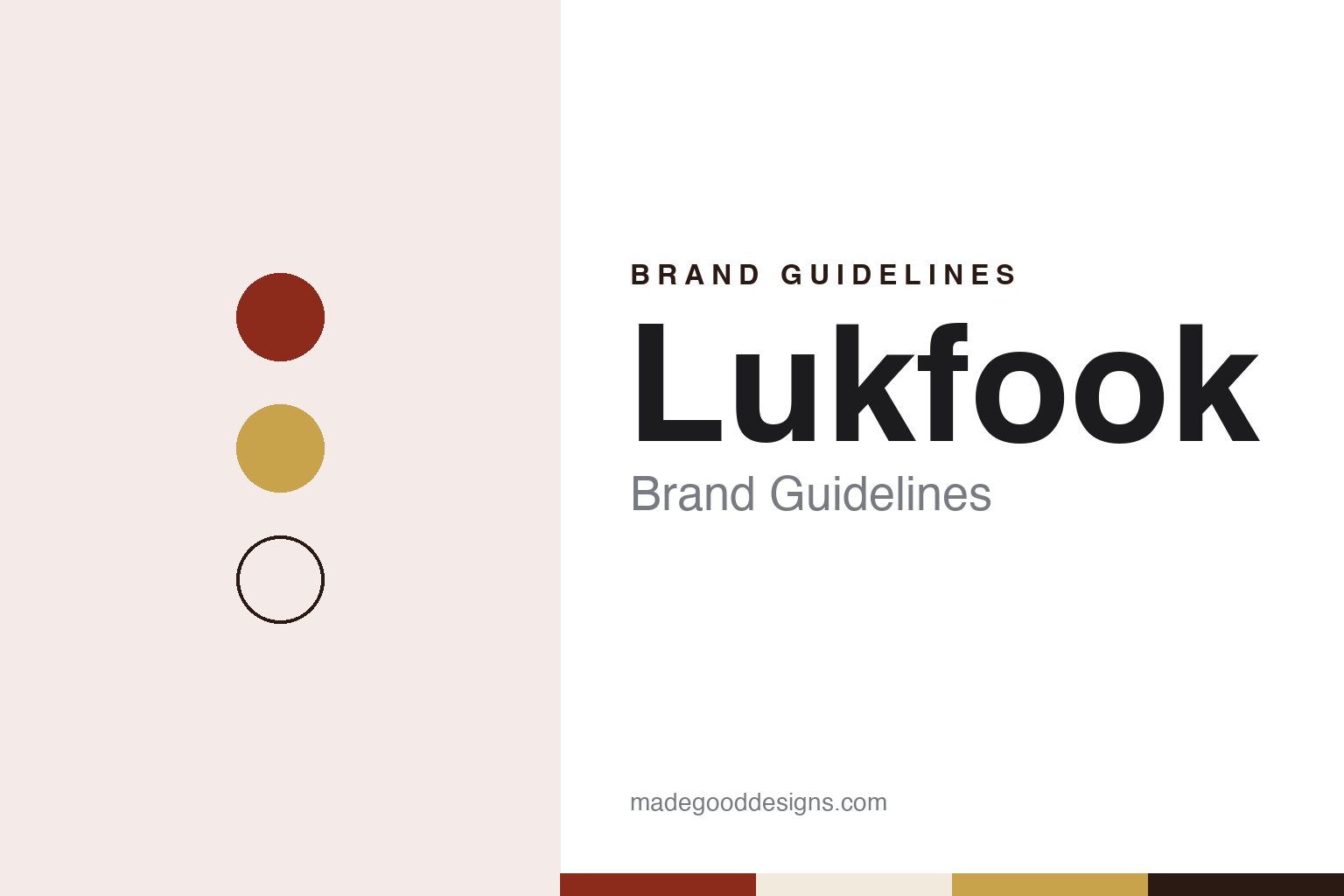
Two constants: a cinnabar and burnished gold palette and a clean CJK sans register. Abstract homage — not a Lukfook product or mark; no jewellery, logo or shopfront is reproduced.
North Point, 1991
A single shop on Hong Kong Island and a listing six years later.
Lukfook opened its first shop, under the name Lukfook Jewellery, in North Point on Hong Kong Island in 1991, according to English and Chinese Wikipedia and the company’s own profile. The company says it was founded by a group of jewellery specialists. Its Chinese name is 六福, and the listed holding company is Luk Fook Holdings (International) Limited, which uses the shorter Lukfook spelling for its shops.
Growth was fast. English Wikipedia dates the first shop in Guangdong province to 1994, a gem-testing laboratory in Hong Kong, China Gems Laboratory, to 1996, and a total of about 70 shops to 2001. The group was listed on the Main Board of the Hong Kong Stock Exchange in May 1997, under stock code 0590, according to both Wikipedia editions and the company.
The company describes its business as the sourcing, design, wholesaling, trademark licensing and retailing of gold, platinum and gem-set jewellery. English Wikipedia adds that it has moved into the mid- to high-end watch market. The first Macau shop followed in 2002, and in 2003, English Wikipedia says, the group obtained a licence to operate as a sole proprietor on the mainland and opened its first shop in Canada.
The company says it opened its own jewellery processing plant, the Lukfook Jewellery Cultural & Creative Industry Park, in the Nansha district of Guangzhou in 2003, on land Chinese Wikipedia says it bought in 2002. The company says the plant gives it a “one-stop production model” for its shops and that it has been expanded in later phases; Chinese Wikipedia records phase-two works starting in 2011 and phase-three building in 2020.
In 2011 the group opened the Luk Fook Jewellery Centre in Jordan, Kowloon, as its headquarters, English Wikipedia says; the company’s milestones add office premises in Shek Mun, Hong Kong, bought in 2018 as group headquarters.
Colour
Overseas shops, rough diamonds and a second listed brand.
Lukfook went abroad step by step. English and Chinese Wikipedia list a first shop in the United States in 2006 and in Singapore in 2010, Malaysia in 2016 and Cambodia in 2018, with a second New York shop in 2016 and a second San Francisco shop in 2017. The company’s milestones add the Philippines in 2018, Laos in 2021, Thailand in 2023 and Vietnam in 2025.
Australia arrived earlier than most. Jeweller, the Australian trade magazine, reported in August 2026, citing the Australian Financial Review, that Lukfook opened its first Australian store in 2013 and then had eight stores in the country, out of more than 2,900 worldwide.
On supply, English Wikipedia says Lukfook signed a three-year rough-diamond sales contract with the De Beers group in 2015, becoming one of its sightholders, the term for buyers that purchase rough stones directly. The group also runs gem-testing laboratories, among them the mainland Victoria Gemological Institute, the company says.
A second listed jeweller joined the group through 3D-GOLD, known in Chinese as 金至尊. English Wikipedia says Lukfook announced in 2014 that it was buying half of China Gold Silver, the 3D-GOLD business of Hong Kong Resources Holdings. Chinese Wikipedia says that on 30 July 2023 Lukfook announced it would buy half of Hong Kong Resources Holdings itself, and that the deal completed on 12 January 2024, making the 3D-GOLD business and its listed parent subsidiaries of the group. The company gives the same completion date and now lists 3DG Jewellery among its brands.
That brand list, on the company’s profile, also includes Goldstyle, which opened its first independent shop in Xi’an in 2019; Lukfook Joaillerie, opened in Xiamen and Kunming in 2020; Heirloom Fortune, which began with a shop in Jiangmen in 2022; and the Love LUKFOOK JEWELLERY collection, which opened a separate store in Zhanjiang in 2023, according to the company’s milestones.
Typography
How the category presents itself.
Jewellery chains in North America and Asia sell much of the same thing — engagement rings, wedding bands, gold chains and gifts — but they present it through the places they trade. In the United States and Canada the typical store sits in a shopping mall, often beside rival banners owned by the same group; in Hong Kong, mainland China and India, the chains’ own store pages often show gold jewellery at long counters and bridal sets as a category of their own.
Advertising carries much of the identity. American chains have long built their brands on television campaigns and on credit offers for buyers paying in instalments, and in recent years their campaigns have widened from engagement and anniversaries to everyday wear and self-purchase, as the trade press reports. Asian chains publish campaigns tied to weddings and festivals, and some name their collections after the occasion, the material or the craft rather than after a designer.
Ownership is often more complicated than the shop sign suggests. Several North American names that began as family businesses now belong to listed groups or to holding companies, and some have changed hands more than once, through mergers, takeovers and restructurings. Several Asian chains are listed on a stock exchange, and their corporate pages name the founders and the controlling shareholders alongside the listing.
This guide sets out what can be checked about each brand: who founded it, where and when, who owns it now, how it has presented itself in its stores and campaigns, and what rests only on the company’s own word. Store counts are given with the date of the source that reports them.
六福
A clean CJK sans for a two-character shop name. (Specimen set in Noto Sans TC, a sans STAND-IN; NOT the Lukfook logo.)
Lukfook
A mainland network and a first store in London.
Most of Lukfook’s shops are on the mainland. The company’s profile, read in November 2026, gives about 2,800 points of sale in 16 countries and regions, of which 2,662 are in mainland China, and lists markets from Taiwan and Malaysia to the United States, Canada, Australia, the United Kingdom and New Zealand.
The network has been trimmed as well as extended. Jeweller reported on 10 November 2026 that Lukfook had opened its first European store, in London, and that in the three months to 30 September 2026 the group closed a net 69 stores while adding a net five in other markets: London, Taiwan, Kuala Lumpur, Singapore and Ho Chi Minh City. As of September 2026, the magazine said, the group operated 2,788 stores worldwide.
The company’s milestones for 2026 list a first shop in Taipei, a first shop in Auckland, New Zealand, the London opening and a shop in Singapore.
Colours and typefaces are not documented in the sources used here, so the palette in this guide is our own.
For a design guide, Lukfook shows how a chain founded in 1991 built a multi-brand family, from 3DG Jewellery to Goldstyle and Heirloom Fortune, around one short Chinese name and a single shopfront spelling. Compare Chow Sang Sang, a Hong Kong jeweller with roots in 1934 Guangzhou, and Chow Tai Fook, another Hong Kong-listed gold and jewellery chain. For this guide we use a cinnabar red, a dark umber and a burnished gold on ivory with a sans, an unofficial interpretation; no product or logo is reproduced.
Explore & save
Keep Lukfook’s identity on hand — save it to a board in the Made Good inspiration library.
Lukfook identity set
Save the Lukfook cinnabar and burnished gold palette and the clean CJK sans register to your own board.