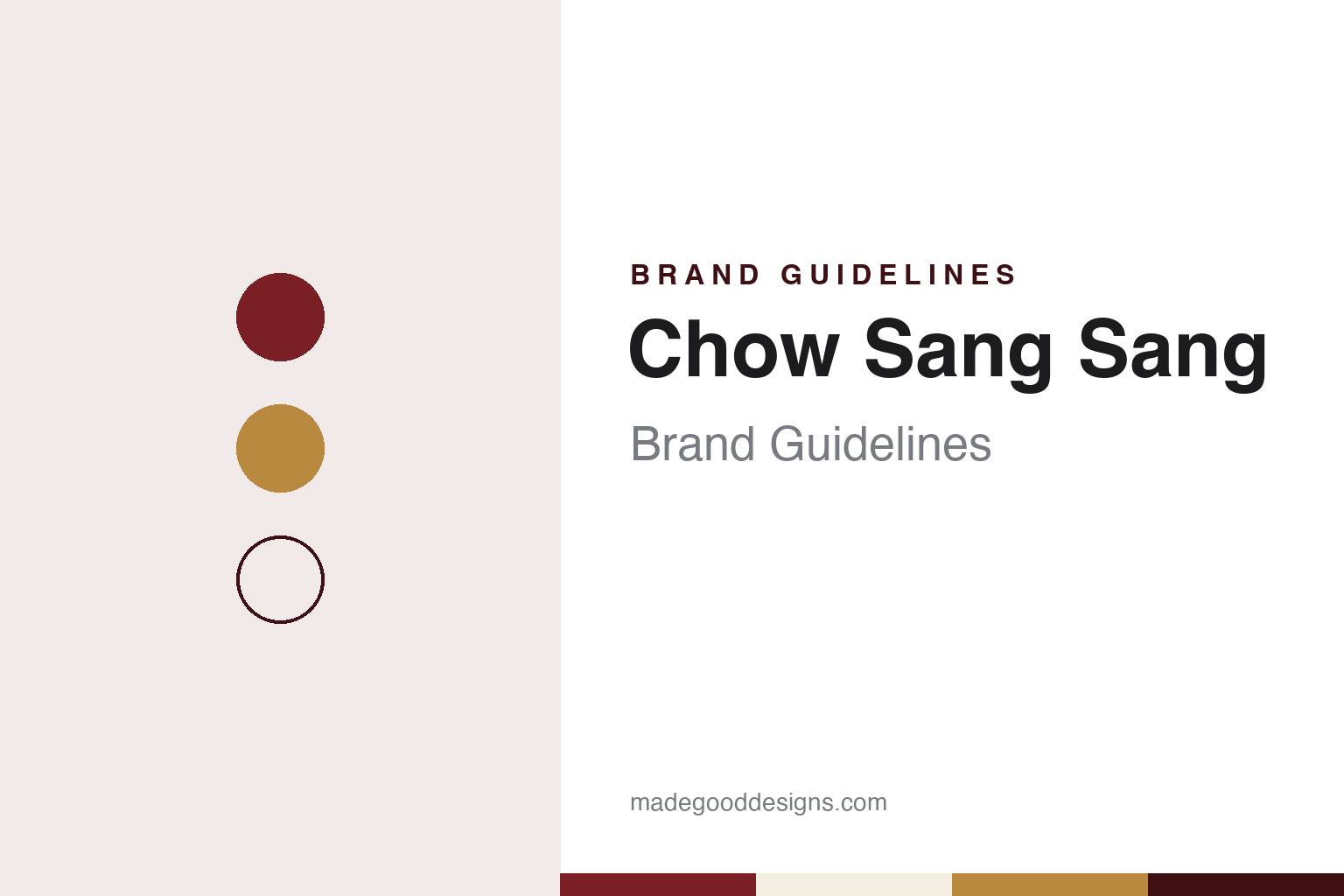
Chow Sang Sang Brand Guidelines
A 1934 Guangzhou gold shop that became a Hong Kong-listed jeweller.
Aa
Two constants: a red and soft gold palette and a brush-cut serif register. Abstract homage — not a Chow Sang Sang product or mark; no jewellery, logo or shopfront is reproduced.
From Guangzhou to Mong Kok
A gold shop in Guangzhou, a move to Macau and a new start in Hong Kong.
Chow Sang Sang began as a gold shop in Guangzhou in 1934. English Wikipedia names the founder as Chow Fang Pu, and Chinese Wikipedia adds that he came from Shunde, in Guangdong, and opened the first shop in the Xiguan district of the city. The Chinese name, 周生生, combines the family name Chow with a wish for renewal without end, which Chinese Wikipedia gives as the founder’s reason for the choice.
Through the 1930s and 1940s the business added branches in Guangzhou, Hong Kong, Macau and Zhanjiang. Chinese Wikipedia lists a shop on Changdi Road in Guangzhou, one in the Ho Tung building in Central, Hong Kong, one on Avenida de Almeida Ribeiro in Macau and one in the Chikan district of Zhanjiang, which together gave the firm the four-place label 粵港澳湛, for Guangdong, Hong Kong, Macau and Zhanjiang.
In 1938 the business relocated to Macau, according to English Wikipedia. Chinese Wikipedia says that in 1941 the founder handed the shops to his sons to run, with the Macau shop going to three brothers. The sources used for this guide do not say how the company operated during the occupation of 1941–1945.
A family arrangement shaped the name that survives today. English Wikipedia says that from 1946 all of the founder’s descendants were entitled to use the 周生生 trademark, and that as a result two unrelated jewellery companies in Hong Kong carry it: the Chow Sang Sang group described here, and C.S.S. Jewellery, trading as 粵港澳湛周生生. Chinese Wikipedia dates that second company to 1982 and states that it has no business connection with the Chow Sang Sang group.
The present company traces its Hong Kong start to 1948, when, Chinese Wikipedia says, the three brothers who had run the Macau shop opened a branch on Shanghai Street in Mong Kok. They formed a goldsmith company in 1957, which took the name Chow Sang Sang Jewellery Company Limited in 1971.
Colour
A listing, a headquarters building and a second brand.
Chow Sang Sang was listed on the Hong Kong Stock Exchange in 1973, under stock code 116, according to both English and Chinese Wikipedia. The holding company, Chow Sang Sang Holdings International Limited, is incorporated in Bermuda, with its headquarters in the Chow Sang Sang Building in Kowloon, which Chinese Wikipedia says was completed in 1979.
The group has kept a laboratory and a wholesale side alongside its shops. English Wikipedia notes a precious-metals wholesale business, and Chinese Wikipedia dates the group’s precious-metals assay laboratory to 1990 and a corporate-gifts team to the same year. For a time the group also ran a securities business, set up in 1986 and closed in 2021, Chinese Wikipedia says.
Expansion into mainland China came in the 1990s. English Wikipedia dates the first mainland shop to 1993, in Fuzhou, Fujian, and the creation of the mainland subsidiary, Chow Sang Sang (China) Company Limited, based in Guangzhou’s Tianhe district, to 2006. Chinese Wikipedia adds a three-storey flagship in Beijing’s Sanlitun in 2009 and a production base, the Shunde industrial park, which began production in 2013.
The group runs more than one name. In 1994 it created EMPHASIS, known in Chinese as 點睛品, with its own product styles and shop interiors, Chinese Wikipedia says, and took it to Taiwan in 1995. It added La Pelle, a pearl brand, in 2009. English Wikipedia also lists PROMESSA and The Future Rocks among the group’s names. In 2004 the group won the right to run the Main Street jewellery shop at Hong Kong Disneyland and began selling Disney-themed pieces, according to Chinese Wikipedia.
As of 31 December 2024, Chinese Wikipedia, citing the group’s figures, gives a total of 958 branches and more than 11,000 staff across the group.
Typography
How the category presents itself.
Jewellery chains in North America and Asia sell much of the same thing — engagement rings, wedding bands, gold chains and gifts — but they present it through the places they trade. In the United States and Canada the typical store sits in a shopping mall, often beside rival banners owned by the same group; in Hong Kong, mainland China and India, the chains’ own store pages often show gold jewellery at long counters and bridal sets as a category of their own.
Advertising carries much of the identity. American chains have long built their brands on television campaigns and on credit offers for buyers paying in instalments, and in recent years their campaigns have widened from engagement and anniversaries to everyday wear and self-purchase, as the trade press reports. Asian chains publish campaigns tied to weddings and festivals, and some name their collections after the occasion, the material or the craft rather than after a designer.
Ownership is often more complicated than the shop sign suggests. Several North American names that began as family businesses now belong to listed groups or to holding companies, and some have changed hands more than once, through mergers, takeovers and restructurings. Several Asian chains are listed on a stock exchange, and their corporate pages name the founders and the controlling shareholders alongside the listing.
This guide sets out what can be checked about each brand: who founded it, where and when, who owns it now, how it has presented itself in its stores and campaigns, and what rests only on the company’s own word. Store counts are given with the date of the source that reports them.
周生生
A brush-cut serif for a gold-shop name. (Specimen set in Noto Serif TC, a serif STAND-IN; NOT the Chow Sang Sang logo.)
Chow Sang Sang
Two logos, a fish motif and a museum partner.
The visual identity has been split in two since 2006. That year, Chinese Wikipedia says, the retail business adopted a new 周生生珠寶 (Chow Sang Sang Jewellery) mark, while the group kept its older oval logo. Colours and typefaces are not documented in the sources used here, so the palette in this guide is our own.
Recent campaigns lean on festival imagery. For Chinese New Year 2026, China Daily reported in February 2026, the company put up installations in Hong Kong, Shanghai and Macao modelled on the traditional New Year candy box of the Lingnan region, built around a galloping red horse with curves that echo fish moving through water; the Shanghai installation opened in the lobby of Grand Gateway 66 on 4 February, and New Year events followed in Shenzhen, Xi’an, Chengdu, Beijing and Shenyang.
The fish runs through the brand’s gold ranges. Marketing-Interactive reported in March 2026 that Chow Sang Sang worked with the Hong Kong egg-waffle chain Mammy Pancake on fish-shaped egg puffs sold in a printed sleeve, as part of a Year of the Horse campaign titled “New year, new horizons.” The magazine described the fish motif of the YuYu collection, an updated YuYu Gold line, and a “blessing box” installation at K11 MUSEA in Hong Kong in February 2026; a company spokesperson told it the fish stands for continuity and abundance.
The same K11 MUSEA mall holds a concept store run with London’s Victoria and Albert Museum, which Chinese Wikipedia dates to 2022. Chinese Wikipedia also records a 2018 character, Cassie, created with the Hong Kong fashion illustrator Mickco, and a 90th-anniversary year in 2024.
For a design guide, Chow Sang Sang shows how a family gold shop can carry one name across four cities, two companies and nine decades, with festival symbols doing much of the visual work. Compare Chow Tai Fook, another Guangzhou-born Hong Kong jeweller, and Lukfook, a younger Hong Kong chain. For this guide we use a lacquer red, a deep garnet and a soft gold on rice-paper white with a serif, an unofficial interpretation; no product or logo is reproduced.
Explore & save
Keep Chow Sang Sang’s identity on hand — save it to a board in the Made Good inspiration library.
Chow Sang Sang identity set
Save the Chow Sang Sang red and soft gold palette and the brush-cut serif register to your own board.