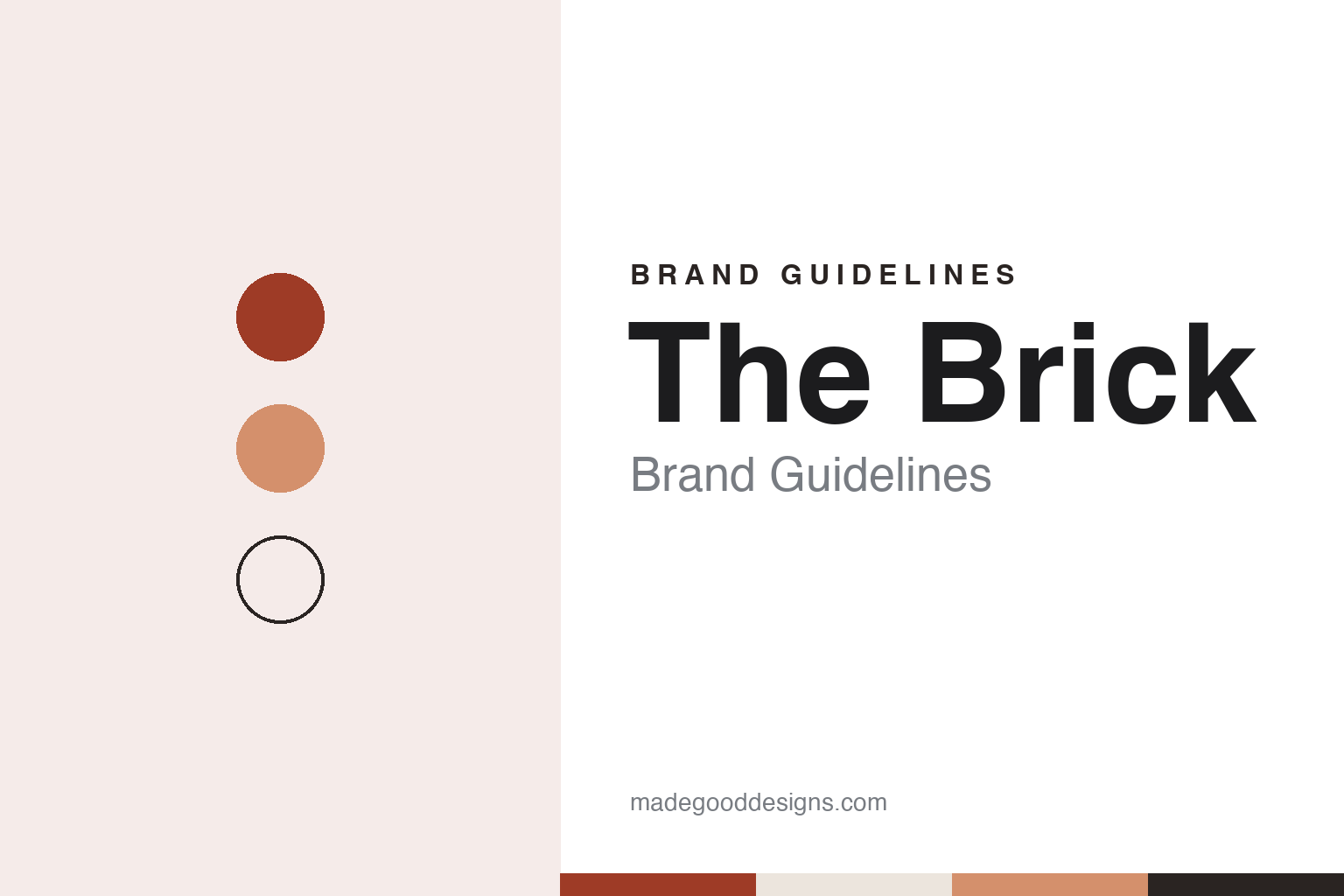
The Brick Brand Guidelines
The Edmonton warehouse named for its red-brick front.
Aa
Two constants: a brick red, clay and charcoal palette and a geometric sans register. Abstract homage — not a product or mark of The Brick; no logo, sign or store front is reproduced.
The Brick Warehouse
Three brothers and a store in Edmonton.
The Brick began in Edmonton, Alberta. English Wikipedia says the company was founded as The Brick Warehouse LP by the brothers John, Fred and Bill Comrie, and that its first warehouse opened on 1 September 1971. The company’s own fifty-year timeline describes the start as a single furniture store in downtown Edmonton, and records its first distribution centre in 1976.
The name came from the building. The company says that in 1978, taking its cue from the store’s red-brick facade, it called itself “The Brick Warehouse,” and later shortened that to “The Brick.” In Quebec, English Wikipedia notes, the stores are signed simply as Brick.
Growth ran first across Alberta and then east. According to the company timeline, the chain moved beyond Edmonton in 1982 with a store in Fort McMurray and then one in Calgary, and English Wikipedia adds that it later bought a competitor in Calgary. The Brick reached Eastern Canada in 1983 with two stores in Toronto, the company says, and in 1984 it set up insurance and warranty divisions under the Trans Global name.
Franchising and Quebec came later. The company says its first franchised store opened in Hinton, Alberta, in 1999, and that in 2004 it entered Quebec by opening five stores and a clearance centre on the same day. By its fiftieth year, in 2021, the company says, it was trading from Victoria to St. John’s and running seven distribution centres; English Wikipedia lists distribution centres in Calgary, Edmonton, Vancouver, Winnipeg, Toronto, Montreal and Dartmouth.
Colour
Four store formats and a group of service businesses.
The Brick sells furniture, mattresses, major appliances and home electronics. Its own about page lists four store formats: The Brick, The Brick Mattress Store, The Brick Super Store and The Brick Outlet. The mattress banner began in 2005 under the name “Sleep Better,” the company says, before it took The Brick’s name.
Acquisitions shaped those banners. In March 2004 The Brick bought United Furniture Warehouse, which English Wikipedia says had 81 locations across Canada at the time; in 2006, it adds, 24 of those stores were rebranded as The Brick. In July 2017 the remaining United Furniture Warehouse stores and The Brick’s clearance centres were brought together under one new name, The Brick Outlet, English Wikipedia says. The parent company’s third-quarter 2025 report lists that banner as Brick Outlet.
Behind the stores sits a group of service businesses. The company names MidNorthern Appliance, which supplies appliances to commercial and residential customers; First Oceans, which sources furniture and other products; and TransGlobal Service, which provides after-sales support. The parent company’s 2025 report describes First Oceans Trading Corporation as an import and quality-control operation in Asia, and Midnorthern Appliance as a banner selling appliances to builders, developers, hotels and property management companies.
The name has also travelled into sport. In the 1980s, English Wikipedia says, the company backed the Edmonton Brick Men soccer team, named after the retailer, whose logo used the same typeface for the word Brick as the furniture chain: ITC Bauhaus, a rounded geometric face. The company says that in 2016 it launched “The Brick Field” with the Canadian Football League’s Edmonton club, and its timeline also records an invitational youth hockey tournament held each year from 1990.
Typography
Showrooms, flyers and corporate pages.
Furniture retail is a category built around the showroom. The chains in this group, from the north-eastern United States and the American South to Canada, Australia and France, sell sofas, beds, tables and storage from large stores where pieces are set out as rooms, so a customer can see a bedroom or a living room as a whole before choosing its parts.
Print came early. The International Directory of Company Histories describes an Atlanta furniture partnership of the 1880s and 1890s selling through illustrated newspaper advertisements and through salesmen who carried photographs of furniture styles from door to door. Catalogues, flyers and weekend sale pages followed in the twentieth century, and today the same chains publish websites with room planners and online showrooms alongside the stores.
Naming tends to be plain. Many of these businesses carry a founder’s surname, sometimes joined to another name after a merger or purchase, and ranges are often sold under the retailer’s own label as well as under manufacturers’ brands. Store formats are named just as directly: showrooms, outlets, clearance centres and mattress departments.
Corporate pages fill in the rest. Listed companies publish founding dates, stock-exchange listings and leadership changes for investors, while family-owned chains tell the same story through founders and generations. Purchases of one chain by another, and changes of owner, are usually dated there too. For a designer, the useful material is this mix of a long-running name, a room-set showroom and a steady flow of printed and digital promotions; the tones and typefaces in each guide here are our own reading of that, not an official system.
Aa
A rounded geometric sans, in the spirit of the ITC Bauhaus wordmark English Wikipedia describes. (Specimen set in Comfortaa, a sans STAND-IN; NOT The Brick logo.)
The Brick
Part of Leon’s since 2013.
The Brick did not stay independent. On 11 November 2012 it announced that its competitor Leon’s would buy the company, English Wikipedia says. The legal trade magazine Lexpert reported in July 2013 that Leon’s Furniture had completed the takeover, and that The Brick’s common shares and share-purchase warrants ceased to be listed on the Toronto Stock Exchange from 1 April 2013; it also listed Fairfax Financial Holdings among the parties with their own legal advisers on the deal. Leon’s has kept the two chains under their own names, English Wikipedia says, and the parent’s third-quarter 2025 report still lists Leon’s, The Brick, Brick Outlet and The Brick Mattress Store as its retail banners.
Edmonton remains the base. In October 2022, Real Estate News Exchange reported that Qualico Properties would develop a 500,000-square-foot distribution centre and office in northwest Edmonton for The Brick division of Leon’s, as a 50/50 joint venture, replacing a 365,000-square-foot building in the city. The new building, the magazine reported, would handle both store and online orders for all of The Brick’s retail and commercial banners. Qualico said in February 2025 that the new headquarters and distribution centre opened on 14 January 2025 at its North 170 Henday Business Park, with three floors of offices, a repair shop, a studio, a customer pickup office and a head office for Trans Global Insurance; the site, on 28 acres near the Anthony Henday ring road, ships to stores in Alberta, Saskatchewan, Manitoba and Northern Canada, Qualico said. The company’s own timeline also records a distribution centre in Dartmouth, Nova Scotia, opened in 2021 to serve the Leon’s Furniture Limited brands in Atlantic Canada.
As of November 2026, The Brick’s about page says it runs more than 209 stores across Canada, from British Columbia to the Northwest Territories and Newfoundland, under its four store formats.
For a design guide, The Brick shows how a name borrowed from one building can carry a national chain. Compare Leon’s, its owner since 2013, and Structube, another Canadian furniture retailer. For this guide we use a brick red, warm clay and charcoal with a geometric sans, an unofficial interpretation; no product or logo is reproduced.
Explore & save
Keep The Brick’s identity on hand — save it to a board in the Made Good inspiration library.
The Brick identity set
Pin The Brick red, clay and charcoal palette and the geometric sans register to your own board.